
Vehicle Transport Platform: 7 Powerful Solutions for Difficult Parking Access
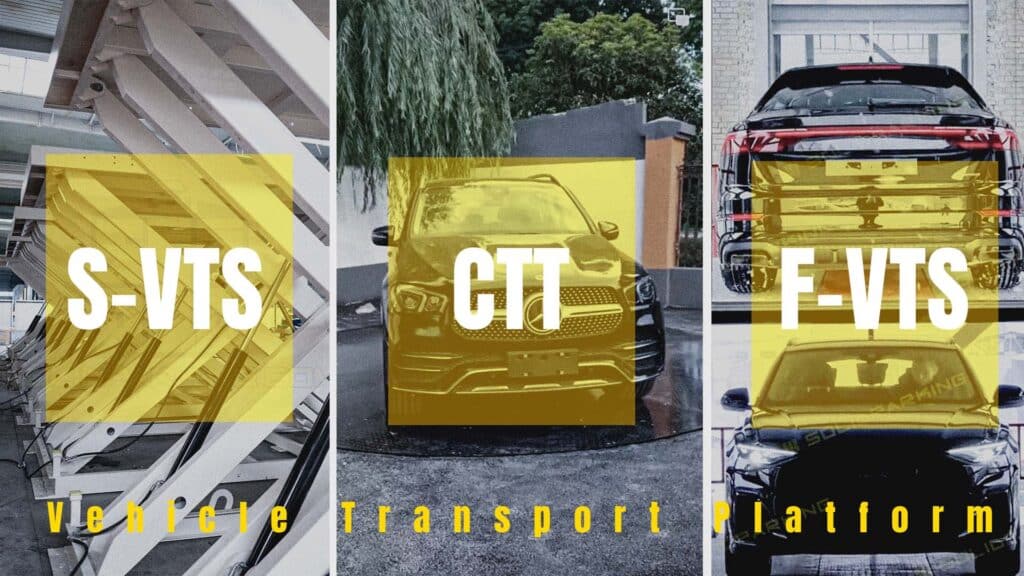
When a vehicle transport platform is needed, the problem is often bigger than simply finding a way to lift a car.
A basement may have no practical space for a long ramp. A dealership may need to move vehicles between a showroom and an underground storage level. A garage may have enough space for a vehicle, but not enough room to turn it around.
In these cases, the real challenge is not always parking capacity.
It is vehicle access.
A vehicle transport platform without a ramp can be one solution for floor-to-floor movement when horizontal circulation space is limited. But the right system depends on the building geometry, vehicle dimensions, required travel, load, and how the space will actually be used.
SolidParking’s special platform range includes the F-VTS four-post vertical platform, the S-VTS scissor-type car elevator, and the CTT car turntable. These systems do not solve exactly the same problem, so choosing between them should start with the site rather than the product name.
What Is a Vehicle Transport Platform?
A vehicle transport platform is a lifting system designed to move a vehicle from one elevation or position to another.
That sounds similar to a conventional parking lift, but the intended use can be very different.
A parking lift primarily answers:
How can I store more vehicles in the same footprint?
A vehicle transport platform answers:
How can I move a vehicle through a difficult site or between building levels?
SolidParking’s F-VTS, for example, is positioned as a four-post hydraulic platform for moving vehicles, machinery and heavy cargo vertically. Its current category information lists a 5,000 kg reference capacity, with project configurations up to 8,000 kg, and a reference lifting speed of 3.5 m/min.
The latest F-VTS guide similarly emphasizes that the system is intended for floor-to-floor transportation rather than simply stacking cars for storage.
This distinction matters because vehicle storage, vehicle transportation and vehicle maneuvering are different project problems.
When Does a Project Need a Vehicle Transport Platform?
There are several situations where a conventional vehicle route starts to consume too much valuable space.
A basement has no practical ramp location
A conventional ramp needs horizontal distance.
The deeper the destination level, the more circulation area may be required. That space could otherwise support parking, storage, circulation or another building function.
A vertical platform changes the geometry of the solution:
Ramp: move the vehicle horizontally and vertically through a slope.
Vehicle transport platform: move the vehicle vertically between prepared access levels.
That is the fundamental reason these systems can be useful on constrained sites. SolidParking describes its F-VTS specifically as a vertical platform for vehicles and heavy cargo, with garages, warehouses and industrial spaces among its intended applications.
A dealership needs to connect showroom and storage levels
A dealership may want customer-facing vehicles at ground level while keeping additional inventory below or above.
The challenge isn’t necessarily parking more cars.
It is:
How do vehicles move between the levels without dedicating a large portion of the property to a ramp?
This is one of the applications identified for the F-VTS concept.
A building has restrictive vertical access geometry
Not every site is equally suitable for a four-post platform.
Basements, underground garages, showrooms and urban parking projects can have structural or spatial restrictions that influence the lifting mechanism and installation arrangement.
This is where a scissor-type system such as the S-VTS can become relevant. SolidParking positions the S-VTS for basements, garages, showrooms and urban parking applications.
The vehicle can enter the space, but it cannot turn
This is a different problem.
You may have enough floor area to accept a vehicle but not enough turning radius to orient it correctly for entry or exit.
That is where a CTT car turntable can be more appropriate than a vertical platform.
The CTT rotates a vehicle 360° and is designed for driveways, garages, commercial areas and tight maneuvering spaces. The current category lists a low-profile design, servo motors, customizable rotation speed and above-ground or in-ground configurations.
In other words:
No room to turn? Rotate the vehicle.
Vehicle Transport Platform Without a Ramp: When Does It Make Sense?
A vehicle transport platform without a ramp can be attractive when the project has more usable vertical space than horizontal space.
But “without a ramp” does not mean “without engineering.”
The project still needs to address:
- vehicle entry and exit
- platform dimensions
- travel height
- vehicle weight
- structural conditions
- anchoring or pit requirements
- electrical supply
- drainage where applicable
- safety controls
- local building requirements
SolidParking’s current F-VTS guide specifically recommends evaluating vehicle dimensions, travel height, available shaft/platform space, pit conditions, slab and foundation conditions, access routes and local electrical/building requirements before finalizing the system.
For a commercial project, this distinction is especially important:
Replacing a ramp with a platform does not eliminate circulation planning. It changes how the vertical connection is handled.
F-VTS: Heavy-Duty Vertical Vehicle Transport
The F-VTS is the most straightforward choice when the project needs a robust, open-platform solution for vertical movement.
Its current SolidParking category listing identifies:
- four-post hydraulic structure
- 5,000 kg reference lifting capacity
- configurations up to 8,000 kg
- 2,500 mm reference parking/platform width
- customizable parking height
- approximately 3.5 m/min reference lifting speed
- overload protection
- anti-skid platform
- optional remote control
- optional ramp.
SolidParking’s project guide provides one reference configuration of 5,000 kg capacity, 2,200 mm vehicle height, 2,500 mm vehicle width, 5,000 mm vehicle length and approximately 4 m/min lifting speed. The article explicitly notes that these should be treated as a reference configuration, not universal limits.
That distinction is important for B2B projects.
The correct question is not:
“Is the F-VTS 5 tons?”
It is:
“What does this project require?”
For example:
- How heavy is the actual vehicle?
- What is the floor-to-floor travel?
- How large is the platform?
- Does the vehicle need to carry cargo?
- How will the vehicle enter and exit?
- What structural conditions exist at both levels?
S-VTS: When Building Geometry Is More Restrictive
The S-VTS addresses the same broad problem—vertical vehicle transport—but uses a hydraulic scissor mechanism.
SolidParking currently positions it for residential basements, underground garages, commercial buildings and showrooms. The category lists a 5,000 kg reference capacity, with configurations up to 10,000 kg, a 2,000 mm reference platform width configurable to larger dimensions, and customizable lifting height.
A more specific SolidParking S-VTS article describes a reference configuration using a 3,000 × 6,000 mm platform, 2,500 mm lifting height, 2–5 m/min speed, a 5.5 kW hydraulic power unit and 24 V control.
Again, these should not be treated as universal specifications for every S-VTS project.
The point of the scissor arrangement is not simply that it is another way to lift a vehicle.
It can be valuable when:
the available building geometry favors a different lifting structure.
That makes the S-VTS particularly relevant to projects where pit arrangement, surrounding structure, platform footprint or vertical travel influence equipment selection.
CTT: When the Problem Is Turning, Not Elevation
CTT belongs in this discussion for an important reason:
not every vehicle-access problem is vertical.
The current SolidParking category describes the CTT as a 360° vehicle turntable designed for tight driveways, garages, commercial areas, and other space-constrained applications. The listed reference configuration features a 3,500 kg lifting capacity, while the product range can be configured for loads of up to 10,000 kg, with a customizable platform width of up to 5,000 mm. Larger capacities and platform dimensions are also available for custom projects, allowing the CTT to be adapted to different vehicle sizes, site conditions, and project requirements.
Its value is easier to understand visually:
Vehicle enters.
Platform rotates.
Vehicle exits in the required direction.
Instead of expanding the turning area, the project changes how the vehicle is oriented.
This can be useful for:
- narrow residential driveways
- constrained garages
- underground parking access
- dealerships and showrooms
- commercial maneuvering areas
The CTT therefore should not be evaluated as a replacement for an F-VTS or S-VTS.
Its primary problem is different:
F-VTS / S-VTS: How do I move the vehicle vertically?
CTT: How do I orient the vehicle when there isn’t enough turning space?
F-VTS vs. S-VTS vs. CTT
The easiest way to compare these systems is not by model number.
Compare the site problem first.
| Project problem | Likely solution | Main reason |
|---|---|---|
| No practical space for a ramp | F-VTS / S-VTS | Vertical vehicle movement |
| Heavy vehicle or cargo needs to move between levels | F-VTS | Four-post heavy-duty platform configuration |
| Basement or urban project has restrictive installation geometry | S-VTS | Scissor-type lifting structure |
| Vehicle cannot turn effectively | CTT | 360° vehicle rotation |
| Dealership needs showroom-to-basement movement | F-VTS / S-VTS | Floor-to-floor vehicle access |
| Garage has a narrow maneuvering area | CTT | Reduce turning requirement |
| Project simply needs more parking spaces | TP / FP / automated systems | This is a storage-density problem, not primarily a vehicle-access problem |
That last distinction is important.
Special platforms should not be forced into projects where a conventional parking lift is the better answer.
How to Choose the Right Solution
Start with the limitation, not the equipment catalogue.
1. Is the main problem turning?
If yes, look at CTT.
The key question is:
Can the vehicle enter and exit efficiently if its orientation can be controlled?
2. Is the main problem floor-to-floor movement?
If yes, consider F-VTS or S-VTS.
Then evaluate:
- travel height
- vehicle dimensions
- rated load
- platform size
- available installation space
- structure
- pit conditions
- access path
3. Is heavy load the dominant concern?
F-VTS may be the more natural starting point because its four-post configuration is positioned for vehicle, machinery and heavy-cargo transport.
But the actual capacity must still be determined from the project and equipment configuration.
4. Is installation geometry the dominant concern?
Then S-VTS deserves closer evaluation.
Its scissor structure can provide a different equipment arrangement when the building geometry does not favor a conventional four-post configuration.
What Should Be Checked Before Ordering a Vehicle Transport Platform?
For a B2B project, a supplier should not need only:
“We need a 5-ton lift.”
That is not enough information to engineer a floor-to-floor vehicle system.
At minimum, establish:
Vehicle
- Gross weight
- Length
- Width
- Height
Building
- Current floor levels
- Required travel height
- Platform/shaft dimensions
- Existing pit
- Slab/foundation conditions
- Surrounding structural elements
Operation
- How often vehicles will move
- How vehicles enter and exit
- Residential, commercial or industrial use
- Whether cargo other than vehicles is involved
Project
- Indoor or outdoor installation
- Electrical supply
- Drainage
- Local approval requirements
- Required delivery and installation schedule
SolidParking’s F-VTS guide follows essentially this project-first approach, asking for vehicle dimensions, travel height, platform space, pit, foundation, access and applicable local requirements before moving from inquiry to site evaluation, layout and quotation.
This is also where a free layout review becomes a meaningful B2B conversion rather than a generic sales CTA.
A Vehicle Transport Platform Is Not Automatically a Ramp Replacement
This is an important qualification point.
A vertical platform can provide an alternative way to handle vehicle movement between levels, but the overall project still needs a compliant access strategy.
For example, the 2024 International Building Code specifically addresses mechanical-access enclosed parking garages and includes requirements covering separation, smoke removal and fire-control equipment. It also has specific provisions for vehicle ramps and mechanical-access parking.
For projects in North America, applicable code and approval requirements should therefore be confirmed with the project’s design professionals and authority having jurisdiction.
Where the equipment falls within elevator or related conveyance requirements, ASME‘s A17.1/CSA B44 framework addresses design, construction, installation, operation, testing, inspection, maintenance and repair of covered conveyances; the specific applicability depends on the equipment and jurisdiction.
So the correct B2B message is not:
“A vehicle transport platform eliminates all ramp/code requirements.”
It is:
“A vehicle transport platform can provide another way to solve a difficult vertical-access problem, subject to project-specific engineering and approvals.”
7 Powerful Ways These Platforms Solve Real Parking Problems
The best way to evaluate these systems is through the problem they solve:
1. Replace long horizontal travel with vertical movement
When a ramp consumes too much valuable floor area, a vertical platform can change the geometry of the solution.
2. Connect a basement without redesigning the entire parking layout
Floor-to-floor transport can be considered when the existing building cannot easily accommodate a conventional ramp.
3. Move heavy vehicles or cargo
A properly configured F-VTS can be designed around vehicle, machinery and heavy-load requirements rather than passenger cars alone.
4. Work around restrictive installation geometry
An S-VTS can provide an alternative lifting structure where the project favors a scissor configuration.
5. Solve difficult vehicle maneuvering
A CTT can rotate a vehicle instead of requiring a large turning area.
6. Adapt equipment to the project
Platform dimensions, travel height, capacity and control configuration need to be selected around the site instead of forcing a project into a standard machine. SolidParking explicitly describes these systems as configurable by project requirements.
7. Turn a vague equipment inquiry into an engineered solution
This may be the most important point for developers and contractors.
Instead of asking:
“Which lift should I buy?”
Start with:
What is preventing the vehicle from moving the way the building requires?
Once that question is answered, equipment selection becomes much more straightforward.
Vehicle Transport Platform vs. Parking Lift: A Simple Rule
The distinction can be reduced to one question.
Need to store more cars?
Look at:
TP / FP / automated parking systems
Need to move a car between levels?
Look at:
F-VTS / S-VTS
Need to turn a car in a restricted area?
Look at:
CTT
That is why SolidParking’s Special Platform category should be understood less as a collection of unusual lifts and more as a group of vehicle-access solutions. The current category itself separates CTT, F-VTS and S-VTS by rotation, vertical transport and different lifting structures.
The Bottom Line
A vehicle transport platform is most valuable when the site’s geometry is the real problem.
A ramp may need too much horizontal space.
A garage may not provide enough turning radius.
A basement may need a practical connection to ground level.
A dealership may need to move inventory without sacrificing showroom or parking area.
A warehouse may need to move heavier loads between levels.
These are different problems, and they should not automatically receive the same equipment.
Start with the site limitation.
Then evaluate:
Turning → CTT
Floor-to-floor movement → F-VTS / S-VTS
Heavy vehicle or cargo transport → F-VTS
More restrictive installation geometry → S-VTS
For a project-specific recommendation, the useful starting information is the site layout, vehicle dimensions and weights, required travel height, parking/operational requirements, and available installation space.
Have a constrained parking or vehicle-access project? Send SolidParking the layout and project requirements for a solution review.
FAQ
What is a vehicle transport platform?
A vehicle transport platform is a platform lift designed to move vehicles, and in some configurations other loads, between different elevations or through constrained access areas.
Can a vehicle transport platform replace a parking ramp?
It can provide an alternative way to handle vertical vehicle movement on some projects, but it is not automatically a universal ramp replacement. Site geometry, vehicle access, structural requirements, codes and approvals must be evaluated first.
What is the difference between F-VTS and S-VTS?
Both can provide vertical vehicle transportation, but F-VTS uses a four-post structure and is strongly positioned for heavy vehicle/cargo transport, while S-VTS uses a scissor mechanism and can be useful where project geometry favors that configuration.
What is a CTT car turntable used for?
A CTT rotates vehicles 360° to help solve maneuvering and turning problems in tight garages, driveways and commercial areas.
What information does a supplier need to recommend a vehicle transport platform?
At minimum: vehicle weight and dimensions, floor-to-floor travel height, available platform or shaft dimensions, site structure, installation conditions, access path, intended use, and applicable project requirements.