
Multi Car Stacker: 7 Powerful Ways to Maximize Parking Space and Vehicle Storage
When parking demand grows but available floor space does not, a multi car stacker can change how a project uses its footprint. Instead of adding more parking area horizontally, a multi car stacker uses vertical space to create multiple vehicle positions within a controlled ground footprint.
This approach can be useful for dealerships with growing inventory, vehicle storage facilities, commercial parking projects, private car collections, and properties where expanding the parking footprint is difficult.
But a multi car stacker is not simply a taller parking lift. Different configurations are designed for different vehicle capacities, ceiling heights, operating requirements, and storage goals. Choosing the right system starts with understanding the problem the project needs to solve.
What Is a Multi Car Stacker?
A multi car stacker is a mechanical parking system that stores multiple vehicles vertically within a limited footprint. For this product category, SolidParking’s multi-stacker range focuses on systems designed to store three or more vehicles through three, four, or five vertical parking levels.
The basic idea is simple.
A conventional parking space uses its footprint for one vehicle. A multi car stacker uses the available height to create additional vehicle positions above the original parking position.
This makes multi car stackers particularly useful when parking space optimization is more important than expanding the building footprint.
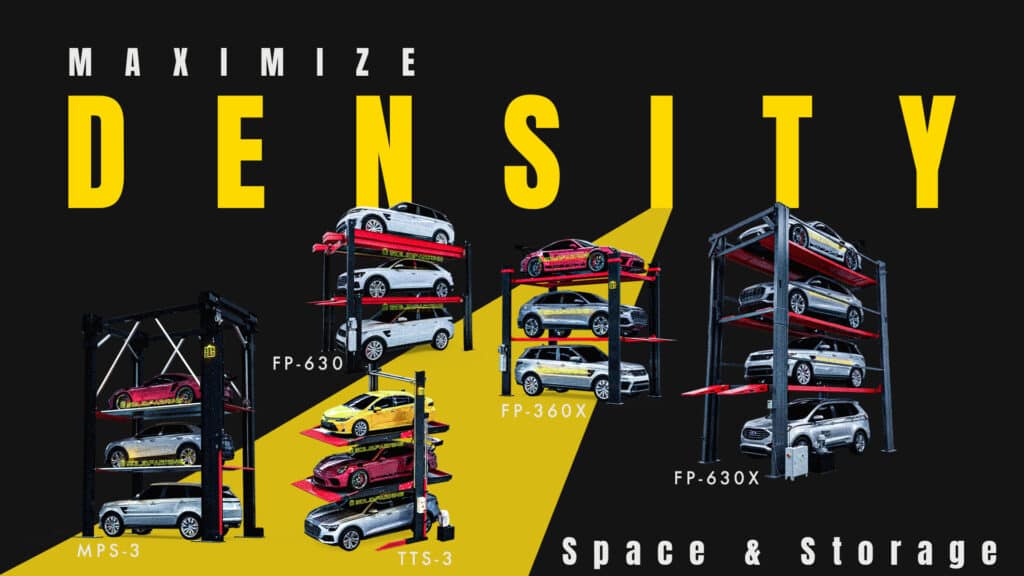
SolidParking’s current range includes the TTS-3 two-post triple stacker, the FP-360X and FP-630 triple-stack four-post systems, the four-car 630X, and the MPS multi-level system with three-, four-, and five-level configurations.
The important point is that these systems do not all solve exactly the same problem. Some prioritize compactness. Some are designed around long-term vehicle storage. Others combine storage with service functions, while MPS is built around increasing vertical capacity.
Who Needs a Multi Car Stacker?
The strongest application for a multi car stacker is not simply “anyone who needs parking.”
It is for projects where vehicle demand is high but available horizontal space is limited.
Dealerships With Growing Inventory
A dealership may have enough space for its building but not enough practical room for all of its vehicles.
New vehicles waiting for delivery, demonstration vehicles, premium inventory, seasonal vehicles, and overflow stock can quickly consume valuable parking area.
That turns into a dealership car storage problem.
A vertical storage system allows a dealership to use existing space more efficiently instead of immediately expanding its lot or constructing additional storage space.
SolidParking’s 630X is specifically positioned for dealership inventory, vehicle warehouses, collections, and other vertical vehicle storage applications.
Vehicle Storage Facilities
Vehicle storage operators face a similar problem.
The objective is often to store more vehicles inside an existing warehouse, garage, or enclosed structure without increasing the floor area.
For these applications, storage density can be more important than fast daily retrieval.
A vehicle storage lift can therefore be useful for long-term vehicle storage, collector cars, inventory awaiting transport, or vehicles that are not retrieved frequently.
Commercial Parking Projects
Hotels, mixed-use properties, commercial buildings, and other developments can face a shortage of usable parking space even when the building itself cannot be expanded.
Multi-level parking lifts introduce another dimension into the planning process: vertical capacity.
Instead of increasing parking spaces only by adding more floor area, the project can use available height to increase vehicle capacity.
Private Car Collections
Collectors may have several vehicles but only enough conventional garage space for a few.
A multi car stacker can turn vertical clearance into additional storage positions while preserving more floor area for access or other uses.
For collector applications, however, vehicle dimensions, access frequency, ceiling height, and the desired retrieval sequence should be considered before selecting a system.
Projects With Limited Parking Space
Some projects simply cannot expand outward.
Property boundaries, existing columns, walls, building structures, circulation routes, or surrounding development can prevent a conventional parking expansion.
In these situations, the key question becomes:
How many usable vehicles can this footprint support?
That is where parking space optimization becomes a capacity problem rather than just a layout exercise.
How Multi Car Stackers Improve Parking Space Optimization
Traditional parking generally starts with a simple relationship:
One parking bay = one vehicle.
A multi car stacker changes that relationship by introducing vertical parking positions.
Depending on the system, one footprint can support three, four, or five vehicle positions.
SolidParking’s MPS family, for example, is available in MPS-3, MPS-4, and MPS-5 configurations.
The planning logic becomes:
Floor area → Vertical capacity → Vehicle positions
But this does not mean that the highest possible stacker is automatically the right choice.
More levels require more ceiling height, different access conditions, and different operating considerations.
The better question is:
How many vehicles does this project need to store, and what vertical space and operating conditions are available?
That distinction matters for developers, contractors, architects, and parking consultants.
SolidParking Multi Car Stacker Product Range
SolidParking’s current multi-stacker range can be understood as several different solutions rather than one universal machine.
| Model | Structure | Levels | Vehicle Capacity | Main Use |
|---|---|---|---|---|
| TTS-3 | Two-post | 3 | 3 cars | Compact triple stacking |
| FP-360X | Four-post | 3 | 3 cars | Long-term vehicle storage |
| FP-630 | Four-post combination | 3 | 3 cars | Storage + maintenance |
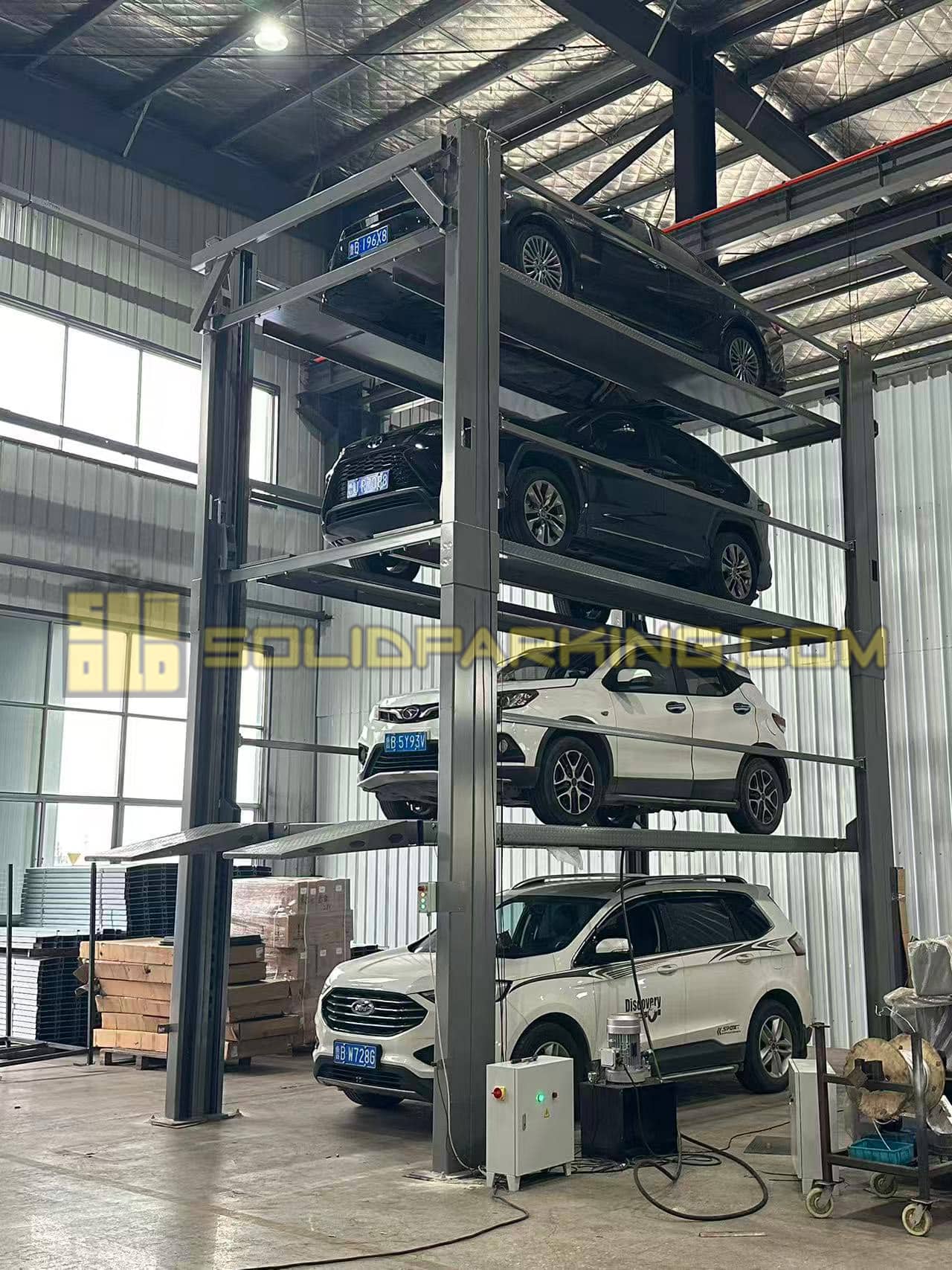
| 630X | Four-post | 3 | 4 cars | High-density vehicle storage |
| MPS-3 | Multi-level system | 3 | 3 cars | Multi-level parking/storage |
| MPS-4 | Multi-level system | 4 | 4 cars | Higher-density parking |
| MPS-5 | Multi-level system | 5 | 5 cars | Maximum vertical stacking |
TTS-3: Three Cars in a Compact Two-Post Configuration
The TTS-3 is a two-post triple car stacker designed to store three vehicles vertically.
Its main advantage is compactness. It is suited to applications such as hotels, valet parking, company parking, indoor storage, and other projects where three vehicles need to occupy a relatively compact footprint.
For a project asking a simple question — “How can I store three cars where one conventional parking position would normally be used?” — TTS-3 is one of the most straightforward answers.
FP-360X: Three-Level Vehicle Storage
The FP-360X is a four-post triple-level parking lift with a single hydraulic power unit.
Its primary role is vehicle storage. It is suitable for projects where the objective is to create additional storage positions vertically without moving into a more complex multi-level parking system.
The exact configuration should be selected according to vehicle dimensions, ceiling height, and required lifting capacity.
FP-630: Storage Plus Service Flexibility
The FP-630 solves a somewhat different problem.
Rather than focusing only on storage density, it combines a larger four-post lift and a smaller four-post lift, each with its own control system.
That makes it relevant for operations where vehicles need to be stored while some of them may also need maintenance or repair access.
In other words:
FP-360X → primarily storage
FP-630 → storage plus operational flexibility
630X: Four-Car High-Density Storage
The 630X is designed around a higher-density storage requirement.
Its current configuration provides four parking positions across three levels, with a rated capacity of 2,500 kg per parking position.
This makes it particularly relevant to dealerships, vehicle warehouses, collections, and other applications where the goal is to increase the number of vehicles stored within a defined footprint.
The key question for a 630X project is not simply “Can this lift four cars?”
It is:
“Do I need four-car storage density within this available space?”
4 Car Parking Lift: 7 Powerful Advantages of the 630X vs. FP-630
MPS: Three to Five Levels
The MPS family takes vertical stacking further.
The current range includes:
MPS-3 — three levels
MPS-4 — four levels
MPS-5 — five levels
This makes MPS more suitable for projects where the vertical requirement itself is part of the planning strategy.
Rather than selecting a single fixed stack height, a project can be designed around the required number of vertical levels.
Multi Car Stacker Specifications
The most important specifications are not always the numbers buyers notice first.
A proper evaluation should include vehicle capacity, vehicle dimensions, ceiling height, footprint, lifting height, retrieval requirements, structural conditions, and intended use.
Vehicle Capacity
The SolidParking multi-stacker range covers three-, four-, and five-vehicle configurations.
Three-vehicle applications include TTS-3, FP-360X, FP-630, and MPS-3.
Four-vehicle applications include 630X and MPS-4.
Five-vehicle stacking is available through MPS-5.
Lifting Capacity
Capacity should always be checked against the actual vehicles expected to use the system.
Published capacities vary by model and configuration, so they should not be treated as interchangeable across the product family.
For heavier SUVs, pickups, and EVs, the actual gross vehicle weight should be checked instead of relying only on the vehicle class or model name.
Vehicle Dimensions
Vehicle length, width, and height can determine whether a vehicle can use a particular level.
This becomes particularly important for mixed fleets.
A stacker designed around standard passenger vehicles may not provide the same usable capacity for larger SUVs or pickups.
For a project serving mixed vehicles, establish the maximum expected vehicle envelope before finalizing the equipment.
Ceiling Height
Vertical storage depends on vertical clearance.
Triple-stack four-post systems require significantly more height than conventional two-level lifts, while four- and five-level systems require substantially more.
For example, SolidParking currently indicates approximately 5,500–5,600 mm of ceiling height for certain triple-stack four-post configurations, while MPS-4 requires approximately 9,200 mm.
The exact requirement depends on the selected configuration and vehicle height.
Ground Footprint and Foundation
The available footprint is only one part of the site assessment.
The floor slab, concrete strength, anchor conditions, vehicle access, structural layout, and surrounding clearance also need to be considered.
SolidParking provides general platform and foundation references, but the final engineering requirements should always be confirmed for the specific equipment and site.
For projects in North America, lift selection should also take into account applicable automotive-lift safety and performance standards. The Automotive Lift Institute’s ANSI/ALI ALCTV:2025 standard covers the construction, testing, and validation of automotive lifts, including parking lifts.
ANSI/ALI ALCTV:2025 – Automotive Lift Institute
What Can a Multi Car Stacker Be Used For?
A multi car stacker is fundamentally a vehicle-capacity solution, but its applications can vary significantly.
Dealership Car Storage
For dealerships, the main goal is often to increase inventory capacity without expanding the lot.
That can be particularly valuable when land is limited or additional storage would be expensive.
Vehicle Warehouses
A warehouse can use vertical stacking to increase the number of vehicles stored within a fixed building footprint.
This is especially useful for medium- and long-term vehicle storage.
Automotive Workshops
A workshop may need to store vehicles waiting for service while keeping floor area available for active repair work.
In this type of environment, operational flexibility can be just as important as storage density.
Car Collections and Showrooms
Collectors and specialty automotive businesses may use vertical storage to preserve valuable floor area for additional vehicles, customer access, or display.
Hotels and Valet Parking
Compact triple stacking can help increase parking capacity where horizontal space is limited.
This is particularly relevant to properties where adding more conventional parking bays would require additional land.
How to Choose the Right Multi Car Stacker
There is no single multi car stacker that fits every project.
Start with the actual site and operating requirements.
First, determine how many vehicles need to be stored.
Three vehicles, four vehicles, and five vertical levels create very different equipment requirements.
Next, look at the vehicles themselves.
Consider:
- Gross vehicle weight
- Vehicle length
- Vehicle width
- Vehicle height
- SUVs and pickups
- EV weight
Then check the available ceiling height.
A project may have enough floor space but still be unsuitable for a particular stacker because of limited vertical clearance.
You should also consider whether the system is intended for storage only or whether vehicles need to be serviced or retrieved frequently.
Finally, review the structural conditions and future expansion plans.
A suitable multi-stacker is determined by the relationship between:
Available footprint + ceiling height + vehicle dimensions + capacity + retrieval requirements + project use
Not simply by the number of cars listed in the product name.
Parking optimization also has to account for accessibility requirements. In the United States, the ADA Standards specify requirements for accessible parking spaces, access aisles, locations, and accessible routes. These requirements should be considered alongside the overall parking layout rather than treated as an afterthought.
2010 ADA Standards for Accessible Design – Parking Spaces
Multi Car Stacker vs. Traditional Parking
Traditional parking uses horizontal floor area as the primary capacity constraint.
A multi car stacker introduces vertical capacity into the equation.
| Traditional Parking | Multi Car Stacker |
|---|---|
| One vehicle per conventional bay | Multiple vertical vehicle positions |
| Capacity grows mainly with floor area | Capacity can grow vertically |
| More land may be required for expansion | Existing footprint can be used more intensively |
| Simple direct access | Access depends on lift position and operating sequence |
| Limited vertical utilization | Designed around vertical vehicle storage |
This does not mean that a stacker is automatically the right choice.
Circulation, retrieval frequency, vehicle dimensions, ceiling height, structural conditions, safety requirements, and local regulations still determine whether vertical stacking is practical.
The goal of parking space optimization should therefore be to improve usable capacity, not simply to put more equipment into a drawing.
Installation and Safety Considerations
Installing a multi car stacker is an engineering task, not simply an equipment delivery.
Before installation, the project should review the concrete slab, structural loads, ceiling clearance, vehicle entry and exit paths, electrical supply, vehicle dimensions, and required safety clearances.
Depending on the model, SolidParking systems include mechanical safety locks, anti-fall protection, limit switches, emergency stop functions, photocells, and hydraulic safety controls.
These systems should be evaluated together with the project layout rather than considered separately.
Vehicle lifting equipment should be selected and operated according to applicable safety requirements and manufacturer instructions. OSHA notes that while it does not have a specific standard dedicated to users of automotive lifts, recognized industry consensus standards and manufacturer recommendations can be relevant to workplace safety.
OSHA – Standards Applicable to Automotive Service Lifts
Frequently Asked Questions
What is a multi car stacker?
A multi car stacker is a mechanical parking lift designed to store multiple vehicles vertically within a limited footprint.
How many cars can a multi car stacker hold?
SolidParking’s current range includes configurations for three, four, and five vehicles.
Is a multi car stacker suitable for dealership car storage?
Yes. Dealerships can use vertical vehicle storage to increase inventory capacity when available lot or indoor storage space is limited.
What is the difference between 630X and FP-630?
The 630X focuses on four-car high-density storage, while FP-630 combines vehicle storage with greater operational flexibility through its separate lift sections.
Does a multi car stacker require a high ceiling?
Usually. The required ceiling height depends on the number of levels, vehicle height, and selected configuration.
Can a multi car stacker store SUVs or EVs?
Potentially, but the vehicle’s actual weight and dimensions must be compared with the selected equipment’s rated capacity and available platform dimensions.
How do I choose the right SolidParking multi-stacker?
Start with the site footprint, ceiling height, number and type of vehicles, required storage capacity, retrieval frequency, and intended use. From there, the appropriate SolidParking configuration can be evaluated.
Final Thoughts
A multi car stacker addresses a simple but increasingly common problem:
The number of vehicles is growing faster than the available floor space.
For a dealership, that becomes a dealership car storage problem.
For a warehouse or collection, it becomes a vehicle storage problem.
For a developer or parking consultant, it becomes a parking space optimization problem.
TTS-3, FP-360X, FP-630, 630X, and MPS approach that challenge in different ways.
The right choice depends on the project rather than the model name alone.
For a project-specific evaluation, provide the available layout, vehicle dimensions, expected parking quantity, ceiling height, and intended use. The equipment can then be matched to the actual site conditions rather than selected from capacity numbers alone.