
Parking System Design Risks: 7 Critical Mistakes in Mixed-Use Projects
Introduction to Parking System Design
In modern urban development, parking system design has become a critical factor that directly influences the success of mixed-use projects.
Across global cities, parking is no longer treated as a secondary infrastructure element. It is now part of core urban mobility planning, affecting traffic flow, user experience, and long-term operational cost.
However, despite its importance, many parking-related issues do not come from equipment failure. Instead, they originate from early-stage design decisions where system logic, user behavior, and operational requirements are not fully considered.
Once construction is completed, these issues are extremely expensive—or in some cases impossible—to fix without structural redesign.
Table of Contents
Why Parking System Design Is Becoming a Global Issue
The increasing complexity of urban development has made parking system design significantly more challenging than in the past.
Modern buildings often combine multiple functions within a single structure:
- Residential units
- Retail spaces
- Office environments
- Public or shared facilities
Each of these generates different traffic patterns and parking behaviors.
As a result, traditional “one-size-fits-all” parking approaches are no longer effective.
Related Reading:
Mixed-Use Parking System Design Parameters
| Function Type | Typical Stay Duration | Peak Traffic Pattern | Turnover Rate | User Priority | Recommended System Type | Access Speed Requirement | Design Focus |
|---|---|---|---|---|---|---|---|
| Residential | Long (8–24 hrs) | Low, stable | Low | Convenience, reliability | Stack parking / 2-post / 4-post lifts | Medium | Space efficiency, predictability |
| Retail | Short (0.5–2 hrs) | Constant flow | High | Fast access, minimal waiting | Ramp parking / fast-access system | Very High | Throughput, circulation speed |
| Office | Medium (6–10 hrs) | Peak (AM/PM rush) | Medium | Entry/exit efficiency | Hybrid system / semi-automated | High (peak-sensitive) | Peak load handling |
| Hotel / Hospitality | Short–medium | Irregular peaks | Medium | Convenience, service speed | Valet + mechanical system | High | Flexibility, guest experience |
| Public / Shared | Variable | Unpredictable | Variable | Accessibility | Mixed system | Medium–High | Adaptability, signage clarity |
Industry Trends: Smart Cities and Parking Inefficiency
Recent global urban development trends—especially those linked to smart city initiatives and sustainable infrastructure planning—have highlighted growing concerns around parking efficiency.
Industry discussions from organizations such as the International Parking & Mobility Institute (IPMI) and urban mobility research groups consistently point to several recurring issues:
- Increased congestion in high-density developments
- Mismatch between parking supply and real user demand
- Inefficient circulation systems in mixed-use buildings
- Rising operational costs due to poor system layout
- Growing demand for automated and space-optimized parking systems
In many cases, these problems are not caused by insufficient space, but by inefficient parking system design logic applied during planning stages.
What Modern Parking System Design Actually Means
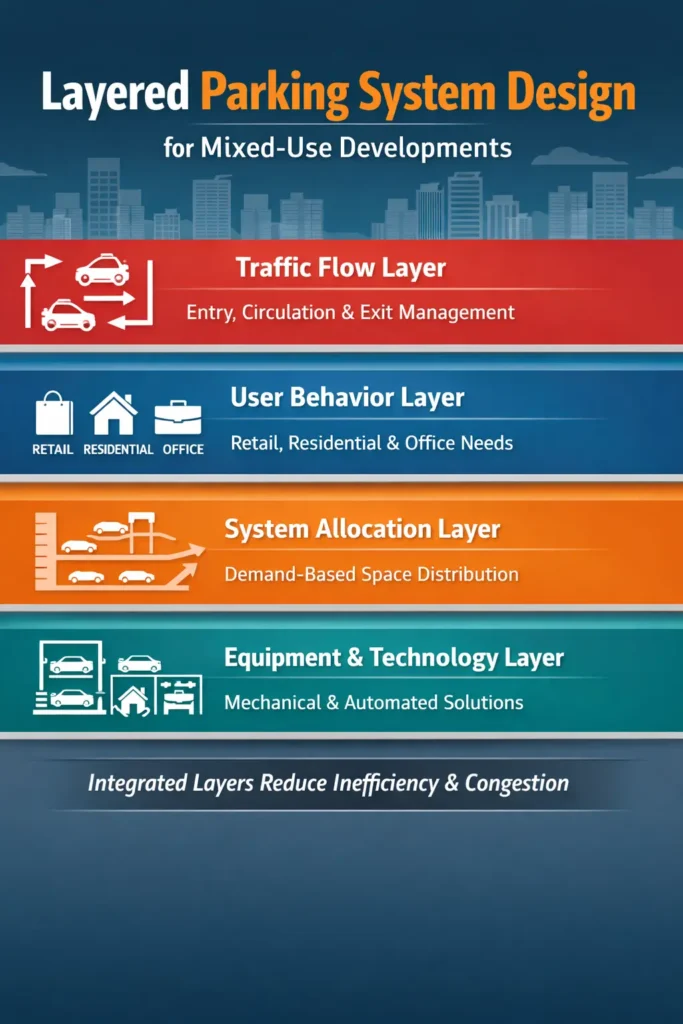
A key concept in modern parking system design is the idea of layered structure.
Instead of treating parking as a single system, it is divided into multiple functional layers:
1. Traffic Flow Layer
Defines how vehicles enter, circulate, and exit the system under different conditions.
2. User Behavior Layer
Different users have different parking needs:
- Retail users: short stay, high turnover
- Residential users: long stay, predictable flow
- Office users: peak-hour concentration
3. System Allocation Layer
Parking capacity is distributed based on demand patterns, not uniform allocation.
4. Equipment and Technology Layer
Different zones may require different solutions such as mechanical parking systems, stack systems, or automated solutions.
Without this layered structure, mixed-use developments often suffer from inefficiency and congestion.
Layered Parking System Design Explained
Modern parking system design is no longer just about maximizing parking capacity.
It now involves a multi-layered system approach that integrates:
- Traffic flow modeling
- User behavior analysis
- Operational lifecycle planning
- Technology selection and system integration
In other words, parking is no longer just infrastructure—it is a dynamic mobility system inside a building environment.
Check out Solid Parking’s Projects that transfer the fixed footprint to a dynamic mobility system
This shift reflects broader changes in urban planning, where mobility efficiency is directly tied to sustainability and asset performance.
7 Critical Mistakes in Parking System Design
Many inefficiencies in modern developments are not random—they are the result of repeated planning mistakes in parking system design.
Understanding these issues early can significantly reduce long-term operational risks.
1. Ignoring Mixed Traffic Behavior
One of the most common mistakes is assuming all users behave the same way.
In reality, different user groups have fundamentally different parking patterns:
- Retail users require fast turnover and frequent access
- Residential users prioritize stability and convenience
- Office users generate concentrated peak-hour demand
When these behaviors are not differentiated, the system becomes unbalanced.
High-frequency users compete with long-term parkers, leading to congestion, delays, and poor user experience.
👉 Key insight: Parking design must start with behavioral analysis, not just space allocation.
2. Applying a Single System Across All Functions
A “one-system-fits-all” approach rarely works in mixed-use developments.
For example:
- High-density mechanical systems may be efficient for residential use
- But they can slow down operations in high-turnover retail environments
Similarly, ramp-based systems may provide fast access but waste valuable space in long-term parking scenarios.
When a single system is forced to serve all functions, it compromises performance across the board.
👉 Key insight: Effective parking system design requires a hybrid or layered solution, not a uniform one.
3. Underestimating Peak Hour Demand
Peak-hour traffic—especially in office environments—is often underestimated during planning.
Morning and evening rush periods can create:
- Entry/exit bottlenecks
- Long waiting queues
- System overload
If peak demand is not modeled accurately, even a well-built parking system can fail under real operating conditions.
👉 Key insight: Designing for average usage is not enough—systems must be designed for peak load scenarios.
4. Lack of Functional Zone Separation
Without clear separation between different parking functions, traffic flows begin to interfere with each other.
For example:
- Retail visitors competing with residents for access routes
- Office peak traffic blocking residential exits
This creates internal conflicts within the system and reduces overall efficiency.
Proper zoning—both physically and operationally—helps maintain smooth circulation.
👉 Key insight: Separating user flows is one of the most effective ways to reduce congestion.
5. Over-Focusing on Space Maximization
Maximizing the number of parking spaces is often seen as a primary objective—but it can backfire.
High-density layouts may:
- Reduce maneuverability
- Increase retrieval time
- Complicate traffic flow
In many cases, adding more spaces leads to lower operational efficiency.
👉 Key insight: Parking performance should be measured by efficiency and usability, not just capacity.
6. Late Integration of Parking into Architecture
Parking is frequently treated as a secondary component and introduced late in the design process.
By that stage:
- Structural constraints are already fixed
- Circulation options are limited
- System flexibility is reduced
This leads to compromised solutions that are forced to fit within existing limitations.
👉 Key insight: Parking system design should be integrated at the earliest architectural planning stage, not added later.
7. No Lifecycle Operational Planning
Many projects focus heavily on installation but overlook long-term operation.
Critical factors often ignored include:
- Maintenance access
- Equipment downtime handling
- Spare parts logistics
- Future system scalability
Without lifecycle planning, even a well-designed system can become inefficient over time.
👉 Key insight: Parking systems should be evaluated across their entire lifecycle, not just initial deployment.
“In modern developments, the biggest parking failures are not technical—they are planning decisions made too early, or too late.”
Real Operational Impact in Mixed-Use Projects
When parking system design is not properly structured, the impact becomes visible during daily operation:
- Peak-hour congestion becomes unavoidable
- Parking capacity is not fully utilized
- Maintenance costs increase over time
- User experience declines significantly
- Operational flexibility is reduced
In many cases, these issues persist throughout the entire lifecycle of the building because structural constraints prevent meaningful correction.
How Developers Can Improve Early Planning
Improving parking system design requires shifting from equipment-based thinking to system-based planning.
Key considerations include:
- Understanding user behavior before design begins
- Separating traffic flows based on function
- Evaluating lifecycle operational costs, not just construction costs
- Aligning architectural planning with mobility logic
- Considering automation and future scalability
In modern developments, parking is no longer an isolated component—it must be integrated into the building’s operational ecosystem from the earliest design stage.
Conclusion
In today’s urban development landscape, parking system design plays a critical role in determining the long-term performance of mixed-use projects.
Most operational issues are not caused by equipment failure, but by early-stage planning decisions that fail to account for traffic behavior, user diversity, and lifecycle operations.
Once structural decisions are finalized, flexibility becomes limited and correction costs increase significantly.
For this reason, parking should be treated as a core system within architectural planning—not a secondary engineering component.