
Smart Parking Systems: 3 Bad Parking Layout Decisions Costing You Millions
Smart Parking Systems are automated parking technologies that replace traditional ramp-based parking garages with high-density mechanical systems. Automated Parking Systems such as SSP, ATP, ASP, and RPS reduce excavation depth, eliminate circulation waste, and significantly improve parking efficiency and ROI in modern developments.
Smart Parking Systems Are Changing How Parking Garages Are Designed
Most parking garages are still designed with one outdated assumption: that vehicles must physically drive through ramps and circulation lanes to move between levels.
This assumption is exactly why so many developments today are overbuilt, over-excavated, and structurally inefficient.
Smart Parking Systems and Automated Parking Systems are fundamentally changing this logic.
Instead of designing parking around movement, architects are now designing around storage efficiency and structural compression.
The result is smaller building footprints, reduced excavation depth, and significantly higher parking density.
In this article, we break down why traditional parking design fails—and how SolidParking systems (SSP, ATP, ASP, and RPS) solve these problems.
Research on how smart parking systems improve urban mobility, reduce emissions, optimize circulation, and support
KEY TAKEAWAYS
- Smart Parking Systems reduce structural waste and excavation volume
- Automated Parking Systems eliminate ramp dependency
- SSP, ATP, ASP, and RPS increase parking density
- Parking efficiency directly improves project ROI
- Modern developments integrate parking systems at early design stages
Why Parking Design Is Becoming a Critical Architectural Decision
Parking is no longer a secondary planning element.
In many projects, it directly determines:
- basement depth
- podium height
- structural grid spacing
- building massing
- project feasibility
This is why Smart Parking Systems are increasingly introduced during schematic design rather than later coordination stages.
As land costs rise globally, inefficiency in parking design is no longer acceptable.
Developers are now prioritizing Automated Parking Systems as part of core feasibility studies.
Research on how automated mobility and parking systems affect congestion, safety, and environmental outcomes.
Problem #1: Excessive Floor-to-Floor Height
Smart Parking Systems Eliminate Vertical Waste
Traditional parking garages require large floor-to-floor heights to accommodate ramps and circulation geometry.
This creates large volumes of non-usable space between levels.
In underground structures, this becomes extremely expensive because every additional meter increases:
- excavation cost
- shoring requirements
- waterproofing systems
- structural load demand
Developers are paying to construct empty air instead of usable parking capacity.
Solution: SSP + ATP (Smart Parking Systems)
SSP — Smart Chess Parking System
The SSP system replaces ramp-based circulation with a mechanical grid movement system.
Vehicles are repositioned mechanically instead of being driven through the structure.
This allows architects to significantly reduce vertical clearance requirements.
Benefits:
- reduced floor-to-floor height
- elimination of ramp geometry
- higher parking density
- improved structural efficiency
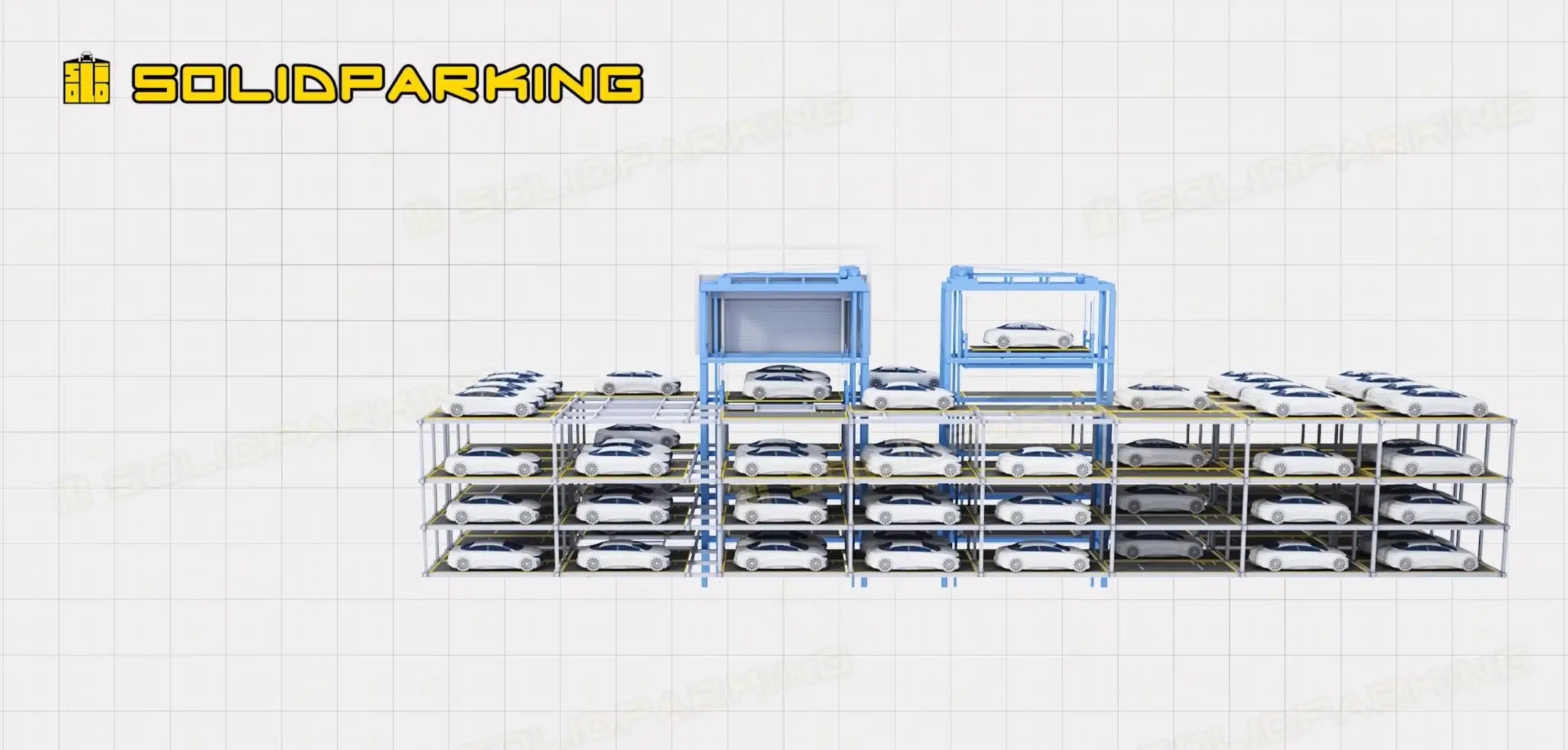
ATP — Automated Tower Parking System
ATP is a vertical high-density parking system that stores vehicles in compact tower structures.
Instead of horizontal circulation, vehicles are lifted and stacked vertically.
Benefits:
- minimal footprint
- maximum vertical density
- reduced excavation spread
- highly efficient urban application

Problem #2: Ramp Space Inefficiency
Automated Parking Systems Reclaim Usable Floor Area
In traditional parking garages, ramps can consume up to 40% of usable floorplate area.
This creates a major inefficiency: valuable architectural space is lost to circulation.
As a result:
- fewer parking stalls are built
- leasable space is reduced
- project ROI decreases
Solution: SSP + ASP
SSP — Grid-Based Parking Efficiency
SSP eliminates the need for ramps entirely by using mechanical repositioning of vehicles.
This creates a continuous parking grid instead of fragmented circulation paths.
Benefits:
- increased parking density
- full floorplate utilization
- elimination of ramp waste
ASP — Automated Shuttle Parking System
ASP uses automated shuttles to move vehicles within structured parking environments.
It is ideal for large-scale developments such as:
- shopping malls
- airports
- mixed-use complexes
Benefits:
- reduced circulation lanes
- improved throughput efficiency
- scalable system architectur
Automated Parking Systems ASP eliminating ramp circulation inefficiency in commercial garages
Problem #3: Deep Excavation Cost Explosion
Smart Parking Systems Reduce Underground Overbuild
Deep excavation significantly increases project cost due to:
- soil retention systems
- groundwater management
- structural reinforcement
- hauling and disposal logistics
Many parking structures become deeper than necessary due to inefficient ramp design.
Solution: RPS + ATP + SSP
RPS — Rotary Parking System
RPS is a compact vertical carousel system designed for extremely constrained urban sites.
Vehicles are stored in a rotating mechanical structure.
Benefits:
- minimal footprint
- reduced excavation depth
- ultra-efficient storage density
ATP — Vertical Compression Strategy
ATP reduces excavation requirements by stacking parking vertically instead of spreading it horizontally.
This reduces underground footprint and structural load.
SSP — Structural Compression System
SSP reduces underground construction requirements by eliminating ramp geometry entirely.
SMART PARKING SYSTEMS VS AUTOMATED PARKING SYSTEMS
| Feature | Traditional Parking | Smart Parking Systems | Automated Parking Systems |
|---|---|---|---|
| Circulation | Ramp-based | Mechanical grid | Fully automated movement |
| Excavation | High | Reduced | Reduced |
| Density | Low | High | Very High |
| Structural Waste | High | Low | Minimal |
Research showing automated mobility systems can reduce external sustainability costs, especially related to parking and congestion.
PEOPLE ALSO ASK
What are Smart Parking Systems?
Smart Parking Systems are mechanical parking technologies that replace traditional ramp-based garages with automated storage systems.
How do Automated Parking Systems reduce costs?
They reduce excavation depth, structural materials, and circulation inefficiency.
Are Smart Parking Systems better than ramps?
Yes. They significantly improve parking density and reduce construction costs.
What is the difference between SSP and ATP?
SSP uses a grid-based mechanical system while ATP uses vertical tower storage.
FAQ SCHEMA
What is the benefit of Smart Parking Systems?
They reduce building volume and improve parking efficiency.
Where are Automated Parking Systems used?
Residential, commercial, mixed-use, and urban developments.
Do Smart Parking Systems replace ramps completely?
In many designs, yes.
CONCLUSION
Smart Parking Systems and Automated Parking Systems are fundamentally reshaping how modern parking garages are conceived, designed, and justified within real estate development. What was once treated as a secondary infrastructure requirement is now emerging as a primary architectural driver that directly influences feasibility, efficiency, and long-term asset performance.
By removing traditional ramp-based circulation, reducing unnecessary excavation depth, and significantly increasing parking density through systems such as SSP, ATP, ASP, and RPS, developers are no longer constrained by the spatial inefficiencies that have defined parking design for decades. Instead, parking becomes a highly optimized, engineered system that aligns directly with the economic and spatial goals of the project.
This shift has a direct and measurable impact on construction outcomes. Reduced excavation translates into lower geotechnical risk and lower cost. Eliminating ramps frees up valuable floor area that can be reallocated to parking efficiency or above-grade program space. Increased density allows projects to achieve required parking counts within smaller footprints, often reducing overall building mass and structural demand. Collectively, these improvements strengthen project feasibility while improving both capital efficiency and long-term return on investment.
More importantly, Smart Parking Systems reposition parking as an early-stage design consideration rather than a reactive constraint. When integrated during conceptual planning, these systems influence everything from structural grids to basement geometry, enabling architects and developers to make more informed, performance-driven decisions before costs are locked in concrete.
In this context, parking is no longer simply about accommodating vehicles. It becomes a strategic design variable that shapes the entire building envelope and financial model.
For developers, architects, and planners working in increasingly dense and cost-sensitive environments, continuing to rely on conventional ramp-based parking logic introduces avoidable inefficiencies that accumulate across every level of a project. The opportunity is not just to improve parking—it is to reframe how space itself is valued and optimized.
Engaging with Smart Parking Systems early in the design process allows teams to unlock this potential at its highest impact point. For projects where land cost, excavation depth, and density constraints are critical, this early integration can be the difference between a constrained design and a high-performance development.
If you are currently planning a project or evaluating a parking strategy, now is the right time to rethink the foundation of your layout. Speak with SolidParking before finalizing your design—because once concrete is poured, efficiency becomes far more expensive to recover than it was to design correctly from the start.