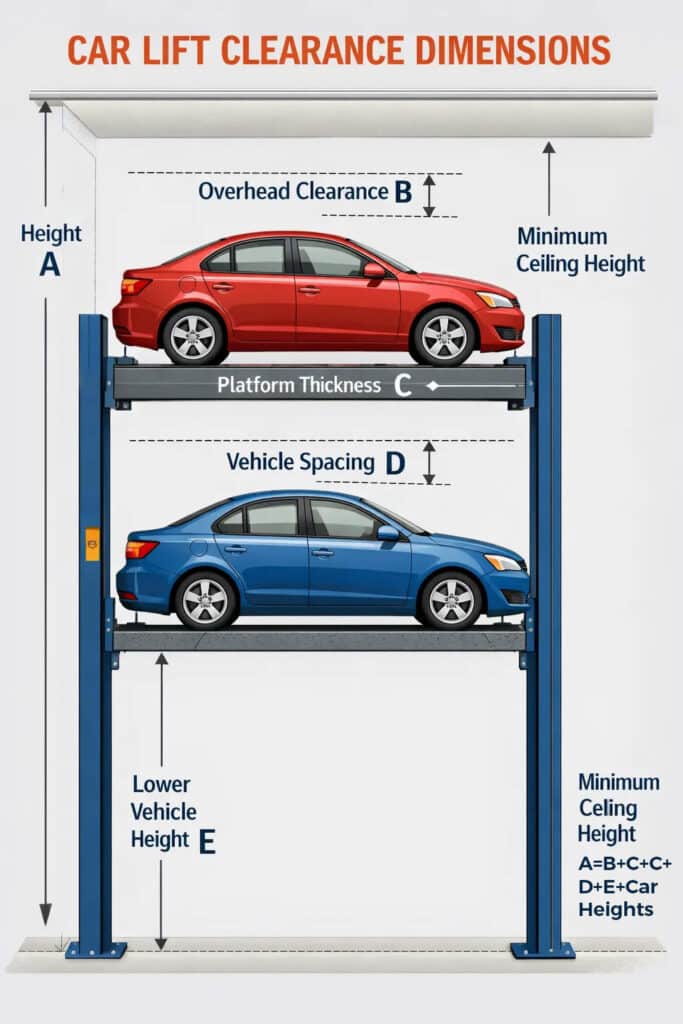
Before installing an auto lift system, one question determines whether the project is even feasible:
Will the space properly accommodate the required car lift dimensions?
In this guide—Part 2 of The High-Density Masterclass: Scaling Your Parking in 2026—we break down the technical requirements needed to evaluate a site for installation.
If you’re just getting started, you can review Part 1 here:
They refer to the full spatial and structural requirements needed to install and operate a vehicle lift safely.
These include:
Ceiling height (vertical clearance)
Platform height and lift travel range
Vehicle height and width
Structural slab requirements
Clearance for operation and safety
Understanding these factors ensures the system fits, functions, and complies with engineering standards.
Why Car Lift Dimensions Matter
They directly affect:
Installation feasibility
Safety and compliance
System selection (sedan vs SUV systems)
Operational efficiency
If dimensions are underestimated, the system may:
Fail to install
Operate unsafely
Underperform in real-world use
How Dimensions Affect 4 Post Lift Installation
Car lift dimensions are not only a product-selection issue. They determine whether the equipment can actually be installed and operated within the available garage footprint.