
The Complete Parking Lift Planning Guide: 7 Essential Parking Lift Requirements for Modern Garages
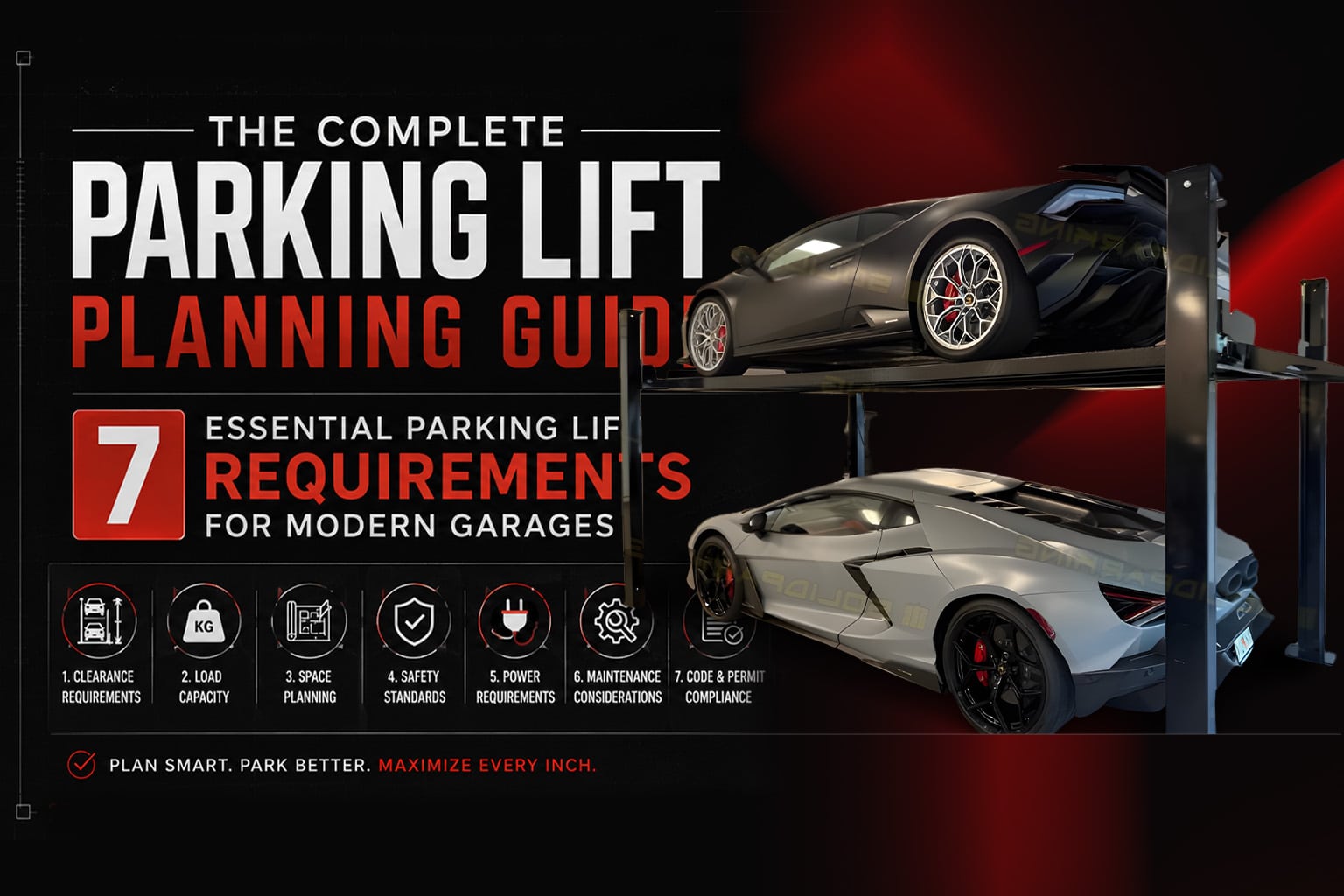
This parking lift planning guide explores the most important parking lift requirements for residential and commercial projects, including garage planning, parking lift dimensions, ceiling height, vehicle compatibility, and system selection.
As urban land becomes more expensive and vehicles continue growing in size, proper garage planning is becoming increasingly important for homeowners, developers, architects, and commercial property operators alike.
Modern parking lift systems are no longer limited to commercial parking garages. Today, they are widely used in luxury homes, apartment developments, dealerships, mixed-use projects, and vehicle storage facilities to increase parking capacity without expanding land footprint.
However, successful parking lift projects require more than simply choosing equipment.
A properly planned system must account for:
- vehicle dimensions
- ceiling clearance
- turning radius
- structural requirements
- operational workflow
- long-term parking needs
This complete parking lift planning guide breaks down the most important planning considerations behind modern parking lift systems and explains how proper garage planning can improve parking efficiency while reducing costly design mistakes.
Why a Proper Parking Lift Planning Guide Matters
Table of Contents
One of the biggest misconceptions about parking lift systems is that they are simple plug-and-play products.
In reality, most parking problems are planning problems.
A parking lift system that works perfectly in one project may perform poorly in another because every garage has different limitations involving:
- ceiling height
- vehicle size
- traffic flow
- structural conditions
- daily parking frequency
- future scalability
Poor garage planning often leads to:
- insufficient vertical clearance
- difficult SUV access
- uncomfortable maneuvering space
- inefficient parking flow
- future compatibility problems
As vehicles continue increasing in size — especially SUVs, EVs, and pickup trucks — parking lift planning becomes even more important for long-term usability.
A properly planned system should not only solve current parking challenges, but also adapt to future vehicle trends and operational requirements.
An insight reading of Cost to Build Parking: Future-Proof Assets & Investments
Understanding Different Types of Parking Lift Systems
Different parking lift systems are designed for different operational goals.
Some prioritize parking density. Others focus on convenience, long-term storage, or high-capacity urban parking.
Understanding these differences is one of the most important aspects of parking lift planning.
2 Post Parking Lifts
2 post parking lifts are commonly used for:
- residential garages
- apartment projects
- valet parking
- commercial parking structures
- space-constrained environments
These systems maximize parking capacity by vertically stacking vehicles within compact footprints.
SolidParking’s TP Series is commonly used in projects where maximizing parking density is critical without significantly expanding the parking structure.
For lower-clearance garages, tilting platform systems such as the TP-200 help optimize parking lift dimensions while accommodating taller vehicles.
However, successful garage planning for 2 post parking lifts must carefully evaluate:
- ceiling height
- SUV compatibility
- turning radius
- vehicle entry angles
- daily usability
because operational comfort matters just as much as physical fit.
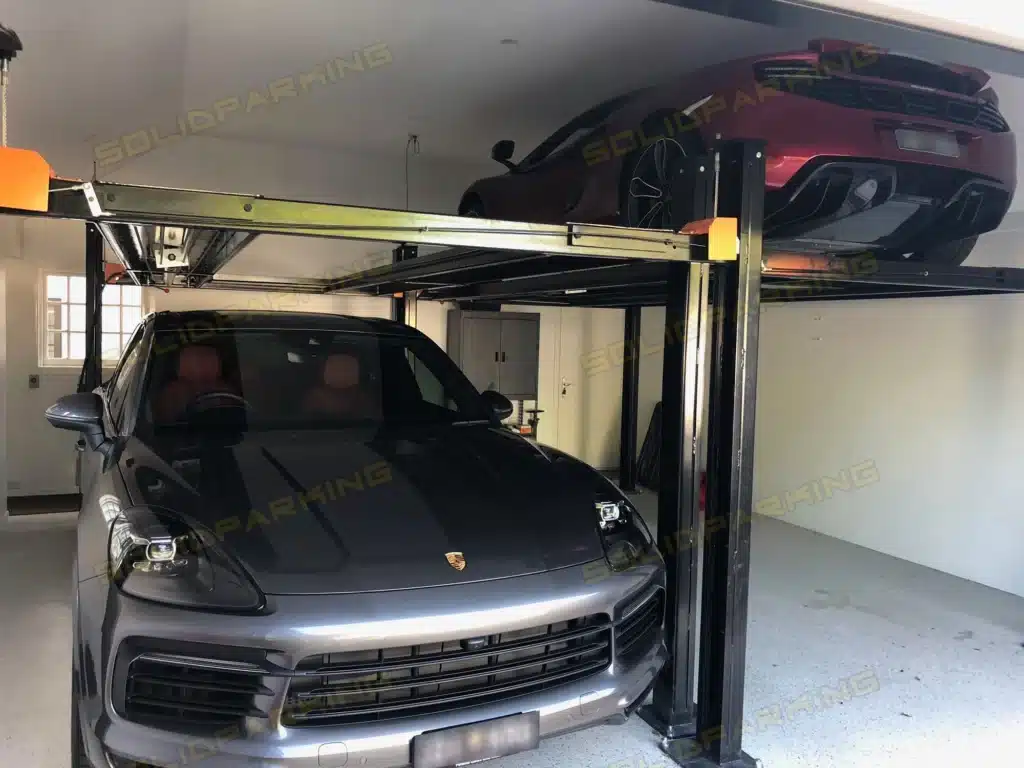
4 Post Parking Lifts
4 post parking lifts are widely preferred for:
- vehicle storage
- collector garages
- luxury homes
- dealerships
- long-term parking
Many homeowners prefer 4 post systems because drive-on platforms feel more natural for daily use.
SolidParking’s FP Series is frequently used in luxury garage planning because of its wider platforms, stable structure, and multi-level stacking capability.
For projects requiring maximum vertical storage density, systems like the FP-630 triple-stack lift can significantly increase parking capacity without expanding garage footprint.
In practical applications:
- 2-post systems are often optimized for parking density and service access
- 4-post systems are frequently preferred for storage and daily usability
Understanding that operational difference is critical during early parking lift planning.
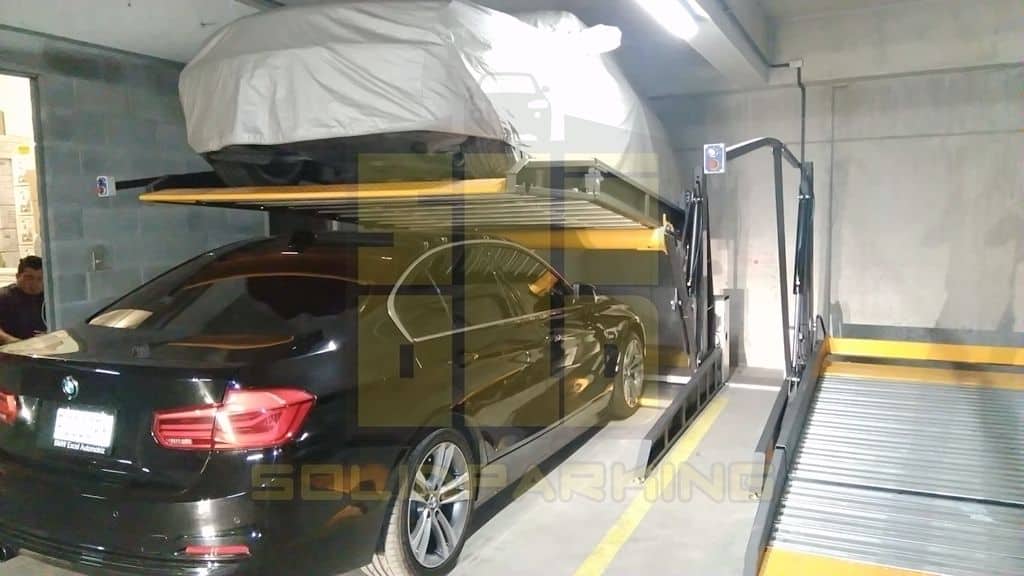
Puzzle Parking Systems
Puzzle parking systems are increasingly used in:
- apartment developments
- mixed-use projects
- commercial buildings
- high-density urban developments
Instead of relying on large circulation ramps, puzzle parking systems move vehicles horizontally and vertically through synchronized platform movement.
The primary advantage is land optimization.
In dense urban environments, puzzle systems can dramatically improve parking ratios while reducing the amount of space required for vehicle circulation.
For developers, this often improves:
- land efficiency
- project feasibility
- parking capacity
- construction optimization
during early garage planning phases.
Automated Parking Towers
Automated parking towers are commonly used in premium urban developments where land costs are extremely high.
These systems prioritize:
- maximum parking density
- reduced land consumption
- architectural integration
- high-capacity parking
Compared with traditional parking structures, automated systems reduce the amount of ramp and driving aisle space required inside the building.
However, these projects also involve more advanced parking lift requirements related to:
- traffic flow
- operational throughput
- maintenance access
- fire safety
- building integration
which is why early parking lift planning is essential.
Garage Planning and Parking Lift Dimensions Explained
One of the most important parts of any parking lift planning guide is understanding real-world garage dimensions.
Many parking projects fail not because of equipment quality, but because the garage planning phase underestimated actual vehicle size and circulation needs.
Modern SUVs and pickup trucks are significantly larger than vehicles from a decade ago.
Planning around outdated dimensions often creates long-term usability problems.
Ceiling Height Requirements
Ceiling height is usually the first limitation encountered during residential garage planning.
Parking lift dimensions vary depending on:
- vehicle type
- stacking configuration
- lift structure
- platform thickness
- operational clearance
The difference between parking a sedan and a full-size SUV can dramatically affect system selection.
Typical Planning Considerations
| Vehicle Type | Planning Consideration |
|---|---|
| Sedan | Lower vertical clearance requirements |
| Mid-size SUV | Additional stacking clearance needed |
| Full-size SUV | Greater ceiling flexibility required |
| Pickup Truck | Often requires higher-clearance systems |
Projects with limited ceiling height may benefit from:
- low-profile platforms
- tilting parking lifts
- recessed installations
- optimized platform angles
This is one reason why tilting 2 post parking lifts are increasingly used in low-ceiling garage planning projects.
Vehicle Width and Length
Modern vehicle dimensions continue increasing across nearly every category.
Vehicles such as:
- Cadillac Escalade
- Tesla Model X
- Ford F-150
- Rivian R1S
require substantially more maneuvering space than traditional sedans.
Garage planning should account for:
- door opening clearance
- side column spacing
- vehicle approach angles
- driver comfort
- circulation flow
A parking lift may technically fit inside the garage while still being uncomfortable for daily use.
That distinction matters.
Turning Radius and Driveway Access
Turning radius is one of the most overlooked parking lift requirements.
Many projects focus heavily on parking lift dimensions while ignoring actual vehicle movement patterns.
This becomes especially important in:
- narrow garages
- underground parking
- gated properties
- tandem parking layouts
- urban infill developments
Large SUVs and trucks require significantly more maneuvering space than compact vehicles.
In some cases, improving circulation layout has a greater impact on usability than changing the parking lift system itself.
Residential vs Commercial Parking Lift Planning
Different projects require completely different planning priorities.
A parking lift system designed for luxury residential use may not work efficiently inside a commercial parking operation.
Understanding operational goals early helps avoid costly redesigns later.
Residential Garage Applications
Residential garage planning typically prioritizes:
- convenience
- aesthetics
- ease of operation
- vehicle protection
- daily usability
Luxury homeowners and collectors increasingly use parking lift systems to:
- maximize garage capacity
- preserve outdoor space
- organize vehicle collections
- support larger vehicle ownership
Many residential projects prefer 4 post parking lifts because of their intuitive drive-on operation.
However, 2 post parking lifts may still be advantageous when maximizing parking density is the primary objective.
Garage planning should also consider future vehicle ownership changes.
A system optimized for sedans today may become restrictive once larger SUVs or EVs enter the garage.
Apartment and Multifamily Projects
Apartment projects focus more heavily on:
- parking ratios
- land efficiency
- circulation flow
- parking throughput
- operational scalability
Puzzle parking systems and stack parking systems are increasingly used where land value makes conventional parking inefficient.
Proper parking lift planning can significantly influence:
- zoning feasibility
- construction cost
- parking capacity
- long-term operational efficiency
during early development stages.
Dealership and Commercial Applications
Commercial parking projects often prioritize:
- inventory storage
- vehicle accessibility
- throughput efficiency
- operational reliability
- showroom flexibility
Dealerships commonly use parking lifts to increase storage capacity while maintaining operational flexibility inside limited footprints.
Structural Parking Lift Requirements for Modern Projects
Parking lift systems create structural demands that should never be overlooked during garage planning.
Concrete Slab Requirements
Concrete slab conditions directly affect parking lift safety and long-term stability.
Important parking lift requirements may include:
- slab thickness
- reinforcement conditions
- anchor placement
- load distribution
- soil conditions
Higher-capacity systems such as triple-stack lifts or automated parking systems may require more advanced structural evaluation.
Electrical Requirements
Many parking lift systems require dedicated electrical planning.
Requirements vary depending on:
- system type
- automation level
- operational frequency
- regional voltage standards
Automated parking systems typically involve more advanced electrical integration compared with basic hydraulic parking stackers.
Planning electrical access early can simplify installation and reduce future modifications.
Drainage and Waterproofing
Drainage is frequently overlooked during garage planning.
However, proper water management becomes increasingly important in:
- underground garages
- snow regions
- humid environments
- wash-down facilities
Poor drainage planning may eventually affect:
- corrosion
- platform durability
- maintenance frequency
over time.
Safety Locking Systems
Safety systems are one of the most important parking lift requirements in modern projects.
Most high-quality parking lift systems incorporate:
- mechanical safety locks
- hydraulic protection
- anti-fall systems
- synchronization control
- emergency stop systems
SolidParking’s dual safety locking approach is designed to improve operational reliability during repeated vehicle stacking cycles.
For homeowners, developers, and commercial operators alike, understanding safety systems should be part of early project evaluation rather than an afterthought.
Common Parking Lift Planning Mistakes
Even experienced property owners often underestimate the importance of proper garage planning.
Several mistakes repeatedly appear across residential and commercial projects.
Ignoring SUV Growth
Modern SUVs and EVs continue increasing in size.
Planning around compact vehicle dimensions may create future compatibility issues.
Underestimating Turning Space
A layout that technically fits on paper may still feel impractical during daily operation.
Choosing the Wrong Lift for Daily Use
Some systems prioritize maintenance access.
Others prioritize parking convenience and long-term storage.
Understanding operational goals matters more than simply maximizing parking capacity.
Focusing Only on Equipment Price
The cheapest parking lift system is not always the most cost-efficient long-term solution.
Garage planning should also consider:
- maintenance requirements
- future scalability
- operational comfort
- structural compatibility
- long-term efficiency
rather than initial equipment price alone.
How to Choose the Right Parking Lift System
The best parking lift system depends entirely on the project itself.
There is no universal solution.
For Homeowners
Residential projects typically prioritize:
- convenience
- aesthetics
- SUV compatibility
- ease of operation
For Developers
Developers often focus on:
- land efficiency
- parking ratios
- operational scalability
- project feasibility
For Architects
Architects frequently evaluate:
- circulation flow
- structural integration
- usable floor area
- visual impact
For Commercial Operators
Commercial parking facilities prioritize:
- throughput efficiency
- durability
- maintenance access
- operational reliability
Recommended Parking Lift Systems for Different Applications
| Application | Recommended System |
|---|---|
| Luxury Home Garage | 4 Post Parking Lift |
| Low Ceiling Garage | Tilting 2 Post Parking Lift |
| Apartment Development | Puzzle Parking System |
| Car Dealership | Triple Stack Parking Lift |
| High-Density Urban Project | Automated Parking System |
Frequently Asked Questions
Are parking lifts safe for daily use?
Modern parking lift systems incorporate multiple safety systems including mechanical locks, hydraulic protection, and synchronization systems designed for repeated daily operation.
How tall should a garage be for a parking lift?
Garage height requirements depend on vehicle size, parking lift dimensions, and stacking configuration. SUVs and pickup trucks generally require greater vertical clearance than sedans.
Can parking lifts fit large SUVs?
Yes. However, garage planning and parking lift dimensions must account for modern SUV height, width, and weight requirements.
Are parking lifts suitable for residential garages?
Many homeowners use parking lift systems to increase garage capacity while preserving outdoor parking space and improving vehicle organization.
Do parking lifts require permits?
Permit requirements vary depending on local regulations, project type, and structural modifications involved in the installation.
Conclusion
Parking lift systems are ultimately space-planning solutions.
The success of a project depends less on the equipment itself and more on how effectively the system aligns with vehicle dimensions, garage limitations, circulation flow, and long-term operational goals.
Whether planning a luxury residential garage, dealership expansion, apartment development, or high-density urban parking project, proper parking lift planning helps prevent costly redesigns while improving parking efficiency over time.
As vehicle sizes continue increasing and urban land becomes more constrained, parking lift systems will likely play an even larger role in future garage planning and parking infrastructure development.
Need help planning a parking lift project?
SolidParking provides customized parking lift solutions for residential garages, commercial parking facilities, apartment developments, and high-density urban projects.