
Hydraulic Scissor Car Lift: 7 Proven Benefits for Smarter Vehicle Access
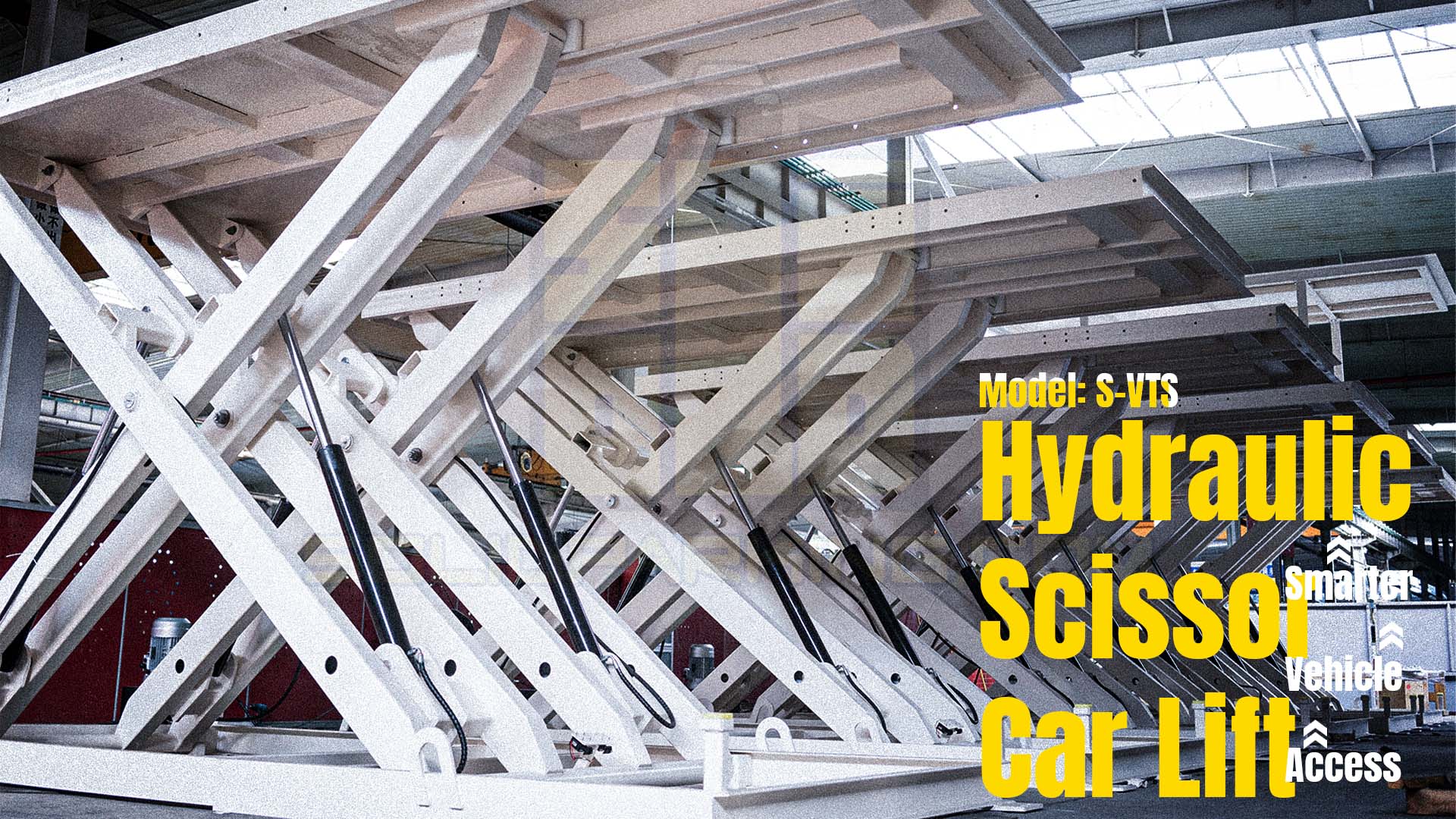
A hydraulic scissor car lift provides a practical way to move vehicles between parking levels when a conventional ramp is difficult to accommodate. Instead of creating a long horizontal driving route, the system uses a hydraulic scissor mechanism to raise or lower a full vehicle platform.
This makes a hydraulic scissor car lift relevant to basement garages, compact urban developments, vehicle storage facilities, showrooms, service centers, and other projects where horizontal circulation is limited.
The term hydraulic elevator is also sometimes used when discussing vertical vehicle transportation. However, a hydraulic elevator and a hydraulic scissor car lift should not automatically be treated as the same equipment. Their structures, applications, platform configurations, and project requirements can be different.
This article explains how a hydraulic scissor car lift works, where it can be used, what benefits it provides, and what should be checked before selecting one.
What Is a Hydraulic Scissor Car Lift?
A hydraulic scissor car lift is a vehicle lifting platform that uses hydraulic cylinders and a scissor-arm structure to move a vehicle vertically.
The vehicle drives onto the platform at one level. The lifting mechanism then raises or lowers the platform to another level, allowing the vehicle to drive off once the platform reaches its designated position.
The main difference from a conventional ramp is the direction of movement.
A ramp creates a horizontal or sloped vehicle route.
A hydraulic scissor car lift creates a vertical vehicle route.
This distinction becomes important when the available floor area is limited or when a project needs to connect a ground level with a basement without allocating a large portion of the site to vehicle circulation.
A Vehicle Platform, Not a Passenger Elevator
A vehicle lifting platform should be specified according to its intended load, platform dimensions, lifting height, structural requirements, safety systems, and applicable local regulations.
ASME’s PASE-2024 standard includes vehicle transport lifts within its scope and addresses aspects including design, construction, operation, maintenance, and inspection.
This is important because vehicle transport equipment has different requirements from a passenger elevator designed primarily for people.
How Does a Hydraulic Scissor Car Lift Work?
The operating principle is relatively simple.
1. The Vehicle Drives Onto the Platform
The vehicle enters the designated platform from the ground or target level.
The platform must provide sufficient width and length for the intended vehicles, together with appropriate entry and exit clearance.
For the SolidParking S-VTS, the specified platform size is 3,000 × 6,000 mm.
2. The Hydraulic System Activates the Scissor Mechanism
A hydraulic pump station supplies hydraulic pressure to the lifting cylinders.
The scissor arms extend or retract, changing the height of the platform.
The S-VTS specification includes a 5.5 kW hydraulic pump station and two hydraulic cylinders with a specified diameter range of approximately Ø110–125 mm.
3. The Platform Moves Vertically
The S-VTS has a lifting height of 2,500 mm and a lifting speed of 2–5 m/min.
The actual required travel must be determined from the project’s floor-to-floor height and installation geometry.
A standard 2,500 mm lifting height should therefore not be treated as a universal floor-to-floor dimension.
4. The Vehicle Drives Off at the Target Level
Once the platform reaches the required position and the safety sequence is complete, the vehicle can leave the platform and continue into the basement, garage, storage area, showroom, or service area.
The equipment is therefore functioning as a vertical vehicle access system, rather than simply as a device for raising a vehicle.
Where Are Hydraulic Scissor Car Lifts Used?
The strongest applications are projects where a vehicle must move vertically between levels but a conventional vehicle route is difficult or space-intensive.
Residential Basement Garages
A homeowner may want a basement garage but have insufficient space for a conventional ramp.
A ramp needs more than its visible driving surface. The layout must also account for slope, entry and exit geometry, turning conditions, structural integration, and vehicle clearance.
A hydraulic scissor car lift offers another design approach by changing the vehicle route from horizontal movement to vertical movement.
Urban Parking Projects
In compact urban buildings, floor area is often one of the most constrained resources.
A long ramp can consume space that could otherwise be allocated to parking, storage, circulation, or another building function.
A vertical vehicle lift can give architects another option for connecting parking levels, provided the structure, regulations, traffic flow, and equipment requirements are suitable.
SolidParking’s installation guidance also recommends evaluating building dimensions, vehicle size, slab conditions, electrical supply, drainage, and traffic flow before selecting and installing parking equipment.
Car Showrooms and Vehicle Storage
A showroom may need to keep its most visible floor area available for display while using a basement or lower level for inventory storage.
A vehicle transport platform can connect the two areas vertically.
The same concept can apply to collector-car storage and commercial vehicle storage where vehicles need controlled movement between levels.
Service Centers and Workshops
A vehicle lift can also provide vertical access between different levels of a service facility.
This application should not be confused with a two-post or four-post maintenance lift.
A service lift raises a vehicle primarily to provide access underneath it.
A vehicle transport lift moves the vehicle itself from one level to another.
That is a fundamental difference in equipment purpose.
Hydraulic Scissor Car Lift vs. Hydraulic Elevator
The term hydraulic elevator is broader than the term hydraulic scissor car lift.
A hydraulic elevator generally describes a vertical lifting system powered through hydraulic equipment. Its exact configuration and permitted application depend on its design and the applicable standards.
A hydraulic scissor car lift, by contrast, uses a scissor structure and vehicle platform specifically configured for vehicle movement.
What Is a Hydraulic Elevator?
A hydraulic elevator uses hydraulic power to produce vertical movement.
Depending on the equipment and application, hydraulic elevator technology can be used for different transportation purposes.
For vehicle applications, however, the relevant question is whether the elevator is specifically designed, rated, and approved for vehicle transportation.
Is a Hydraulic Scissor Car Lift the Same as a Hydraulic Elevator?
No.
Although both systems can use hydraulic power, the lifting configuration and intended use may be different.
More insight: Elevator Parking Garage Systems: Complete Buyer’s Guide & VTS Models
| Feature | Hydraulic Scissor Car Lift | Hydraulic Elevator |
|---|---|---|
| Main purpose | Vehicle transportation between levels | Vertical transportation according to system design |
| Lifting structure | Scissor mechanism | Hydraulic elevator mechanism |
| Platform | Full vehicle platform | Elevator car or designated platform |
| Vehicle application | Specifically configured for vehicles | Must be specifically designed for vehicle use |
| Typical parking role | Vehicle access between levels | Project-dependent |
| Ramp alternative | Common application | Depends on system design and approval |
For developers and architects, the better question is therefore not simply whether a system is hydraulic.
The key questions are:
What must be moved? How far must it move? What load must be carried? What platform is required? And what regulations apply?
7 Proven Benefits of a Hydraulic Scissor Car Lift
1. Reducing Dependence on Long Vehicle Ramps
One of the most important advantages of a hydraulic scissor car lift is the ability to create a vertical vehicle route.
A conventional ramp occupies horizontal floor area.
A vehicle lift concentrates the movement into a defined lifting zone.
For projects with limited floor area, this can provide a different way to approach basement access and multi-level vehicle movement.
2. Turning Vertical Space Into Vehicle Access
Parking design is often treated as a two-dimensional planning problem.
A hydraulic scissor car lift introduces another option: using the available vertical envelope.
Instead of designing a long driving route between levels, the vehicle can be transported vertically on a dedicated platform.
This can be especially relevant to compact garages and urban projects.
3. Supporting Full-Platform Vehicle Movement
The vehicle remains on a complete platform while it moves between levels.
The S-VTS platform measures 3,000 × 6,000 mm according to the provided technical specification.
The actual vehicle suitability must still be checked against the confirmed rated capacity, vehicle dimensions, clearances, and project requirements.
4. Creating More Flexible Garage Layouts
A hydraulic scissor car lift does not automatically increase the number of parking spaces.
Its value is different.
It gives the designer another way to connect parking levels.
That can help when a conventional ramp conflicts with:
- building footprint
- parking layout
- basement configuration
- property boundaries
- circulation requirements
- available floor area
5. Supporting Residential and Commercial Applications
The same basic vertical transport principle can be applied in residential and commercial projects.
Residential projects may prioritize compact installation and daily convenience.
Commercial projects may prioritize operating frequency, vehicle mix, traffic flow, access control, and maintenance.
The equipment should therefore be selected based on the project rather than by the equipment name alone.
6. Providing Controlled Hydraulic Movement
The S-VTS uses a 5.5 kW hydraulic pump station, two hydraulic cylinders, and a specified lifting speed of 2–5 m/min.
The hydraulic system includes high-pressure double-layer steel-wire-reinforced hoses and Italian Aston seals according to the provided S-VTS specification.
These components contribute to the overall hydraulic system design, but the complete system should always be evaluated as a combination of pump, cylinders, hoses, valves, controls, structural components, and safety devices.
7. Integrating Multiple Safety Functions
A hydraulic scissor car lift can incorporate multiple safety functions into the lifting system.
The S-VTS specification includes:
- 24 V low-voltage control
- emergency stop
- limit switches
- cylinder anti-burst protection
- self-locking during power loss
Optional functions include:
- full-stroke locking
- motion detection
- vehicle over-length detection
- deceleration
- soft landing
- EV charging station mounting provisions and cable routing
Safety should be evaluated as part of the complete equipment and installation rather than through one feature alone.
OSHA’s guidance on automotive lifts emphasizes proper use, manufacturer instructions, safety devices, inspections, and appropriate operating procedures.
What Should You Check Before Choosing a Hydraulic Scissor Car Lift?
Lifting Height
The lifting height must match the actual vertical distance that the vehicle needs to travel.
The S-VTS specification provides a 2,500 mm lifting height.
Before selection, verify:
- finished floor levels
- pit depth
- platform height
- required clearance
- entrance and exit levels
Platform Dimensions
The S-VTS platform is specified at:
3,000 mm wide × 6,000 mm long
Vehicle length and width should be checked together with door opening conditions, wheel position, entry geometry, and surrounding clearance.
Rated Load Capacity
Rated capacity must be confirmed for the actual configuration.
This is especially important for projects involving SUVs, heavy vehicles, or EVs.
The S-VTS technical information provided for this article does not include a confirmed rated load capacity, so a load figure from another SolidParking model should not be applied to S-VTS without confirmation.
OSHA materials dealing with automotive lifts emphasize that rated load capacity and operating instructions need to be clearly identified and followed.
Structural and Pit Requirements
A vehicle lift transfers load into the structure.
Project planning should therefore evaluate:
- concrete condition
- slab design
- reinforcement
- foundation conditions
- anchoring
- pit requirements
- drainage
- surrounding structural elements
SolidParking’s current installation guide also emphasizes that slab conditions, vehicle capacity, structural conditions, electrical requirements, and drainage need to be considered before installation.
Hydraulic and Electrical Requirements
The S-VTS uses a 5.5 kW hydraulic power unit and a 24 V low-voltage control system.
Electrical planning should confirm the available voltage, frequency, phase, motor requirements, control configuration, emergency-stop circuit, and cable routing.
SolidParking’s installation guidance identifies supply voltage, frequency, phase, motor size, control systems, emergency-stop circuits, and cable routing as important electrical planning factors.
S-VTS Example: Turning Vertical Space Into Vehicle Access
The S-VTS provides a clear example of how vertical vehicle access can be applied.
Consider a building with a ground floor and a basement.
A conventional approach would create a vehicle route between those two levels.
If the project cannot efficiently accommodate a long ramp, a vertical platform can provide another option.
The basic sequence is:
Ground Level
Vehicle drives onto the S-VTS platform.
↓
Vertical lifting movement
The platform moves up or down through the hydraulic scissor mechanism.
↓
Basement Level
The vehicle reaches the target level and drives off the platform.
For the specified S-VTS configuration, the platform is 3,000 × 6,000 mm and the lifting height is 2,500 mm.
The main value is therefore not simply lifting a car.
The value is creating a vertical vehicle connection between levels when a conventional vehicle route is difficult, inefficient, or undesirable.
Safety Features That Matter
Anti-Burst Hydraulic Protection
The S-VTS specification includes an anti-burst valve at the bottom of each cylinder.
This is intended to help prevent uncontrolled descent in the event of hydraulic hose failure.
Self-Locking During Power Loss
The platform is specified with a self-locking function during power interruption or sudden power loss.
24 V Low-Voltage Control
The system uses low-voltage control to operate the high-voltage circuit.
This separates the operator controls from the higher-voltage power circuit.
Emergency Stop and Limit Switches
Emergency stop functions provide an immediate method of stopping equipment operation during unexpected conditions.
Limit switches define the intended operating range.
Optional Detection and Soft Landing
Additional options can include vehicle detection, motion detection, full-stroke locking, controlled deceleration, and soft landing.
These functions should be specified according to the actual site and operating conditions.
ASME’s PASE standard identifies vehicle transport lifts within its covered equipment categories and includes requirements related to design, operation, maintenance, and inspection.
Is a Hydraulic Scissor Car Lift Right for Your Project?
A hydraulic scissor car lift is worth considering when a project needs to move vehicles vertically between levels and a traditional ramp is difficult to integrate.
It may be appropriate when:
- a vehicle needs access to a basement
- horizontal space for a ramp is limited
- the project requires a dedicated vehicle platform
- vehicle dimensions fit the platform
- the structural design can support the equipment
- local regulations permit the proposed configuration
It may not be the best solution when the main objective is simply to stack more cars in the same parking space.
For example, two-post and four-post parking lifts are often considered when the main requirement is vertical vehicle storage. Automated systems may be more appropriate when the project requires higher parking density and automated vehicle handling.
SolidParking currently provides two-post lifts, four-post lifts, semi-automated parking systems, fully automated systems, and customized parking solutions.
The correct equipment therefore depends on the actual problem:
vehicle storage, vehicle transportation between levels, or parking-density optimization.
Conclusion
A hydraulic scissor car lift is primarily a vertical vehicle access solution.
Its most relevant application is moving vehicles between levels when creating a conventional ramp would require significant space or conflict with the project’s layout.
The SolidParking S-VTS combines a 2,500 mm lifting height, 3,000 × 6,000 mm platform, 5.5 kW hydraulic power unit, two hydraulic cylinders, and multiple safety and optional control functions.
For architects, developers, garage owners, and vehicle-storage operators, the starting point should therefore be the site problem rather than the equipment name.
The key question is:
How should vehicles move between these levels?
Once the floor-to-floor height, vehicle dimensions, required capacity, structural conditions, and site layout are understood, a hydraulic scissor car lift can be evaluated against ramps, parking lifts, hydraulic vehicle elevators, and other vehicle access systems.
For project-specific evaluation, provide the floor plan, floor-to-floor height, vehicle dimensions, vehicle weights, and intended application for a layout review.
FAQ
What is a hydraulic scissor car lift?
A hydraulic scissor car lift is a vehicle platform that uses hydraulic cylinders and scissor arms to move a vehicle vertically between levels.
Is a hydraulic scissor car lift the same as a hydraulic elevator?
No. A hydraulic elevator is a broader equipment category. A hydraulic scissor car lift specifically uses a scissor lifting mechanism and a vehicle platform for vertical vehicle movement.
Can a hydraulic scissor car lift replace a parking ramp?
It can provide an alternative vertical vehicle route where a conventional ramp is difficult or inefficient to integrate. Project-specific structural, dimensional, operational, and regulatory conditions must be reviewed.
How high can a hydraulic scissor car lift go?
The specified S-VTS lifting height is 2,500 mm. The actual required height should be confirmed from the project’s finished floor levels and installation conditions.
What is the S-VTS platform size?
The specified platform size is 3,000 × 6,000 mm.
Can a hydraulic scissor car lift be used for underground parking?
Yes. Ground-to-basement vehicle transport is one of the key applications for this type of equipment when the project conditions are suitable.
Can SUVs and EVs use a hydraulic scissor car lift?
Potentially, provided the vehicle dimensions and confirmed rated capacity are compatible with the equipment. EV projects may also require provisions for charging equipment and cable routing.
What safety features should a hydraulic scissor car lift have?
Important considerations include emergency stop, limit switches, hydraulic hose-burst protection, self-locking, low-voltage control, and, where required, additional locking and vehicle-detection functions.
How do I choose between a hydraulic scissor car lift and a hydraulic elevator?
Start with the actual application, vehicle requirements, travel height, platform size, rated capacity, structural conditions, operating frequency, and applicable regulations. A system intended for vehicle transport must be specifically suitable for that application.
What information is needed to select a hydraulic scissor car lift?
The basic information includes the site layout, floor-to-floor height, pit conditions, vehicle dimensions and weights, required lifting height, operating frequency, power supply, and intended application.