Residential car lift: 3 Key Lift Systems Transforming Urban Parking
2026-05-06
residential-car-lift-commercial-parking-lift

Urban development is facing a structural contradiction that traditional parking design can no longer solve.

Cities are expanding vertically, but parking systems remain largely horizontal and inefficient. This is where the Residential car lift is emerging as a critical solution, enabling vertical space utilization in modern housing and urban planning.

This creates three global challenges:

  • Increasing land cost per square meter
  • Rising vehicle ownership in residential and commercial sectors
  • Accelerating demand for EV-ready infrastructure

In high-density regions such as United States, Singapore, and Germany, parking space is no longer just an architectural requirement—it is a financial constraint that directly affects real estate ROI. As a result, developers are increasingly adopting Residential car lift systems to optimize limited space while maintaining project profitability.

Traditional parking structures fail because they assume:

  • unlimited horizontal space
  • static vehicle technology
  • no energy infrastructure requirements

Modern cities require a shift toward vertical, modular, and EV-integrated parking systems, where the Residential car lift plays a foundational role in transforming how parking is designed, engineered, and integrated into real estate projects.

More ideas to solve urban challenge to see on Smart Cities World

What Is a Residential Car Lift? (TP-Series Systems)

A Residential car lift is a vertical parking system designed to maximize parking capacity in homes, villas, and residential buildings by stacking vehicles using hydraulic lifting platforms.

Unlike traditional garages that allocate one vehicle per horizontal space, residential car lifts transform a single footprint into a multi-vehicle vertical structure.

Key Problems Solved:

  • Limited garage space in urban residential developments
  • High land cost preventing horizontal expansion
  • Increasing number of vehicles per household
  • Lack of basement construction feasibility in compact housing

TP-Series Engineering Models:

  • TP-200
  • TP-230H
  • TP-270
  • TP-270H
  • TP-320

Engineering Logic:

TP-Series systems are designed to:

  • double parking capacity without structural expansion
  • integrate into existing residential architecture
  • minimize excavation and civil construction cost
  • provide flexible height configurations for different garages

A residential car lift is a hydraulic vertical parking system that increases garage capacity by stacking vehicles in a compact vertical structure.

What Is a Commercial Parking Lift? (FP-Series Systems)

A Commercial parking lift is a high-capacity vertical parking system designed for real estate developments such as shopping malls, office buildings, hotels, and mixed-use complexes.

Key Problems Solved:

  • inefficient land utilization in commercial buildings
  • high cost of underground parking construction
  • low ROI per square meter due to wasted parking space
  • congestion in traditional ramp-based parking systems

FP-Series Engineering Models:

  • FP-630
  • FP-360X
  • FP-630 Triple Stack System

Engineering Logic:

FP-Series systems are designed to:

  • maximize parking density in high-traffic environments
  • support continuous operation cycles
  • reduce excavation and construction complexity
  • increase revenue-generating usable building area

A commercial parking lift is a vertical multi-level parking system that increases parking capacity in real estate projects by stacking vehicles efficiently using hydraulic platforms.

What Is an Electric Car Lift System? (EV Integration Layer)

An Electric car lift system is an EV-ready vertical parking solution designed to integrate vehicle lifting systems with electric vehicle charging infrastructure.

This is not a separate product category—it is an engineering upgrade layer applied to TP and FP systems.

Key Problems Solved:

  • EV weight increase compared to traditional vehicles
  • lack of charging integration in existing parking systems
  • high cost of retrofitting old garages for EV use
  • inability of traditional systems to scale with EV adoption

EV System Capabilities:

  • structural reinforcement for EV load requirements
  • integrated EV charging station planning
  • modular electrical infrastructure design
  • future-proof scalability for smart parking systems

Industry Insight:

According to International Energy Agency, EV adoption is accelerating faster than infrastructure development, creating a global demand for EV-integrated parking systems.

Key Problems Solved by Vertical Parking Systems

Across residential and commercial sectors, three structural problems dominate:

1. Land scarcity

Urban land is too expensive for inefficient parking layouts.

2. Parking inefficiency

Traditional systems waste vertical potential by using only horizontal space.

3. EV infrastructure gap

Most parking systems were not designed for electrified mobility.

Vertical parking systems solve these by converting parking from a horizontal layout into a three-dimensional engineered structure.

TP-Series Residential Car Lift Engineering Breakdown

TP-Series systems represent the residential layer of vertical parking engineering.

Functional Advantages:

  • compact hydraulic lifting system
  • low structural modification requirement
  • suitable for private garages and villas
  • flexible installation in constrained spaces

Application Scenarios:

  • urban villas
  • private residences
  • small residential developments
  • luxury housing projects

Core Engineering Outcome:

TP-Series transforms a single parking footprint into a dual-vehicle vertical structure without expanding land use.

FP-Series Commercial Parking Lift Engineering Breakdown
FP-Series systems represent the commercial scalability layer.

Functional Advantages:

  • multi-vehicle vertical stacking
  • high-frequency operational stability
  • optimized real estate land utilization
  • reduced construction cost for developers

Application Scenarios:

  • shopping malls
  • office complexes
  • hotels
  • mixed-use real estate developments

Core Engineering Outcome:

FP-Series converts underutilized parking footprints into high-density revenue-supporting infrastructure.

Electric Car Lift and EV Infrastructure Transformation

Electric mobility is reshaping parking system design requirements.

EV Integration Requirements:

  • structural reinforcement for EV weight increase
  • EV charging station integration planning
  • electrical routing compatibility
  • modular expansion architecture

System Transformation:

Parking systems are evolving from:

static storage infrastructure
to
dynamic energy-enabled mobility infrastructure

Comparison Table (Featured Snippet Target)

System TypeSeriesApplicationCore Problem Solved
Residential Car LiftTP-SeriesHomes, villasResidential space shortage
Commercial Parking LiftFP-SeriesReal estate projectsParking inefficiency
Electric Car LiftEV Integration LayerSmart buildingsEV charging infrastructure gap

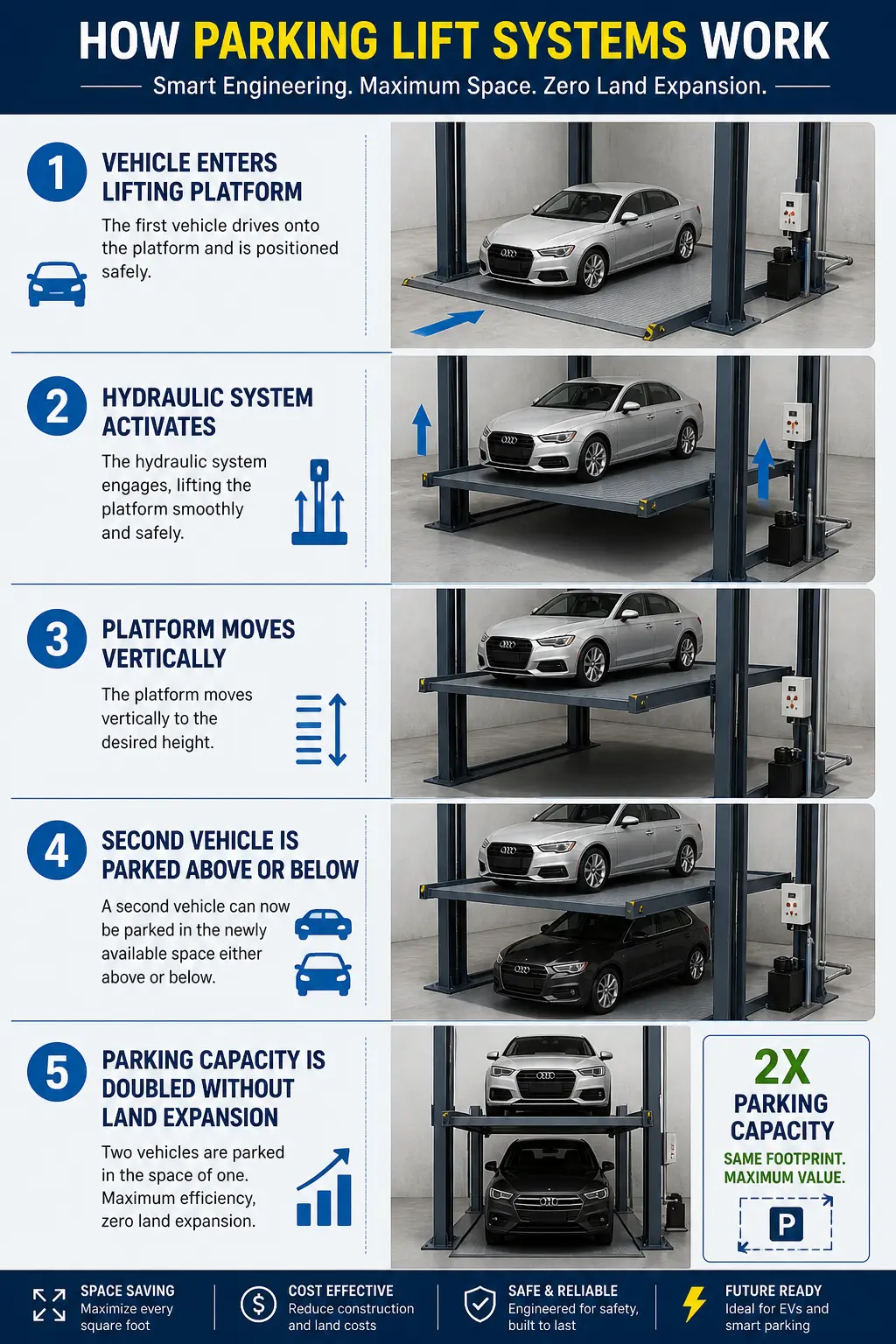
How Parking Lift Systems Work (Step-by-Step Guide)

  • Vehicle enters lifting platform
  • Hydraulic system activates
  • Platform moves vertically
  • Second vehicle is parked above or below
  • Parking capacity is doubled without land expansion
Step-by-step infographic of a car lift stacking two vehicles vertically to save space.

Applications in Real Estate Development

Residential Sector:

  • space optimization in urban housing
  • villa garage expansion
  • private multi-vehicle households

Commercial Sector:

  • parking optimization in malls
  • office building infrastructure
  • hotel parking efficiency

EV Sector:

  • smart city infrastructure
  • EV charging networks
  • sustainable urban planning systems

FAQ

What is a residential car lift used for?

A residential car lift is used to double parking capacity in homes by stacking vehicles vertically.

A commercial parking lift uses hydraulic systems to stack vehicles vertically in real estate projects.

Yes, electric car lifts can integrate EV charging systems and structural reinforcement.

TP-series is for residential use, FP-series is for commercial high-density parking systems.

Final Insight: The Future of Parking Engineering

The global parking industry is undergoing a structural transformation.

It is no longer defined by mechanical equipment.

It is defined by engineered vertical systems that solve urban constraints:

  • residential space optimization (TP-series)
  • commercial land efficiency (FP-series)
  • EV infrastructure integration (electric car lift systems)

Final Conclusion:

Residential car lift, commercial parking lift, and electric car lift systems represent the evolution of parking from mechanical infrastructure into urban space engineering systems.

qrcode