
ATP Automated Parking System: 7 Critical, Proven Design Tips
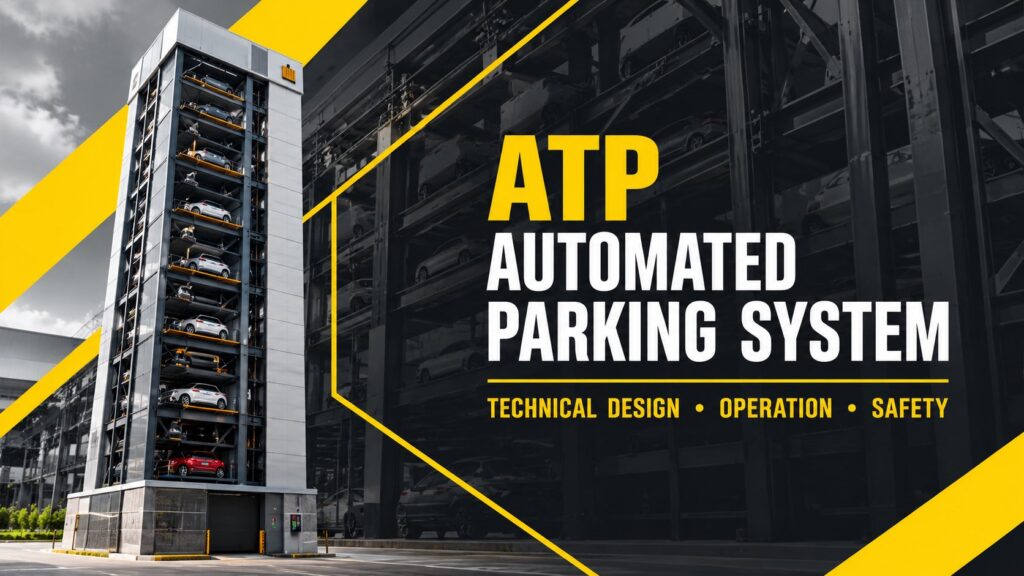
ATP Automated Parking System: Technical Design, Operation, and Safety
The ATP automated parking system is a tower-type solution that stores and retrieves vehicles through a coordinated lifting and transfer mechanism. Its main components include a steel structure, vehicle-carrying platforms or comb-type pallets, a lifting system, a carrier, electrical controls, and safety devices.
For developers, architects, contractors, and parking consultants, understanding these components is essential before coordinating parking capacity, building dimensions, vehicle access, and equipment installation. This technical guide explains how the tower system operates, the functions of its key components, and the project information required before specifying an ATP configuration.
1. What Is an ATP Tower-Type Automated Parking System?
An ATP tower-type automated parking system stores vehicles in vertically arranged parking positions and uses mechanical equipment to move them between the transfer area and their assigned spaces.
Instead of driving through internal ramps and parking aisles, users leave their vehicles in a designated transfer area. The automated equipment then transfers the vehicles into the storage structure. When a vehicle is requested, the system retrieves it and returns it to the designated collection area.
SolidParking’s ATP solution uses a lifting mechanism and vehicle-transfer components to support this sequence. The final arrangement depends on the selected configuration, available site dimensions, target capacity, and vehicle requirements.
The system may be considered for urban developments, commercial properties, residential projects, and other sites where vertical storage is a potential alternative to conventional parking layouts. Suitability should be established through project-specific design rather than assumed from the available land area alone.
2. How the ATP Automated Parking System Operates
The operating sequence consists of vehicle positioning, safety confirmation, automated transfer, and retrieval. The exact control sequence depends on the equipment configuration.
Step 1: Vehicle Entry and Positioning
The driver enters the designated transfer area and positions the vehicle according to the system’s guidance instructions.
Vehicle dimensions must fall within the permitted limits for the selected model. The project specification should define the maximum vehicle length, width, height, and weight, including any relevant protrusions such as mirrors.
Step 2: Transfer-Area Safety Confirmation
Before automated movement begins, the control system checks the required operating conditions through its configured interlocks and detection devices.
These may include door-position monitoring, vehicle-position detection, and person-detection devices. Users should follow the system’s instructions and leave the transfer area as directed before automated movement starts.
Step 3: Lifting and Vehicle Transfer
The lifting mechanism moves the vehicle or its carrying assembly to the required level. The carrier then positions the vehicle at its designated storage location using the system’s configured transfer arrangement.
The lifting path, carrier movement, pallet design, and parking positions must work together within the available structure. These components should therefore be coordinated with the building layout, clearances, and structural design before installation.
Step 4: Vehicle Retrieval
When a vehicle is requested, the control system initiates the retrieval sequence. The lifting and carrier mechanisms retrieve the vehicle from its storage position and return it to the transfer area.
Retrieval time depends on factors such as storage location, equipment configuration, movement sequence, and simultaneous user demand. For a commercial project, evaluate expected peak-period performance using the proposed system layout instead of relying on a single general retrieval-time claim.
3. Main Components of the ATP Tower Parking System
Each component has a specific role in vehicle storage and transfer. The final equipment list and specifications should be confirmed in the approved drawings and quotation.
| Component | Primary function | Key technical consideration |
|---|---|---|
| Steel structure | Supports the tower arrangement and equipment | Structural loads, connections, foundation, and building interfaces |
| Vehicle platform or comb-type pallet | Supports the vehicle during storage and transfer | Vehicle dimensions, weight limits, positioning, and transfer compatibility |
| Lifting mechanism | Moves the vehicle-carrying assembly vertically | Travel height, movement path, clearances, and operating sequence |
| Carrier or transfer mechanism | Positions the vehicle at the designated storage location | Transfer path, positioning accuracy, and layout coordination |
| Electrical control system | Coordinates equipment movements and operating sequence | Control logic, interfaces, monitoring, and system configuration |
| Transfer-area door and safety devices | Manage access to the equipment operating zone | Interlocks, sensor coverage, and safe operating conditions |
SolidParking’s published product information identifies a PLC-based control system for its tower-type ATP solution and lists Schneider PLC and SEW motor options. Confirm the actual controller, motor, and component specifications for the model being quoted rather than assuming every configuration uses identical hardware.
For the available automated parking solutions, see the SolidParking Automated Parking System product category.
4. ATP Automated Parking Safety Devices and Interlocks
An ATP installation relies on coordinated safety functions rather than one sensor or one mechanical component. The design should identify how access control, detection devices, interlocks, and equipment movement work together.
SolidParking’s published ATP description identifies the following safety and guidance devices. Their availability, functions, and control logic should be confirmed for the proposed configuration.
Transfer-Area Door
The automated door controls access to the transfer area. Its operation should be coordinated with the carrier position and the system’s permitted operating states.
The design should specify the required door interlocks and the conditions under which vehicle transfer is allowed.
Person-Detection Sensor
The published ATP description states that person-detection devices monitor the transfer area and that the described configuration keeps the door open and stops operation when a person or pet remains in the detected area.
For a project specification, confirm the detection coverage, response logic, and interfaces in the approved technical documentation.
Photocell Sensor
Photocell sensors help detect vehicles or obstructions within their monitored area. SolidParking’s published description identifies photocell sensing for vehicle-position and vehicle-envelope detection, including features such as mirrors and bumpers.
The permitted vehicle envelope must still be specified separately. Sensor functions do not replace verification of maximum vehicle dimensions and weight.
Driver Guidance Devices
Guide lights, mirrors, and voice guidance can help users position vehicles correctly in the transfer area. Clear instructions support a more consistent handover process and reduce positioning errors.
Maintenance and Safety Verification
Before operation, the project team should confirm the required safety devices, interlocks, inspection procedures, emergency instructions, and maintenance responsibilities.
For general background on the hazards associated with moving machinery and the purpose of safeguarding, consult the U.S. Occupational Safety and Health Administration’s Machine Guarding overview. This is general machinery-safety guidance, not a substitute for applicable local regulations or the equipment-specific safety assessment.
5. Transfer-Area Options: 90° and 180° Rotating Carriers
The transfer area is the interface between the driver and the automated equipment. Its arrangement affects how vehicles enter, how they are positioned, and how the available site space can be used.
SolidParking offers optional 90° or 180° rotating-carrier configurations for its tower-type system, subject to the selected design.
Before specifying a rotating carrier, confirm:
Vehicle entry and exit directions.
Available transfer-area dimensions.
Required vehicle orientation before storage and after retrieval.
Clearance for vehicle positioning and carrier movement.
Compatibility with the selected equipment and intended operating sequence.
A rotating carrier should address a defined circulation or layout requirement. The project team should compare the proposed configuration against the actual site geometry instead of selecting rotation solely because the option is available.
6. Technical Checks Before Specifying an ATP System
The following project information helps the manufacturer assess whether the proposed tower configuration fits the site and operating requirements.
Vehicle Dimensions and Weight
Provide the maximum vehicle length, width, height, and weight. Identify the expected mix of sedans, SUVs, and other permitted vehicle types.
A design based mainly on sedans may not accommodate the same vehicle envelope as one intended for a wider mix of vehicles. Confirm the permitted dimensions for the selected model.
Available Footprint and Building Height
Provide a site plan and, where available, building sections showing the usable footprint, height, access points, adjacent structures, and other constraints.
The lifting mechanism, carrier path, transfer area, and storage positions must fit within the coordinated layout. Do not assume that the maximum available building height is entirely usable equipment space.
Target Capacity and Retrieval Demand
Define the target number of parking spaces and the expected operating pattern. Identify peak entry periods, simultaneous retrieval requests, and any service expectations for users.
Total parking capacity and retrieval performance are different design considerations. Both should be reviewed when selecting the configuration.
Structural, Electrical, and Building Coordination
The project team should coordinate equipment loads, foundations, structural connections, required openings, clearances, electrical supply, control interfaces, fire strategy, and maintenance access.
Do not rely on a generic concrete thickness or load value as a substitute for the requirements of the selected equipment. Obtain the manufacturer’s drawings and arrange project-specific structural review.
Maintenance and Operating Requirements
Confirm how equipment will be inspected and serviced, who will be responsible for routine maintenance, and how the operator will respond to faults or downtime.
These operating requirements should be considered during planning, not left until after the tower structure and surrounding building layout have been finalized.
For a broader project-level checklist, see Automated Parking System Planning. For site suitability and project trade-offs specific to tower parking, see Automated Tower Parking.
7. What Information Should Be Included in an ATP Project Inquiry?
A useful technical review starts with clear project information. Where available, prepare:
A site plan showing the available footprint and vehicle access points.
Building sections or drawings showing usable height and structural constraints.
The target parking capacity.
Permitted vehicle dimensions, weight, and expected vehicle mix.
The required transfer-area arrangement.
Expected operating demand and peak retrieval requirements.
Project location and applicable approval requirements.
This information helps the engineering team review the proposed application, identify missing inputs, and determine which equipment configuration and technical documentation are needed.
Request an ATP Project Review
Share your site dimensions, target capacity, vehicle requirements, and available drawings with SolidParking. The engineering review can focus on the actual site constraints, proposed equipment configuration, and technical requirements.
Frequently Asked Questions
What is the difference between ATP and other automated parking systems?
ATP is SolidParking’s tower-type automated parking solution. Other automated parking systems may use different storage and transfer mechanisms. The most suitable type depends on site geometry, required capacity, vehicle characteristics, and operating demand.
How does the tower system retrieve a vehicle?
The user requests a vehicle through the designated operating interface. The control system coordinates the lifting and carrier mechanisms to return the vehicle to the transfer area. The exact sequence depends on the approved configuration.
Does the ATP system support 90° or 180° rotation?
SolidParking offers optional 90° or 180° rotating-carrier configurations, subject to the selected design. Confirm suitability against the planned site layout and equipment specification.
What should be confirmed before selecting ATP?
Confirm vehicle dimensions and weight, available footprint and usable height, target capacity, transfer-area arrangement, expected retrieval demand, structural requirements, and building interfaces. The proposed configuration should be reviewed against these project-specific requirements.
Conclusion
An ATP tower-type automated parking system integrates vertical lifting, vehicle transfer, control equipment, and safety devices within a coordinated structure. Evaluating it properly requires more than estimating how many vehicles fit on the site.
Vehicle limits, transfer-area configuration, structural coordination, equipment safety functions, maintenance access, and retrieval demand all need to be considered. A project-specific technical review is the appropriate next step before finalizing the equipment arrangement.