
Garage Car Lift: 10 Essential Strategies for Systems
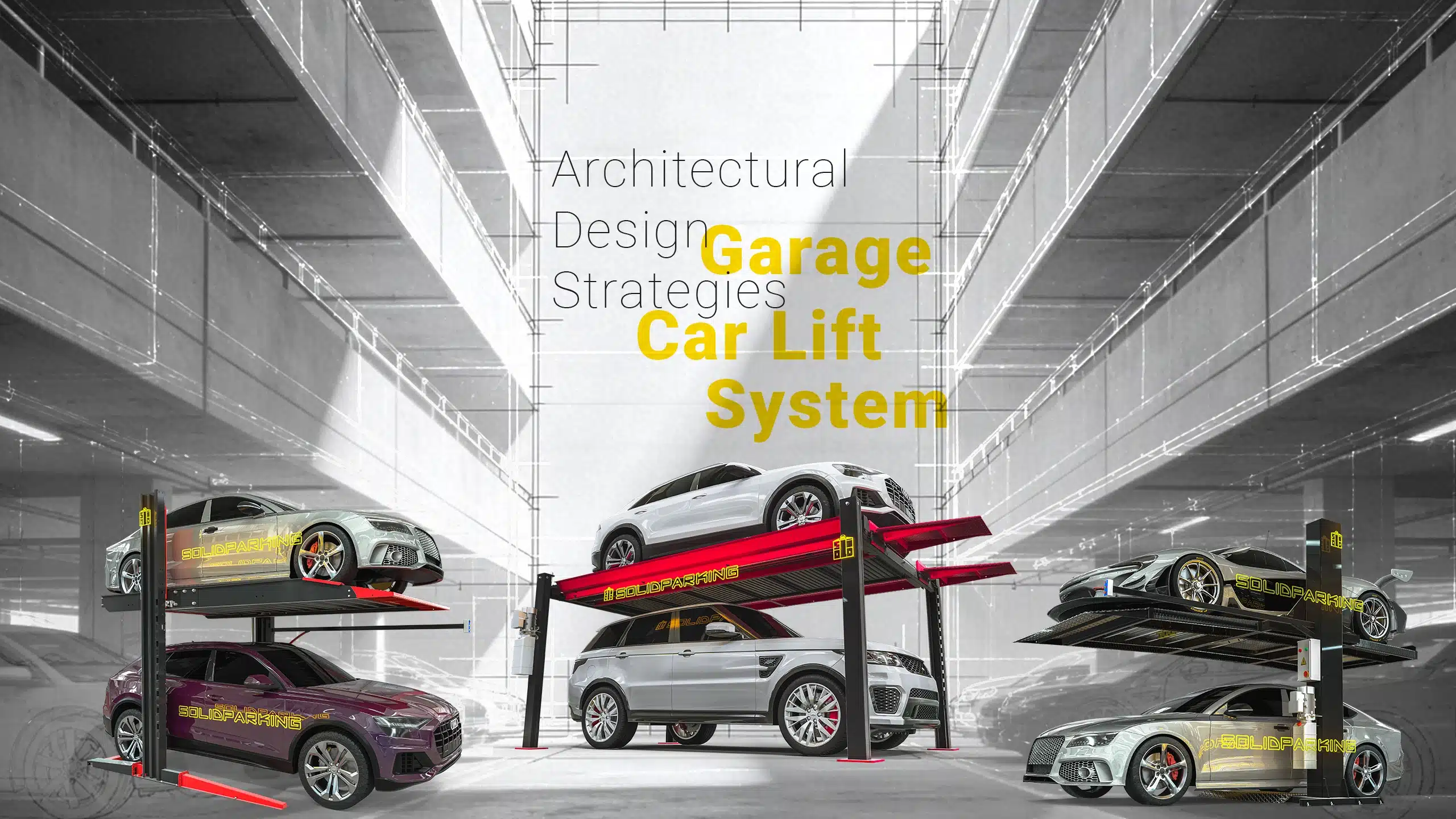
Abstract
Residential and commercial garages are increasingly constrained by land cost, building footprint limitations, and rising vehicle ownership density. Conventional approaches such as small garage storage hacks (wall systems, shelving, and overhead racks) offer marginal improvements in organization but fail to address the core architectural constraint: vehicle volume occupancy.
This whitepaper examines how garage car lift systems provide a structural and spatial solution that enables architects and designers to fundamentally rethink garage capacity. By introducing vertical vehicle displacement, these systems allow for up to 100% increase in parking density while maintaining functional access and operational efficiency.
The focus of this document is not storage optimization, but engineered spatial reconfiguration.
Reference:
The High-Density Masterclass-1: Space-Saving Car Stacker Solutions
Table of Contents
1. Introduction: Why Small Garage Storage Hacks Are Reaching Their Limit
In residential architecture, most garages are still designed using outdated assumptions:
- One vehicle = one fixed floor position
- Storage is treated as perimeter optimization
- Vertical space is considered secondary or decorative
This is why most small garage storage hacks focus on:
- wall-mounted systems
- ceiling racks (Car Lift Dimensions Guide for Auto Lift Installations (2026))
- modular cabinets
- foldable utility zones
While these improve organization, they do not change capacity.
Architectural limitation:
Storage systems optimize edges, not core spatial occupancy.
As a result, garages remain structurally underutilized, even when visually organized.
This creates a critical gap between:
- perceived efficiency
- and actual spatial performance
2. Reframing the Problem: How to Double Garage Parking Space
The question of how to double garage parking space is not a storage problem—it is a volumetric engineering problem.
Traditional garage layouts operate on a single-plane logic:
- horizontal vehicle distribution
- fixed floor occupancy
- no vertical displacement of functional load
This leads to inefficiency in spatial utilization, especially in modern residential developments with limited expansion potential.
Key insight:
Parking capacity is not determined by floor area alone, but by how effectively vertical space is engineered.
3. Garage Car Lift Systems as Spatial Infrastructure
A garage car lift system introduces a second functional layer within the same footprint.
Instead of reorganizing storage, it restructures occupancy logic:
Before:
- 1 vehicle = 1 ground-level footprint
After:
- 2 vehicles = 1 vertical stack footprint
This is not simply an improvement in storage efficiency. It is a transformation of spatial hierarchy.
Architectural implication:
Garage space shifts from:
static allocation system
to
dynamic vertical infrastructure system
4. System Types in Garage Car Lift Design
From an architectural integration perspective, garage car lift systems are classified into three functional categories:
4.1 Storage-Oriented Systems (4-Post Configuration)
- Distributed load system across four structural columns
- Minimal slab modification required
- Vehicle rests on full-length platforms
Design role:
- residential storage optimization
- collector vehicle stacking
- seasonal vehicle separation
4.2 Service-Oriented Systems (2-Post Configuration)
- Point-load mechanical lifting system
- Requires reinforced slab anchoring
- Optimized for maintenance access and repair work
Design role:
- mechanical service environments
- workshop integration
- diagnostic access systems
4.3 High-Density Stack Systems
- Multi-level mechanical platforms
- Designed for commercial and semi-automated parking environments
- High spatial efficiency per square meter
Design role:
- urban parking infrastructure
- hospitality and mixed-use developments
- high-density residential projects
📊 System Classification Table
| System Type | Structural Behavior | Installation Complexity | Spatial Efficiency | Primary Application |
|---|---|---|---|---|
| 4-Post Lift | Distributed load | Low | Medium | Residential storage |
| 2-Post Lift | Point load (anchored) | High | Low | Service/maintenance |
| Stacker System | Platform-based | High | Very High | Commercial density |
Car Storage Lift Systems: Solving Architects’ #1 Parking Design Problem
5. Structural and Spatial Constraint Model
Successful integration of garage car lift systems depends on four primary architectural constraints:
5.1 Vertical Envelope Utilization
Rather than focusing on ceiling height alone, designers must evaluate:
- stacked vehicle height combinations
- platform structural thickness
- clearance safety buffer zones
This defines the true usable vertical occupancy envelope, not just physical height.
5.2 Load Distribution Mechanics
Load transfer varies significantly by system type:
- 4-post systems → distributed vertical loading
- 2-post systems → concentrated anchor loading
Improper modeling can result in:
- slab fatigue
- stress concentration failure
- long-term structural degradation
5.3 Access Geometry and Movement Flow
Access geometry defines how vehicles enter, align, and exit lift zones.
Critical factors include:
- turning radius constraints
- door swing interference
- approach alignment angles
- lift column positioning
This is often the most overlooked constraint in residential applications.
5.4 Functional Sequencing Logic
Vehicle usage is not static. A functional garage must account for:
- daily-use vehicles
- stored vehicles
- seasonal rotation cycles
This introduces dependency chains that affect:
- retrieval order
- parking logic
- system usability
Structural and Spatial Constraint Model
(Plan + Section + Workflow Overlay)
PLAN VIEW (Top-Down Layout)
+————————————————–+
| GARAGE PLAN |
| |
| ENTRY |
| ↓ |
| ┌──────────────────────────────────────────┐ |
| | | |
| | Vehicle A (Ground Level) | |
| | | |
| | ┌────────────────────────────┐ | |
| | | Lift Platform Zone | | |
| | | Vehicle B (Above) | | |
| | └────────────────────────────┘ | |
| | | |
| └──────────────────────────────────────────┘ |
| |
| Utility / Storage Strip |
+————————————————–+
SECTION VIEW (Vertical Envelope)
CEILING
│
│ ┌───────────────┐
│ │ Vehicle B │
│ └───────────────┘
│ ────────────────
│ Lift Platform
│ ────────────────
│ ┌───────────────┐
│ │ Vehicle A │
│ └───────────────┘
│
│____________________
FLOOR
Add Load Indicators
↓ ↓
[Load Transfer]
│
Lift Posts
│
Slab Contact Points
WORKFLOW & ACCESS OVERLAY
Movement Paths
ENTRY →
↘
↘ (Turning Radius Arc)
↘
→ Lift Alignment Zone
→ Final Parking Position
Access Triangle (CENTERPIECE)
[ Lift Zone ]
▲
/ \
/ \
/ \
[Entry]—–[Exit Path]
Conflict Zones (Highlight)
⚠ Turning radius overlaps lift column
⚠ Door swing intersects wall clearance
⚠ Exit path crosses storage zone
| Constraint Category | Design Variable | Architectural Impact | Risk if Ignored |
|---|---|---|---|
| Vertical Envelope | Vehicle stacking height | Determines feasibility of lift integration | Incompatible installation |
| Slab Engineering | Thickness & reinforcement | Supports load transfer system | Cracking / structural failure |
| Access Geometry | Turning radius & entry angle | Controls usability and workflow | Vehicle blockage |
| Load Distribution | Point vs distributed loads | Influences system selection | Uneven stress concentration |
| Functional Sequencing | Vehicle usage patterns | Defines layout logic | Operational inefficiency |
6. Spatial Configuration Models
Architectural integration of garage car lift systems can be structured into three primary layout strategies:
6.1 Linear Stack Model
Entry → Ground Vehicle → Lifted Vehicle → Back Wall
Characteristics:
- compact footprint
- simple structural integration
- sequential access system
Limitation:
- high dependency between vehicle access sequences
6.2 Offset Parallel Model
[ Daily Vehicle Zone ] [ Lift Zone ]
Characteristics:
- reduced blockage interaction
- improved access flexibility
- better workflow separation
Requirement:
- increased lateral garage width
6.3 Zoned Functional Architecture
This is the most advanced architectural model.
Garage is divided into functional zones:
- Entry / maneuvering buffer
- Primary parking zone
- Lift integration zone
- Utility and storage strip
Outcome:
- independent spatial behavior layers
- reduced operational conflict
- scalable lift integration
7. The Access Triangle Principle
A critical design rule for integrating garage car lift systems:
All garage layouts must preserve an independent access triangle between entry, lift zone, and exit path.
Failure to maintain this results in:
- blocked vehicle retrieval
- inefficient movement paths
- reduced functional usability despite increased capacity
8. Capacity Optimization: From Storage Hacks to Engineered Systems
While small garage storage hacks improve organization efficiency, they do not alter vehicle density.
In contrast, garage car lift systems enable:
- vertical displacement of vehicle occupancy
- elimination of redundant horizontal expansion
- controlled stacking within fixed structural boundaries
Result:
Up to 100% increase in parking capacity without increasing footprint
However, this increase is conditional on:
- access design
- structural compatibility
- usage behavior modeling
9. Architectural Implications for Modern Design
The integration of garage car lift systems represents a shift in architectural philosophy:
Traditional approach:
- garages as static storage zones
Modern approach:
- garages as dynamic spatial systems
This aligns with broader architectural trends:
- adaptive residential design
- multi-functional spatial planning
- infrastructure-efficient housing models
10. Conclusion
The limitations of small garage storage hacks highlight a broader architectural issue: treating garages as static containers rather than dynamic systems.
By introducing garage car lift systems, architects and designers can:
- activate unused vertical space
- double parking capacity within fixed footprints
- reconfigure garages as functional spatial systems
- improve long-term residential and commercial efficiency
However, success depends not on the lift itself, but on:
- spatial configuration logic
- access geometry design
- structural load planning
- behavioral usage modeling
When properly integrated, garage car lift systems do not simply add capacity—they redefine the architectural function of the garage itself.
Case Study Comparison Table
| Scenario | Garage Type | Configuration | Capacity Gain | Access Complexity | Best Use Case |
|---|---|---|---|---|---|
| 2-Car Urban Garage | Narrow footprint | Linear stack | +100% | High | Daily + storage vehicle |
| 3-Car Suburban Garage | Medium width | Offset hybrid | +50–75% | Medium | Mixed-use households |
| Collector Garage | Large/custom | Zoned system | +100%+ | Low (planned) | Luxury / low-frequency access |