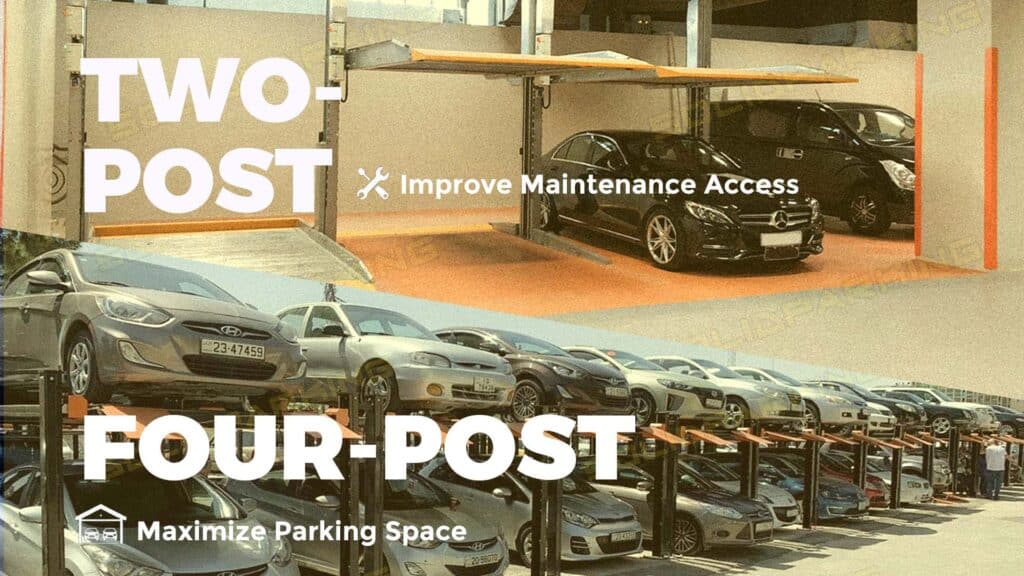
Most homeowners comparing a 2 post vs 4 postlift for residential garage are not actually looking for a technical answer.
They are trying to solve a much simpler problem:
“How do I maximize parking in my garage without making daily use inconvenient?”
This is where modern residential parking lift planning has changed.
Traditionally, the 2 post lift was associated with automotive service work, while the 4 post lift was seen as a storage or maintenance platform. But in today’s parking-first garage design, the logic is different.
For SolidParking systems, the real question is no longer “which lift is better overall,” but:
Which system improves residential parking efficiency?
Which system fits real garage planning constraints?
Which system works better with modern parking lift dimensions and SUVs?
This guide breaks down the real-world comparison between 2 post and 4 post residential parking lifts from a parking optimization perspective—not a workshop perspective.
Choosing a lift for a residential garage is only one part of the decision. Different car stackers and parking systems are designed around different space, vehicle, and access requirements.
Table of Contents
Parking-First Thinking: Why This Comparison Has Changed
The traditional industry view was simple:
2 post = repair / workshop
4 post = storage / alignment / maintenance
But residential demand has shifted.
Today’s homeowners are not building workshops—they are building:
multi-car garages
compact luxury storage spaces
SUV-friendly residential parking systems
space-efficient garage layouts
This changes everything.
In modern garage planning, both systems are evaluated based on:
parking efficiency
usability
space optimization
vehicle compatibility
not just mechanical access.
2 Post vs 4 Post Lift: Core Structural Difference
Understanding structure is key to understanding behavior.
Feature
2 Post Lift
4 Post Lift
Parking Method
Arm lifting system
Drive-on platform
Core Purpose
Parking optimization
Stable parking + maintenance
Garage Interaction
More technical
More intuitive
User Experience
Requires precision
Easy daily use
Parking Efficiency
High
Moderate
Vehicle Access
Full underbody
Limited without accessories
From a parking-first perspective, the difference is not “better or worse”—it is workflow design.
2 post lift vs 4 post lift structural difference parking lift dimensions
Why Most Homeowners Misunderstand Residential Parking Lifts
Most confusion comes from mixing two completely different use cases:
Use Case A: Automotive Service Thinking
lifting vehicles for repair
full wheel access
mechanical work
Use Case B: Residential Parking Thinking
storing vehicles
daily parking
maximizing garage space
Most homeowners do NOT need a workshop.
They need:
a reliable residential parking lift system that makes parking easier and more space-efficient.
2 Post Lift for Residential Parking (Pros & Cons)
Advantages
High Parking Efficiency in Compact Garages
2 post systems are extremely effective for maximizing vertical parking density in tight spaces.
This makes them suitable for:
compact residential garages
low ceiling environments
apartment parking systems
Smaller Footprint
Less structural presence inside garage space improves layout flexibility.
Strong Compatibility with Parking Optimization Systems
SolidParking TP series systems are designed for:
compact parking layouts
shared-post configurations
low-ceiling residential optimization
Disadvantages
Requires More Precise Parking Behavior
Daily use requires accurate alignment.
Not Ideal for Casual Family Use
Residential environments with multiple drivers may find this less intuitive.
Depends Heavily on Garage Planning
Incorrect parking lift dimensions planning can reduce usability.
4 Post Lift for Residential Parking (Pros & Cons)
Advantages
Best for Daily Residential Use
Drive-on design makes it intuitive for all users.
Strong Stability for Vehicle Storage
Vehicles remain supported on tires, ideal for long-term parking.
Better for SUVs and Larger Vehicles
Wider platforms improve comfort and usability.
SolidParking FP series is commonly used for:
residential garages
luxury home parking
multi-vehicle storage systems
Disadvantages
Larger Space Requirement
Requires more garage planning consideration.
Less Efficient for Tight Parking Density
Compared to 2 post systems, vertical efficiency is lower.
Parking Lift Dimensions and SUV Reality
Modern residential garage planning must account for:
SUV height increase
EV battery weight
pickup truck width expansion
Examples:
Tesla Model X
Rivian R1S
Cadillac Escalade
This directly impacts parking lift requirements such as:
ceiling height
platform clearance
turning radius
garage width
Ignoring these factors is one of the most common planning mistakes.
Why it Wins: Designed specifically for private garages and residential communities. These lifts feature a space-saving footprint, with options like the TP-200 utilizing a tilting design for low-clearance areas. Features like shared posts (TP-230H, TP270H) for parallel lifting make it highly efficient for multi-car households or community lots, ensuring family-friendly usability and minimal user error.
Vehicle Storage & Light Maintenance Use
Best Choice: 4-Post Parking Lift (FP Series)
Why it Wins: Built with the stability required for “Car Repairing” and “Auto Repair Shops”. With heavier lifting capacities and models offering independent hydraulic systems (like the FP-630), the 4-post design provides the mechanical flexibility and robust support necessary for demanding garage environments and long-term vehicle storage.
Real Residential Garage Scenarios
Scenario 1: Luxury Home Garage
✔ 4 Post Lift Focus: convenience + storage
Scenario 2: Compact Urban Garage
✔ 2 Post Lift Focus: parking density
Scenario 3: SUV-Focused Household
✔ 4 Post Lift Focus: usability
Scenario 4: Enthusiast Garage
✔ 2 Post Lift Focus: maintenance access
Recommended Residential Parking Lift Selection
Use Case
Recommended System
Daily residential parking
4 Post Lift (FP Series)
Compact garage optimization
2 Post Lift (TP Series)
Low ceiling garage
TP-270H
SUV storage
FP Series
Multi-car family
4 Post Lift
2 post vs 4 post lift for residential garage comparison
FAQs
Is a 2 post lift good for residential parking?
Yes, but it is better suited for parking density and compact garage optimization rather than casual daily use.
Is a 4 post lift easier for daily parking?
Yes. It is generally more intuitive for residential environments.
Which lift is better for SUVs?
Most homeowners prefer 4 post systems due to easier drive-on operation.
Do I need special concrete for a 2 post lift?
Yes. Proper slab thickness and reinforcement are critical.
What is the main difference in residential use?
2 post focuses on parking efficiency, while 4 post focuses on usability and stability.
Conclusion
The choice between a 2 post vs 4 post lift for residential garage is not about which system is universally better.
It is about how the garage is used.
In a modern parking-first residential environment:
2 post lifts optimize space efficiency and parking density
4 post lifts optimize usability and daily convenience
The best residential parking lift is the one that aligns with your garage planning, vehicle dimensions, and long-term usage behavior.
If you’re planning a project, SolidParking provides customized residential parking lift solutions based on real garage layouts, not just equipment specifications.