
2-Post vs. 4-Post Car Lift: U.S. Brand Comparison
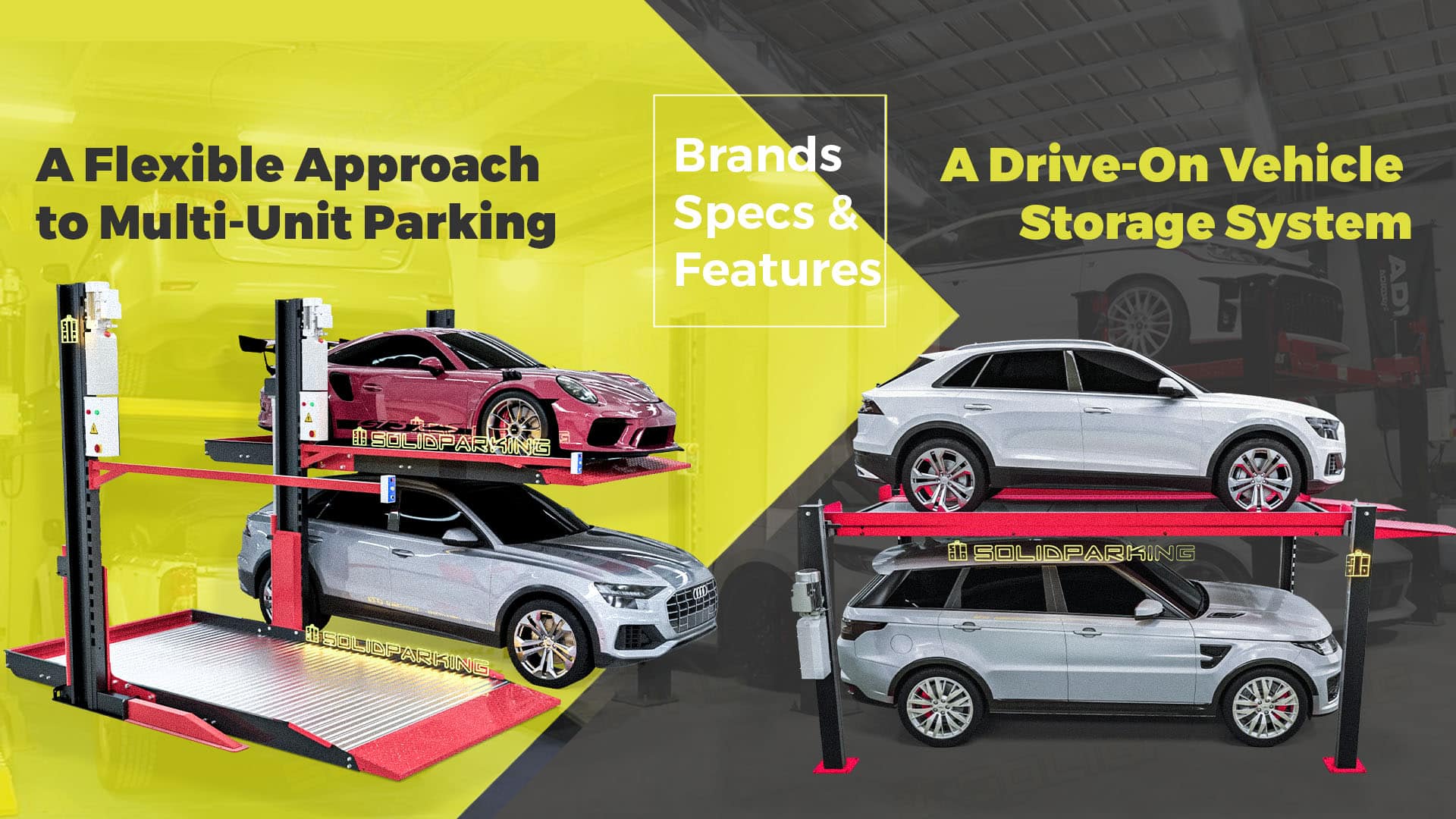
2-Post vs. 4-Post Car Lift: U.S. Brands, Specs and Warranties
For long-term storage in one garage bay, start by comparing four-post runway models. For several adjacent bays, compare two-post models with shared-column options. For a low ceiling, SUV or pickup, verify both vehicles and the clearance beneath the locked platform before choosing either.
A car lift for parking is a way to add vehicle storage without extending the garage horizontally. The right storage car lift depends on the vehicles, available space and retrieval routine – not simply the number of posts. This guide compares five brands for parking and storage only, not automotive repair.
2-Post vs. 4-Post Car Lift at a Glance
| Comparison | 2-post parking lift | 4-post parking lift |
|---|---|---|
| Vehicle support | Raised parking platform supported by two main columns | Drive-on runways supported at four corners |
| Layout feature to compare | Shared-column arrangements on compatible models | Runway dimensions and the footprint of each storage unit |
| Useful starting scenario | Several side-by-side storage bays | One garage bay or a private collection |
| Low ceilings, SUVs and pickups | Check vehicle fit, load limits and locked-position clearance | Make the same checks; more posts do not guarantee more clearance |
| Taking out the upper car | Clear the lower position first on the dependent systems discussed here | The same access limitation applies |
These are screening recommendations, not rules excluding either design from residential or commercial use. They reflect the published configurations of the SolidParking TP series, BendPak HD-9 and ParkPlus DP003. For the access limitation, see KLAUS’s explanation of dependent parking.
Table of Contents
Who Uses a Parking Car Lift?
The models compared here serve two overlapping markets: individual garage storage and planned multi-bay parking. This is a product comparison, not a market-share or sales-volume ranking.
Homeowners and collectors
For an occasionally driven car above a daily driver, focus on the vehicle combination, door operation, drip protection and access. A compact car lift footprint is useful only if there is also room to drive in and open the vehicle doors.
Dealerships and storage operators
For rows of vehicles, compare the net additional parking positions, not the standalone size of one car lift. Shared posts may reduce duplicated structure, but aisles, ramp placement and retrieval space remain part of the layout. These are relevant applications for the TP-series configurations and DP003.
Developers and managed parking facilities
Here, the car lift is part of an operating system. Vehicle turnover, staffing, keys, installation approval and maintenance access matter alongside equipment specifications. Two unrelated drivers who both need immediate departure may find a dependent stacker unsuitable, regardless of whether it has two or four posts.
How to Read Car Lift Specifications
Platform width is not post spacing. Lift height is not garage clearance. Compare the same car lift measurement, configuration and document revision before deciding that one model is larger or more capable.
| Measurement | What it means | What it must not replace |
|---|---|---|
| Usable platform width | The manufacturer’s defined usable deck width | Post-center spacing or total equipment width |
| Post center-to-center width | Distance between column centerlines | Clear opening available to a vehicle |
| Overall width and length | The equipment’s outside envelope, with ramp inclusion specified | Platform length or vehicle wheelbase |
| Runway width | Width of one tire-supporting runway | Width of the entire parking platform |
| Maximum lifting height | The published maximum raised position | Clearance below a platform resting on its locks |
| Locked underside clearance | Available height below the platform at a specified locked position | Required building height |
| Building clear height | Space needed for both vehicles and the complete operating envelope | Post height alone |
How these tables were prepared: this is a comparison of published specifications, not hands-on testing. U.S. units come first; parenthetical metric conversions are approximate. Standard capacities are not replaced by optional maximums. Sources and access notes appear with the relevant tables.
Missing-data key: Confirm with manufacturer means the reviewed source does not establish that exact field. Configuration-dependent means it must be specified for the selected version or project. Neither means zero capacity, zero clearance or no warranty. Unresolved source conflicts are identified rather than silently reconciled.
Two-Post Car Lift Models Compared
A two-post parking lift carries the tires on a platform. The TP-series and PL-series configurations below should not be confused with chassis-engaging repair equipment.
Two-post car lift capacities and suitable scenarios
| Model / official source | Standard rated capacity | Relevant configuration | Scenario to evaluate |
|---|---|---|---|
| SolidParking TP-270H | Approx. 5,952 lb (2,700 kg) | Single cylinder; shared-column option | Adjacent storage bays and garages with defined vehicle requirements |
| SolidParking TP-320 | Approx. 7,055 lb (3,200 kg) | Dual cylinders; shared-column option | Vehicles requiring more capacity than the 6,000 lb examples |
| BendPak PL6000DC | 6,000 lb (2,722 kg) | Shared-column layout | Standard-width storage bays and vehicle collections |
| BendPak PL6000DCX | 6,000 lb (2,722 kg) | Wider platform; shared columns | A wider deck without an increase in rated capacity |
| ParkPlus DP003 | 6,000 lb (2,722 kg) | Shared legs; project configurations | Managed parking and multi-unit installations |
SolidParking’s single- and dual-cylinder arrangements are also compared in its TP-series technical overview. Capacity alone does not establish compatibility with an SUV, pickup or EV.
Car lift width: compare like with like
| Model / dimensional source | Usable platform width | Post center-to-center width | Overall outside width |
|---|---|---|---|
| TP-270H | Confirm with manufacturer* | Confirm with manufacturer | Confirm with manufacturer |
| TP-320 | Confirm with manufacturer* | Confirm with manufacturer | Confirm with manufacturer |
| PL6000DC – manual | 82.5 in (2,096 mm) | 93.75 in (2,381 mm) | 100.25 in (2,546 mm) |
| PL6000DCX – manual | 94.5 in (2,400 mm) | 105.5 in (2,680 mm) | 112 in (2,845 mm) |
| DP003, W01-W04 | Confirm with manufacturer | 95-108 in (2,413-2,743 mm) | Confirm with manufacturer |
SolidParking publishes parking widths of 82.7 in (2,100 mm) for TP-270H and 86.6 in (2,200 mm) for TP-320. Until the measurement boundaries are established in a drawing, those figures are not relabeled as usable platform widths. BendPak centerline figures follow the cited Rev. A6 manual. ParkPlus defines W01-W04 as leg-center to leg-center, not clear deck width.
Car lift length and height: the complete model list
| Model / source | Platform length | Overall equipment length | Maximum lifting height | Locked underside clearance |
|---|---|---|---|---|
| TP-270H | Confirm with manufacturer | Confirm with manufacturer | Confirm with manufacturer* | Confirm with manufacturer |
| TP-320 | Confirm with manufacturer | Confirm with manufacturer | Confirm with manufacturer* | Confirm with manufacturer |
| PL6000DC | 157 in (3,988 mm) | 163.5 in (4,153 mm) | 82.5 in (2,096 mm) | Confirm with manufacturer |
| PL6000DCX | 157 in (3,988 mm) | 163.5 in (4,153 mm) | 82.5 in (2,096 mm) | Confirm with manufacturer |
| DP003 | 162 in (4,115 mm) | 198 in (5,029 mm), including overhang | Configuration-dependent | Configuration-dependent |
The TP listings use the term parking height, with 82.7 in (2,100 mm) shown for the standard configurations. That is retained as the supplier’s terminology, not substituted for maximum rise or locked underside clearance. Required building height is vehicle- and configuration-dependent for every model.
What the features change in practice
SolidParking TP-270H and TP-320: the choice combines vehicle-load requirements with hydraulic configuration and a shared-post layout. The TP-320’s standard rating is approximately 18% above 6,000 lb after conversion, but its platform and load-distribution limits still need to match the vehicle. The TP-320 model overview and TP-series comparison provide the product context; project drawings define the installed footprint.
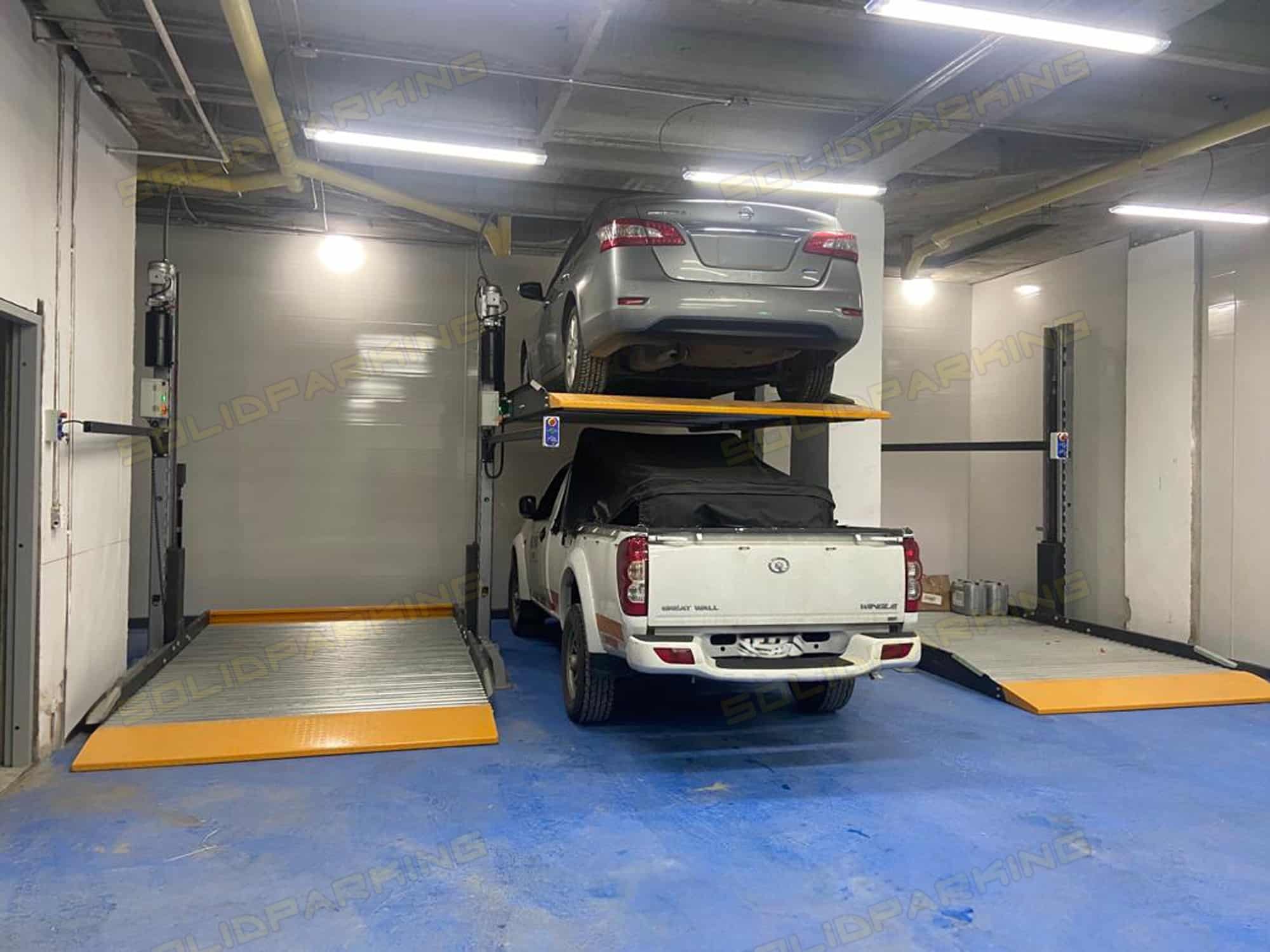
SolidParking TP-230H 2 post car lift for vehicle storage
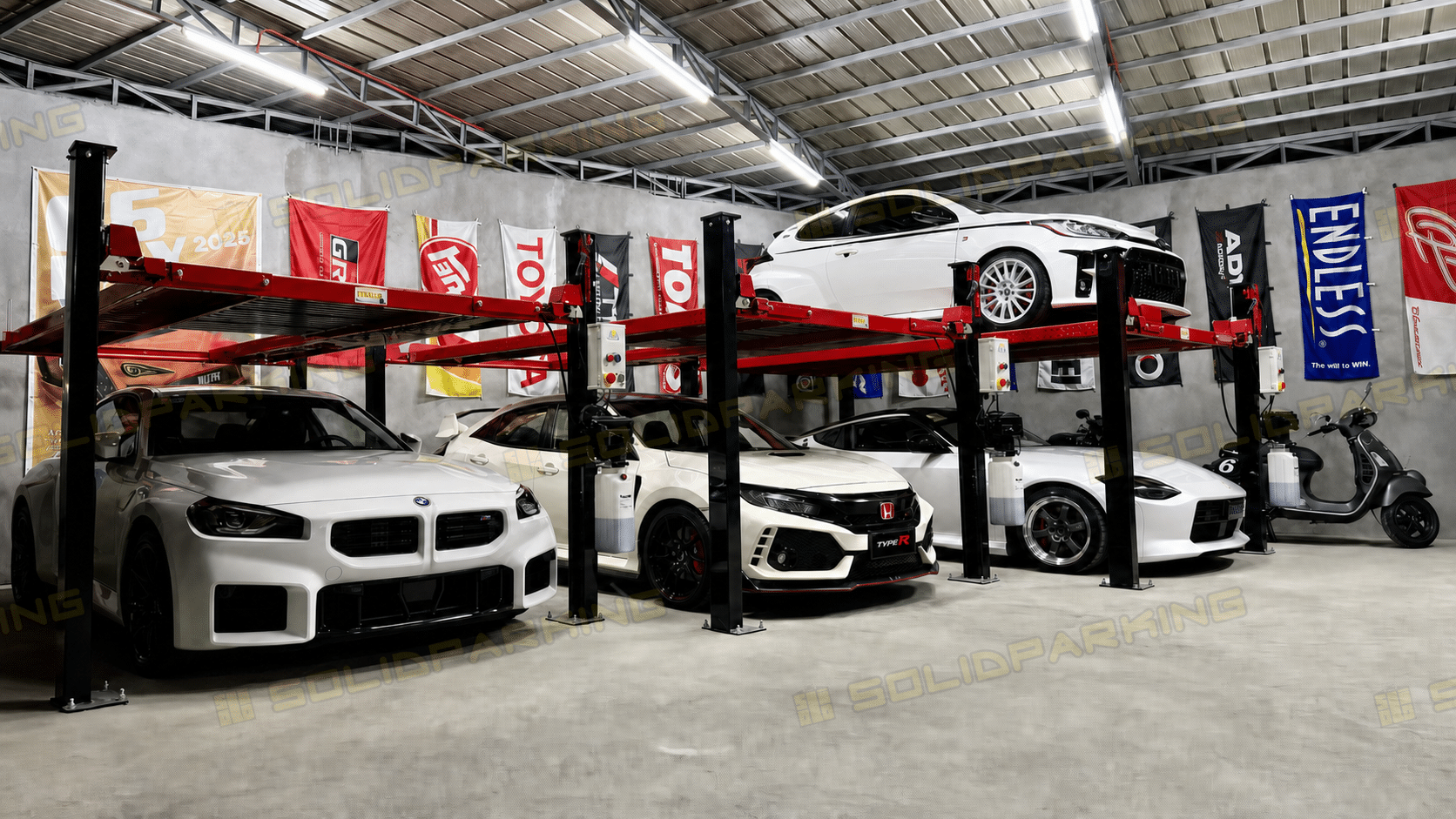
SolidParking FP-360 4 post car lift for vehicle storage
BendPak PL6000DC and DCX: their clearest difference is platform width. A wider deck can solve a positioning problem, but the DCX remains a 6,000 lb model. The listed electrical supply is 208-240V, single-phase, 50/60Hz. Refer to the linked model specifications rather than assuming a wider lift carries more weight.
ParkPlus DP003: its configurable layout and centralized hydraulic options are relevant when several bays form one project. The manufacturer publishes vehicle-combination height examples, which are more informative than one universal garage-height claim. Outdoor use, operating conditions and site service still belong in the selected configuration.
Four-Post Car Lift Models Compared
For a drive-on storage lift, compare runway length, overall footprint, locked clearance and vehicle protection. A higher car lift load rating does not automatically provide a wider deck or taller lower parking space.
Four-post car lift capacity and footprint
| Model / dimensional source | Rated capacity | Runway length | Overall length | Overall width |
|---|---|---|---|---|
| SolidParking FP-360 reference | Approx. 7,937 lb (3,600 kg) | Confirm with manufacturer | 199.0 in (5,054 mm); ramp inclusion to confirm | 105.0 in (2,667 mm) |
| BendPak HD-9 | 9,000 lb (4,082 kg) | 158.25 in (4,020 mm) | 200.5 in (5,093 mm), with ramps | 110.25 in (2,800 mm) |
| BendPak HD-9XW | 9,000 lb (4,082 kg) | 182.25 in (4,629 mm) | 224.5 in (5,702 mm), with ramps | 110.25 in (2,800 mm) |
| Atlas Garage PRO8000 | 8,000 lb (3,629 kg) | 165.75 in (4,210 mm) | 206.75 in (5,251 mm), with ramps | 104.5 in (2,654 mm) without motor; 115 in (2,921 mm) with motor |
| AMGO 408-P | 8,000 lb (3,629 kg) | Confirm with manufacturer | 208 1/16 in (5,285 mm), with ramps | 102.5 in (2,604 mm) |
FP-360 dimensions follow its named installation reference. Other dimensions follow the linked product listings. These are source snapshots, not interchangeable installation drawings. Do not combine dimensions from different revisions to create a configuration the manufacturer has not specified.
Car lift height, underside clearance and garage height
| Model / source | Maximum lifting height | Published underside height | Explicit locked underside clearance |
|---|---|---|---|
| FP-360 reference | 82.7 in (2,100 mm) | Confirm with manufacturer | Confirm with manufacturer |
| HD-9 | 75 in (1,905 mm) | Confirm with manufacturer | Confirm with manufacturer |
| HD-9XW | 87 in (2,210 mm) | Confirm with manufacturer | Confirm with manufacturer |
| PRO8000 | 72 in (1,829 mm), runway top | 67 in (1,702 mm); lock state not specified | Confirm with manufacturer |
| 408-P | 73 11/16 in (1,872 mm) | 69 in (1,753 mm), maximum | 66 1/4 in (1,683 mm), online specification |
Required garage clear height is configuration-dependent for all five models. It must include both vehicles, the platform and the complete operating movement. The AMGO online value above differs from an earlier 408-P manual; confirm which configuration is being supplied.
For example, a hypothetical 70 in-tall lower vehicle cannot fit beneath 66 1/4 in of locked clearance, even though 73 11/16 in maximum lifting height may appear sufficient. This is a measurement example, not an approved installation.
Features and scenarios by model
SolidParking FP-360: a 3,600 kg standard rating, drive-on storage format, hydraulic operation and mechanical locking provide a starting point for single-bay storage. Its technical reference lists a 2.2 kW power rating, but voltage and phase must be established for the ordered U.S. configuration. The rating is close to the 8,000 lb class, not above the HD-9’s 9,000 lb limit.
BendPak HD-9 and HD-9XW: the XW adds runway length and lift height while retaining the same rated capacity. Their published 208-230V, single-phase supply and pneumatic lock-release arrangement also affect utility planning. The HD-series manual specifies reduced permitted loads for shorter wheelbases, so total vehicle weight is not the only capacity check.
Atlas Garage PRO8000: included casters and drip trays make the package relevant to private storage. The listed 110V supply still requires a 30A breaker; it is not a promise that any existing outlet will suffice. Atlas describes the PRO8000 as a hobbyist product, so frequent-cycle commercial operation needs separate confirmation.
AMGO 408-P: manual single-point release, anti-slip runways, optional casters and back-to-back installation are relevant storage features. Its published motor is 110V/60Hz. Local floor conditions and the manufacturer’s movement procedure still apply when mobility options are fitted.
Car Lift Warranty and After-Sales Service
Warranty length, local service and free shipping are different questions. Compare the purchased model’s component schedule, claim process and installation responsibilities.
SolidParking’s FAQ publishes a general 12-24-month product-dependent range; it does not establish the same term for every component of the three models below. ParkPlus lists a 12-month standard DP003 warranty, without a component breakdown in the cited specification. Neither overall statement is placed in the structural-coverage column.
Car lift component coverage by named model
| Model / warranty source | Structure | Hydraulic parts / cylinders | Power unit | Other electrical components |
|---|---|---|---|---|
| TP-270H | Confirm model schedule | Confirm model schedule | Confirm model schedule | Confirm model schedule |
| TP-320 | Confirm model schedule | Confirm model schedule | Confirm model schedule | Confirm model schedule |
| FP-360 | Confirm model schedule | Confirm model schedule | Confirm model schedule | Confirm model schedule |
| PL6000DC – commercial parking schedule* | 2 years | 1 year | 1 year | 1 year |
| PL6000DCX – commercial parking schedule* | 2 years | 1 year | 1 year | 1 year |
| HD-9 – ordinary four-post schedule* | 5 years | 2 years | 2 years | 1 year |
| HD-9XW – ordinary four-post schedule* | 5 years | 2 years | 2 years | 1 year |
| PRO8000 – product listing | 2 years | 1 year hydraulic | Confirm detailed terms | Confirm detailed terms |
| 408-P – AMGO policy | 5 years | 3 years | 2 years | 2 years |
| DP003 – product specification | Confirm component schedule | Confirm component schedule | Confirm component schedule | Confirm component schedule |
BendPak publishes separate categories; the rows identify the schedule being compared, not a substitute for written confirmation of the ordered model’s coverage. The ordinary two-/four-post schedule excludes commercial parking equipment. Missing component detail does not establish an exclusion.
Labor and warranty freight
Rows are grouped only where the applicable models and referenced terms are stated explicitly.
| Applicable model(s) / source | Labor | Warranty-related freight |
|---|---|---|
| TP-270H, TP-320, FP-360 | Confirm model contract | Confirm model contract |
| PL6000DC, PL6000DCX – commercial schedule* | 1 year, subject to terms | 1 year specified ground freight; territorial limits and surcharges apply |
| HD-9, HD-9XW – ordinary four-post schedule* | 1 year, subject to terms | 1 year specified ground freight; territorial limits and surcharges apply |
| PRO8000 | Advertised parts-only coverage; labor not included | Confirm claim terms |
| 408-P | Confirm written labor terms | Eligible warranty parts sent by standard ground at AMGO’s cost; expedited charges are the customer’s responsibility |
| DP003 | Confirm project contract | Confirm project contract |
AMGO’s published policy limits its stated coverage territory to the 48 contiguous states unless separately arranged. That is different from a promise covering installation, downtime or every shipping expense.
Warranty references reviewed November 25, 2026. The check date is not the document revision date. Signed terms, exclusions and claim procedures control.
What car lift after-sales support looks like
| Brand / support source | Published service route | Point to establish locally |
|---|---|---|
| SolidParking | Manuals, remote troubleshooting, direct/distributor parts and local-team guidance | Named installer, warranty-labor responsibility and parts availability |
| BendPak | Installation and service-provider locator | Coverage at the site and the scope of the service quote |
| Atlas | Product package and parts-oriented warranty | Who supplies installation and warranty labor |
| AMGO | Manufacturer troubleshooting and independent-installer referrals | Contractor scope and workmanship responsibility |
| ParkPlus | Mechanical-system maintenance agreements and inspections | Site-specific agreement and emergency-callout terms |
These are service models, not measured response-time rankings. ParkPlus distinguishes mechanical-system agreements from fully automated-system monitoring; do not assume every automated-system feature accompanies a DP003. Remote technical help also should not be confused with guaranteed on-site attendance.
U.S. Installation Requirements and Car Lift Cost
Site information needed to compare car lift proposals
Use the same information for every supplier. This makes differences between proposals visible before equipment is ordered.
| Information | What to record |
|---|---|
| Upper and lower vehicles | Weight, height, length, width, wheelbase, tire placement and modifications for each |
| Clear height | Lowest obstruction, including beams, garage-door tracks, lights, ducts and sprinklers |
| Usable floor area | Bay dimensions, ramps, approach, door-opening room and retrieval route |
| Floor conditions | Available slab records, cracks, joints, known reinforcement and post-tensioning |
| Utilities and environment | Voltage, phase, frequency, circuit requirements, any required air supply, indoor/outdoor exposure |
| Location and operation | City/state, expected use frequency, managed/unattended operation, installer and maintenance arrangements |
The HD-series installation manual illustrates why concrete condition and overhead obstructions require model-specific checks. Do not turn one manufacturer’s slab specification into a rule for every parking lift.
For SolidParking, the TP technical guide and FP-360 assembly reference provide context. They are not substitutes for a dimensioned, configuration-specific approval drawing showing anchors, platform levels, utilities and vehicle envelopes.
Certification and project approval
Where ALI certification is claimed, check the exact model in the ALI certified-lift directory. Certification should not be inferred from another product made by the same brand.
Separately confirm applicable building, electrical, fire and structural requirements with the responsible local authority and project professionals. U.S. sales availability, manufacturing location, certification and approval for a particular site are not interchangeable. This guide does not certify an installation.
Published car lift equipment price examples
These BendPak figures are examples of publicly displayed equipment prices, not a five-brand price ranking.
Checked November 25, 2026. Prices can change; these are not installed quotations or market averages. No unsupported price advantage is assigned to another brand.
For comparable car lift project economics, calculate:
Cost per added usable parking position = complete installed project cost / net additional usable parking positions.
A two-car stacker over one existing space normally adds one parking position. Include delivery, unloading, foundations, utilities, accessories, installation, necessary approvals and the agreed service scope. For a shared-post row, compare the actual base-and-extension configuration rather than multiplying a standalone price.
Car Lift and Car Stacker FAQs
Which car lift is better for a home garage?
A four-post runway model is a useful starting point for single-bay storage, but a two-post layout may fit the site better. Start with the side-by-side comparison, then check the actual vehicle pair.
Can a car stacker hold SUVs, pickups or EVs?
Only when the vehicle meets the model’s weight, wheelbase, tire-position and dimensional limits. A vehicle category is not a compatibility approval; see the model comparisons.
How much ceiling height does a parking lift need?
There is no universal figure. The lower car needs locked-position clearance, while the upper car must clear obstructions throughout the operating movement. See the height definitions.
Can two-post parking lifts share columns?
Compatible TP-series, PL-series and DP003 arrangements offer shared supports. The final row must follow the manufacturer’s approved structural layout; two independent units cannot simply be combined without that design.
Can the upper vehicle leave without moving the lower one?
Not on the dependent stacker configurations covered here. Independent retrieval is a separate system requirement, not a benefit that follows automatically from choosing two or four posts.
What does each parking lift warranty cover?
Coverage differs for structure, hydraulics, electrical parts, labor and shipping. The warranty tables identify the available detail and the terms still needing model-specific confirmation.
Can a parking lift be installed outdoors?
Only when the selected configuration permits it. DP003 offers outdoor configurations; the cited HD-series manual restricts those lifts to indoor use. Paint or galvanizing alone does not establish suitability.
What maintenance does a storage lift need?
Follow the supplied model manual for locks, hydraulics, cables or chains where fitted, controls, lubrication and inspections. There is no single schedule for all equipment; service arrangements should identify who performs the work and keeps records.
What should I ask a U.S. parking lift supplier before ordering?
Ask for the dimensioned drawing of the exact model and configuration, rated load and vehicle-fit limits, locked-position clearance, foundation and electrical requirements, applicable approval documentation, and a written installation and after-sales scope.
Confirm who handles on-site labor, parts shipment and warranty claims. Prepare both vehicles’ specifications, the lowest site clearance and the installation location so each supplier can evaluate the same project.
Choosing a Car Lift: The Practical Next Step
Compare the vehicle fit, usable parking layout, installed cost and service responsibility as one package. That is more informative than choosing the highest load rating or the lowest equipment price.
For a SolidParking layout assessment, submit both vehicle specifications, bay dimensions, the lowest clear height and the installation location through the project contact page. Those details provide a useful basis for comparing the proposed configuration with the other models in this guide.