
Mechanical vs Automated Parking Systems: 7 Key Benefits & Differences
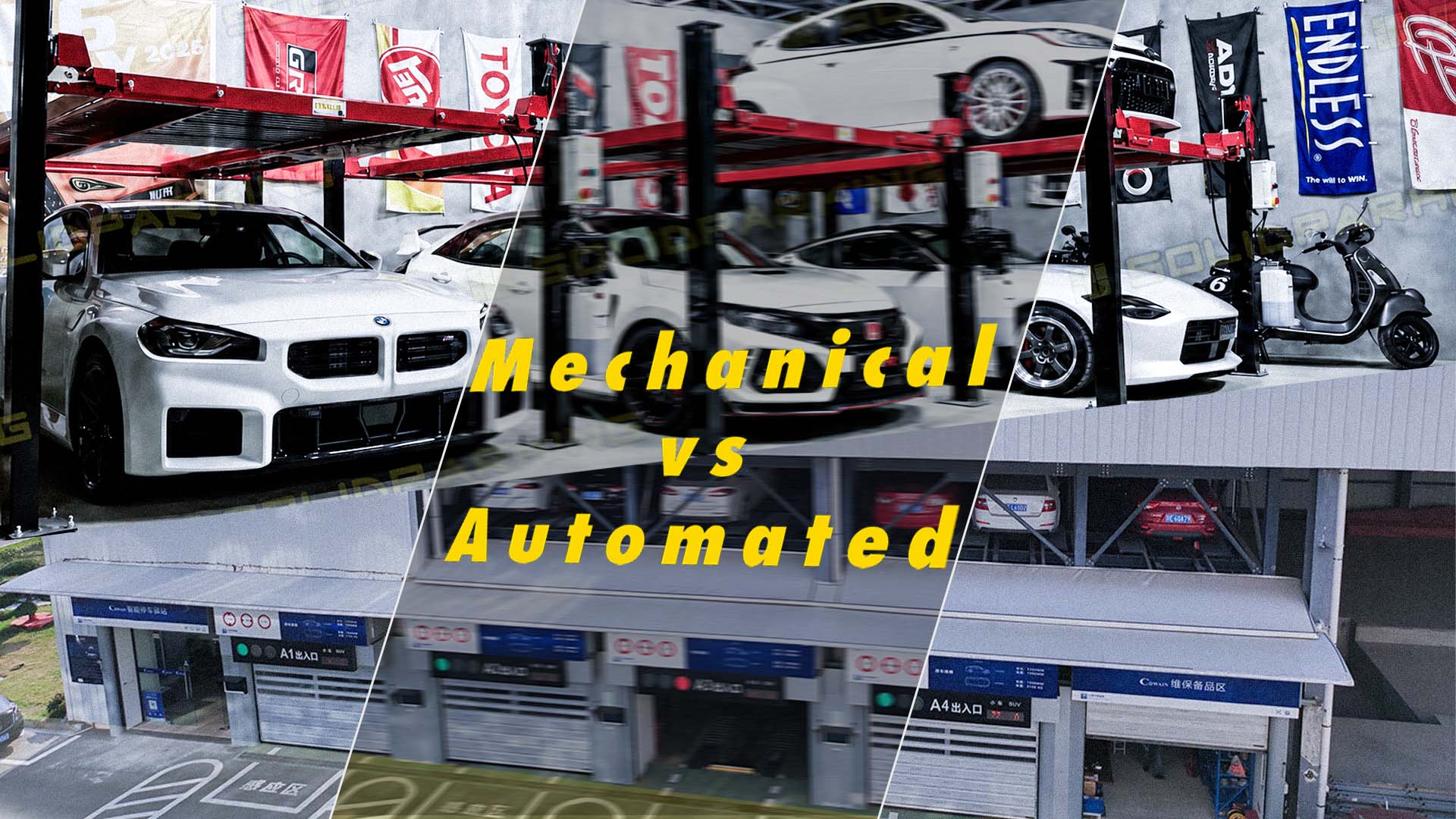
Mechanical vs automated parking systems are often treated as two completely different types of parking technology. In practice, the relationship is more nuanced. Many automated parking systems are also mechanical systems. The main difference is how much of the parking and vehicle retrieval process is handled by equipment rather than by the driver.
For developers, architects, contractors, and parking consultants, understanding this difference is important. A simple mechanical parking lift may be enough for a residential project that needs a few additional parking spaces, while a high-density urban development may benefit from an automated parking system that reduces conventional circulation and makes better use of a limited footprint.
The right solution depends on the project, not simply on the level of technology.
What Is a Mechanical Parking System?
A mechanical parking system uses equipment to move vehicles vertically, horizontally, or in both directions so that more vehicles can be stored within a limited space.
The term can cover a wide range of equipment, from relatively simple two-post and four-post parking lifts to multi-level stackers and semi-automated parking systems.
Mechanical parking does not necessarily mean fully automated parking.
With a conventional mechanical parking lift, the driver may still need to drive onto the platform and position the vehicle. The equipment then performs the lifting, lowering, or stacking function.
This makes mechanical parking useful for projects where the main goal is to increase parking capacity without introducing a fully automated operating model.
SolidParking’s mechanical parking range includes two-post and four-post systems for applications such as vehicle storage, residential parking, commercial parking, and larger vehicle storage projects. Explore SolidParking mechanical parking systems
What Is an Automated Parking System?
An automated parking system combines mechanical equipment with controls, sensors, and software to move and retrieve vehicles with limited or no driver involvement inside the parking area.
Instead of driving through the garage to find a parking space, the driver typically brings the vehicle to a designated entrance or transfer area. The system then moves the vehicle to an available parking position.
A simplified process is:
Drive to the entry → Leave the vehicle → The system stores it → The system retrieves it → Collect the vehicle
Depending on the design, an automated parking garage may use vertical lifts, horizontal shuttles, pallets, carriers, towers, or other automated movement technologies.
SolidParking’s automated parking systems include different configurations such as shuttle, tower, chess, rotary, and AGV-based systems. Explore SolidParking automated parking systems
Mechanical vs Automated Parking Systems: What Is the Real Difference?
The easiest way to understand mechanical vs automated parking systems is to look at driver involvement.
A mechanical parking system may assist with vehicle movement while the driver remains responsible for entering the parking position.
A semi-automated parking system performs more of the positioning and movement process, but some driver interaction remains.
A fully automated parking system is designed to handle storage and retrieval with minimal driver involvement.
This means that automation is better understood as a level of operation rather than a completely separate category of equipment.
In simple terms:
Mechanical parking uses equipment to increase parking capacity.
Automated parking uses equipment and control systems to automate more of the parking process.
That distinction becomes important when selecting equipment for a specific project.
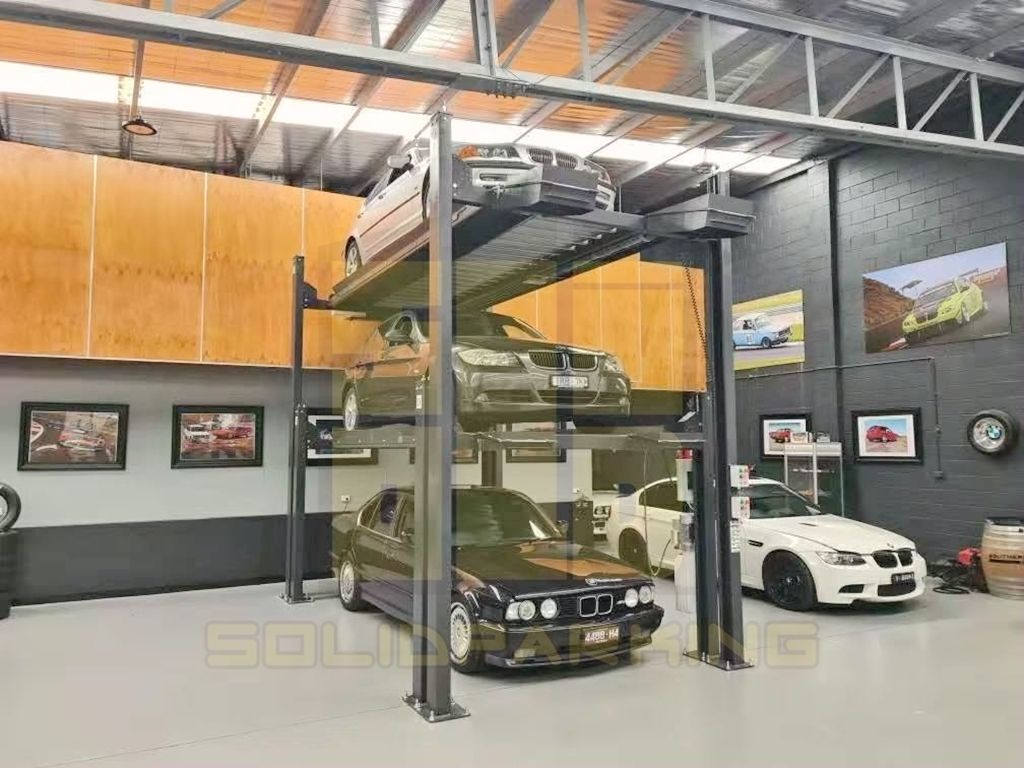
Mechanical parking system for vehicle storage
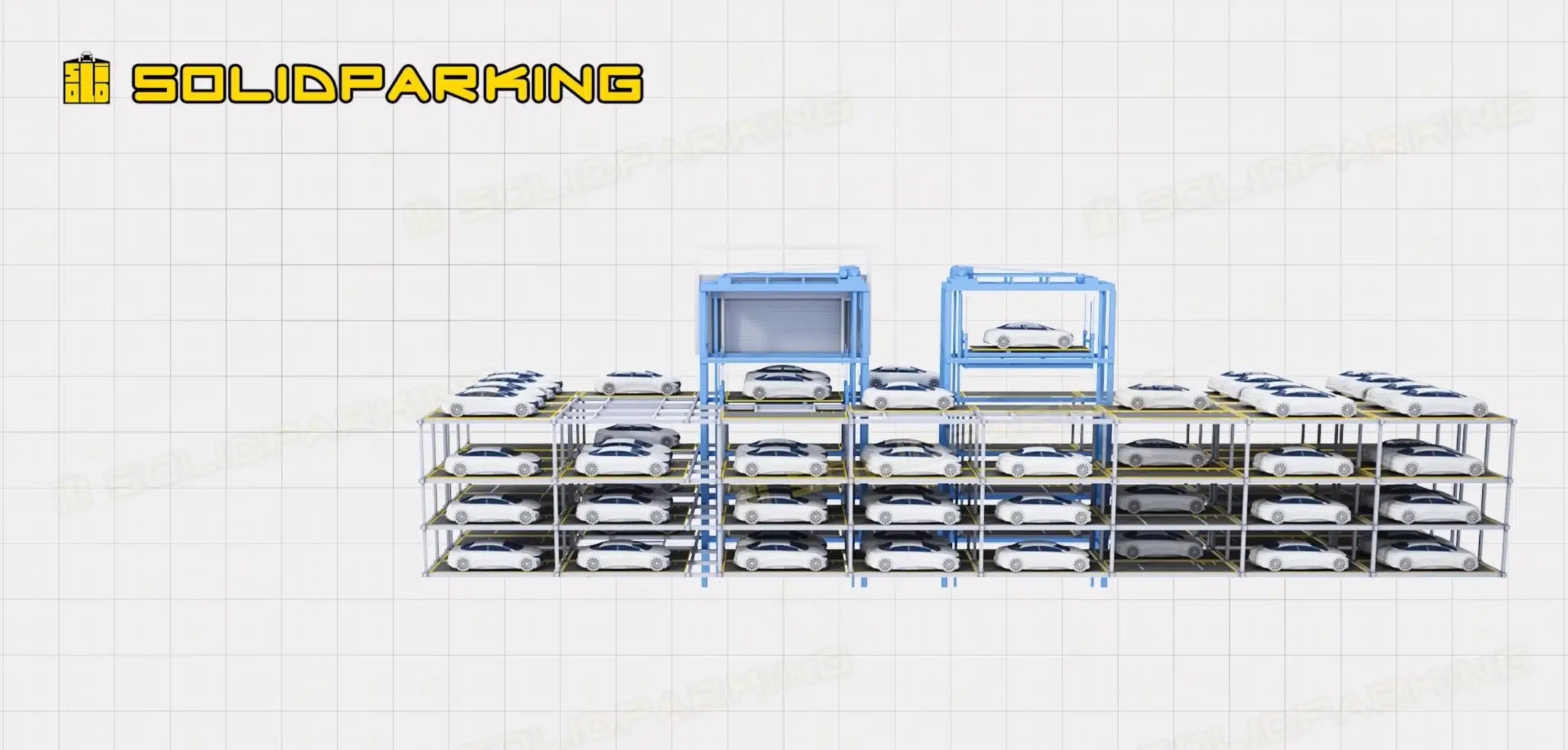
Automated parking system for high-density parking-SSP
Mechanical vs. Semi-Automated vs. Fully Automated Parking
Mechanical parking, semi-automated parking, and fully automated parking can be viewed as different points on an automation spectrum.
Mechanical parking usually involves the highest level of direct driver interaction. A two-post or four-post lift is a common example.
Semi-automated parking reduces some of that interaction through additional horizontal or vertical movement. Puzzle and lift-slide systems are typical examples.
Fully automated parking goes further by moving vehicles between designated transfer areas and storage positions with centralized control.
The terminology is not completely standardized across the industry, so the actual operating process matters more than the label.
7 Key Factors to Compare
1. Driver Involvement
This is one of the clearest differences between a mechanical parking system and an automated parking system.
With a mechanical parking lift, the driver generally drives directly onto the platform.
With a fully automated system, the driver typically leaves the vehicle at a dedicated transfer point. The system then handles the storage and retrieval process.
For projects where a simple user interaction is sufficient, mechanical parking may be adequate. For facilities designed around centralized storage and retrieval, higher automation may be more appropriate.
2. Parking Density
Mechanical parking can increase capacity by using vertical space more efficiently than conventional parking.
Automated parking can potentially increase density further because the system can reduce the amount of space needed for conventional drive aisles and internal vehicle circulation.
This does not mean that automated parking is automatically the better choice. The actual result depends on the building footprint, structural layout, required parking capacity, vehicle dimensions, and operating model.
This is also why parking space optimization should be evaluated together with the equipment strategy rather than as two completely separate design decisions.
For a broader discussion of circulation, structural grid, ramps, and usable parking capacity, see our guide to parking garage layout.
3. Internal Vehicle Circulation
Traditional parking requires enough space for vehicles to enter, turn, and move between parking bays.
Mechanical parking can reduce the amount of space required for some storage applications, but drivers may still need to travel within the facility.
An automated parking system can reduce internal vehicle movement because the equipment takes over after the vehicle reaches the transfer area.
This becomes especially relevant when a project has a constrained footprint or when ramps and drive aisles consume a significant portion of the available floor area.
4. Equipment and Control Complexity
A mechanical parking lift may have a relatively straightforward operating sequence.
As automation increases, the system can involve more sensors, controls, vehicle-positioning logic, communication, monitoring, and centralized management.
This additional complexity does not automatically make an automated parking system unsuitable. It simply means that engineering, commissioning, operation, maintenance, and service requirements should be considered during the design stage.
For this reason, automated parking should be treated as part of the overall parking infrastructure rather than added after the building layout has already been finalized.
5. Project Scale
The size and purpose of the project also matter.
A small residential or commercial project may only need a mechanical parking lift to add one or two additional vehicles to a parking bay.
A larger facility with hundreds of parking positions may have different requirements. Centralized storage, retrieval, circulation, and parking density may make a more automated solution worth evaluating.
This is one reason there is no single “best” parking system for every project.
6. Site Geometry
Site conditions can be more important than the technology label itself.
Before selecting a mechanical parking system or automated parking system, the project team should evaluate:
- Available footprint
- Ceiling and floor-to-floor height
- Structural grid and column locations
- Vehicle dimensions and weight
- Ramp and access conditions
- Turning space
- Entry and exit locations
- Required parking capacity
A system that works efficiently in a new high-density development may not be suitable for an existing parking garage with low clearance, difficult columns, or irregular access.
7. Operating Model
Parking technology should also match how the vehicles will actually be used.
A residential project with occasional vehicle storage has different requirements from a commercial facility with frequent vehicle turnover.
A dealership may prioritize vehicle storage density.
A high-density urban development may place greater emphasis on reducing ramps and circulation.
A long-term vehicle storage facility may focus more on vertical capacity than on rapid retrieval.
The best parking system is therefore the one that matches the project’s operating requirements as well as its physical constraints.
When Should You Choose Mechanical Parking?
A mechanical parking system may be suitable when the project mainly needs additional vertical storage without requiring a fully automated operation.
Typical applications include residential parking, small commercial projects, vehicle storage, and straightforward stacking applications.
Two-post systems can provide a compact way to stack vehicles in appropriate spaces, while four-post parking lifts can be useful when the project requires stable platform-based vehicle storage.
For example, SolidParking’s TP-series and FP-series systems are designed for different vehicle capacities, dimensions, and site requirements. See SolidParking two-post parking lifts
When the priority is simply to increase the number of vehicles that can be stored vertically, full automation may not be necessary.
When Should You Consider Automated Parking?
An automated parking system becomes more relevant when the project has a stronger need for parking density, centralized vehicle storage, or reduced conventional circulation.
This can include high-density urban developments, larger commercial parking facilities, projects with limited land, and buildings where conventional ramps or drive aisles would take up valuable space.
Automated systems can also create a different user experience. Instead of asking drivers to navigate the entire parking facility, the project can concentrate vehicle interaction around dedicated transfer areas.
However, automation also introduces additional controls, equipment, and engineering considerations. The project should therefore be evaluated as a complete system rather than selecting automation simply because it appears more advanced.
How to Choose a Parking System for Your Project
The right approach is to start with the project constraints and then choose the appropriate technology.
First, determine how many vehicles need to be stored and how much usable space is available.
Next, check the ceiling height, structural conditions, vehicle dimensions, circulation, access points, and any existing building constraints.
Then consider how frequently the vehicles will be accessed and how much driver involvement is acceptable.
Finally, compare the required parking density with the complexity of the system.
A simple decision framework looks like this:
Simple vertical storage → Mechanical parking system
Higher-density platform movement → Semi-automated parking system
Centralized, high-density vehicle storage → Automated parking system
This does not mean every project should move toward higher automation. In many cases, the most practical solution is the one that provides the required capacity while matching the site’s structural and operational conditions.
For architects and developers planning a new project, parking equipment should be considered together with the overall parking garage layout rather than selected after the structural design is complete.
Mechanical vs Automated Parking Systems: A Practical Conclusion
Mechanical vs automated parking systems is not really a choice between “old technology” and “new technology.”
Mechanical parking is a broad category that uses equipment to increase parking capacity. Automated parking adds a higher level of control and automation to the vehicle storage and retrieval process.
A two-post or four-post lift may be appropriate when the project needs straightforward vertical vehicle storage.
A semi-automated system may be useful when the project needs more density while retaining some driver interaction.
A fully automated parking system may be worth considering when the project requires centralized storage, reduced conventional circulation, and a high level of parking density.
The key is to start with the parking problem and the site conditions, then select the appropriate level of automation.
Frequently Asked Questions
Is automated parking mechanical parking?
Often, yes. Automated parking systems normally rely on mechanical equipment to move vehicles. In that sense, automated parking can be considered part of the broader mechanical parking category. The main distinction is the level of automation involved.
What is the difference between mechanical parking and automated parking?
A mechanical parking system uses equipment to move or stack vehicles, while an automated parking system uses additional controls and automation to perform more of the parking and retrieval process with less driver involvement.
Is a parking lift an automated parking system?
Not necessarily. A parking lift can be a mechanical parking system operated directly by the user. More advanced parking systems can automate additional vehicle movement and retrieval.
Is semi-automated parking the same as automated parking?
Not always. Semi-automated parking still involves some user interaction, while a fully automated parking system is designed to handle vehicle storage and retrieval with minimal driver involvement.
Which parking system is suitable for a high-density project?
The answer depends on the project footprint, required capacity, structural conditions, circulation, retrieval requirements, and operating model. High-density projects may evaluate automated parking systems, while some projects can achieve their required capacity with mechanical or semi-automated solutions.
Can mechanical parking work in an existing parking garage?
Potentially, but the existing building must be evaluated first. Ceiling height, slab conditions, structural columns, vehicle dimensions, access routes, and available circulation can all affect equipment selection.
What should developers check before choosing a parking system?
The key factors include available footprint, ceiling height, structural conditions, vehicle size and weight, parking capacity, circulation, access frequency, electrical requirements, local regulations, maintenance access, and the required level of automation.