
4 Car Parking Lift: 7 Powerful Advantages of the 630X vs. FP-630
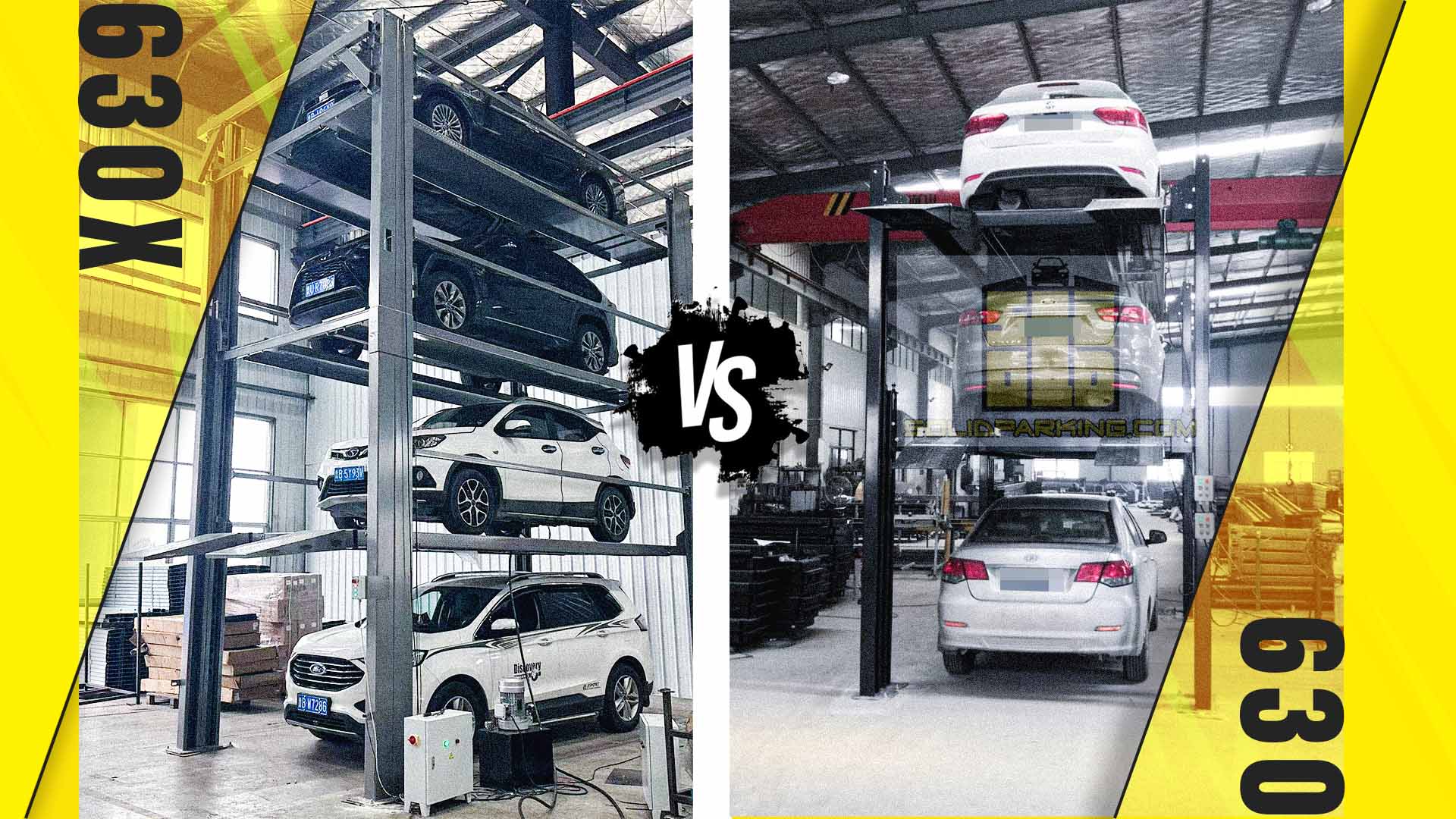
When floor space becomes limited, adding more parking does not always mean building more floor area. A 4 car parking lift can use vertical space to increase vehicle storage capacity within a controlled footprint.
This is particularly relevant for automotive dealerships, vehicle warehouses, private collections, workshops, and property developers looking for a dealership car storage system or a compact vertical car storage system.
But there is an important question before choosing a four-car configuration:
Do you need maximum storage density, or do you need more flexibility and faster vehicle access?
That is where the difference between the SolidParking 630X configuration and the standard FP-630 becomes important.
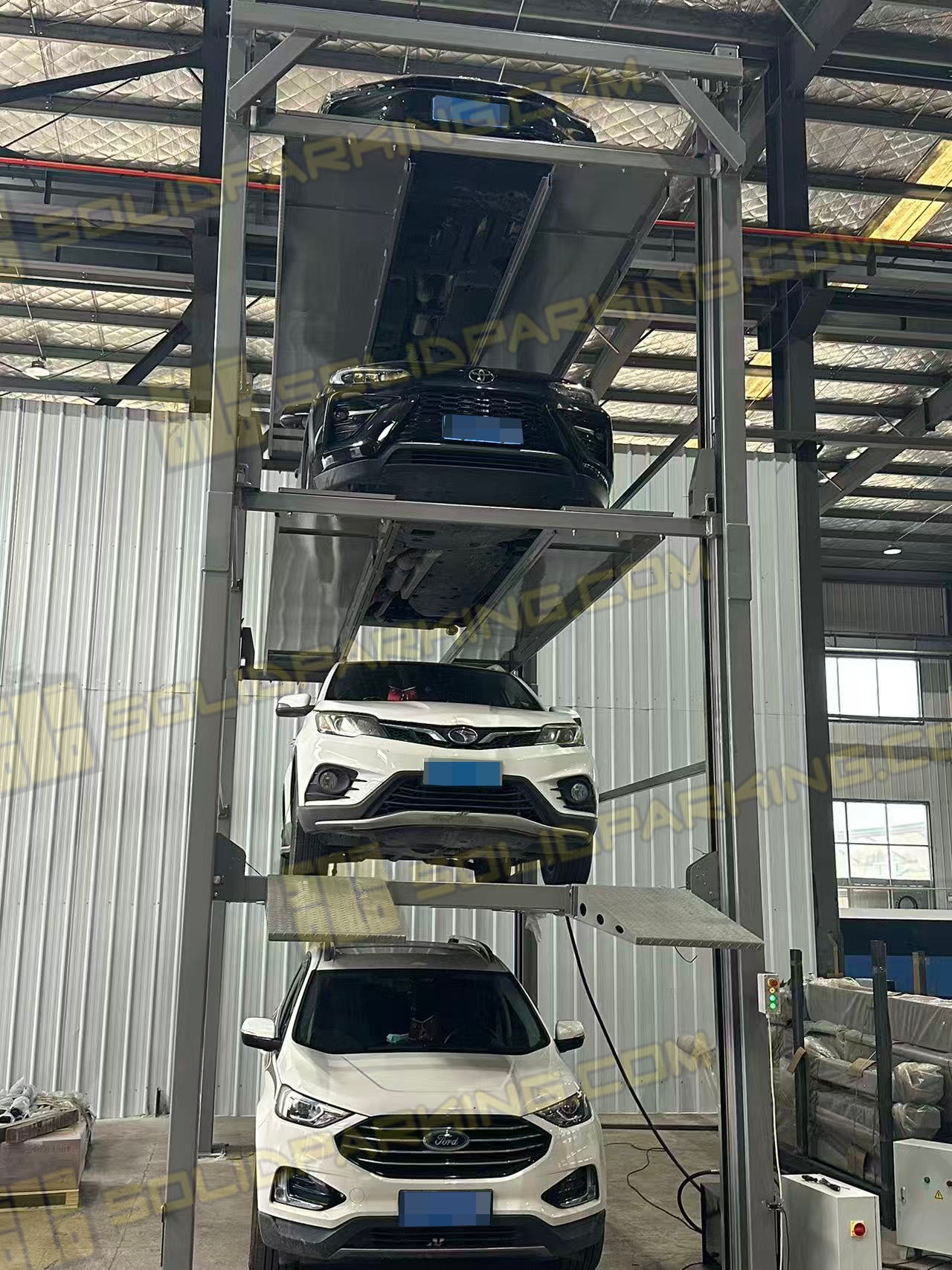
The 630X configuration supplied for this comparison is a three-level, four-car four-post system with 2,500 kg capacity per parking position. The standard FP-630, by comparison, is a triple-stack four-post lift with separate large and small lifts and independent control systems.
What Is a 4 Car Parking Lift?
A 4 car parking lift is a mechanical parking system designed to store four vehicles vertically within a relatively compact ground footprint.
Instead of expanding the parking area horizontally, the system uses multiple parking levels.
The concept becomes particularly useful when the available footprint is fixed but vehicle inventory continues to grow.
For example, a dealership may have limited indoor storage but a large number of vehicles waiting for delivery. A private collector may have several vehicles but only limited garage space. A vehicle warehouse may need additional storage capacity without purchasing additional land.
In these situations, vertical storage changes the calculation.
The question becomes less about:
“How much more floor area do we need?”
and more about:
“How much more vehicle capacity can we create from the space we already have?”
That is the basic value proposition behind a vertical car storage system.
630X vs. FP-630: Technical Comparison
The biggest difference between these two SolidParking configurations is not simply the number in the model name.
It is the design priority.
The 630X configuration prioritizes four-car storage density, while the FP-630 prioritizes flexibility, independent operation, and a wider range of vehicle applications.
| Feature | 630X Four-Car Configuration | FP-630 Standard |
|---|---|---|
| Parking levels | 3 | 3 |
| Vehicles stored | 4 | 3 |
| Parking type | Four-post vertical storage | Four-post combo |
| Lifting capacity | 2,500 kg / position | Up to 3,600 / 2,700 kg, depending on lift section |
| Vehicle length | 5,000 mm | 5,000 mm |
| Vehicle width | 2,000 / 1,850 mm | Up to 2,000 / 1,850 mm |
| Vehicle height | Up to 2,000 | Up to 2,000 |
| Power unit | 1 | Two lift sections / independent controls |
| Cylinder | 1 | Double-sealed hydraulic cylinder |
| Working pressure | 16 MPa | 16 MPa |
| Control voltage | 24 V | 24 V |
| Anti-fall protection | Mechanical + wire-rope safety system | Full-range anti-fall locks |
| Hydraulic overload protection | Included in supplied configuration | Included |
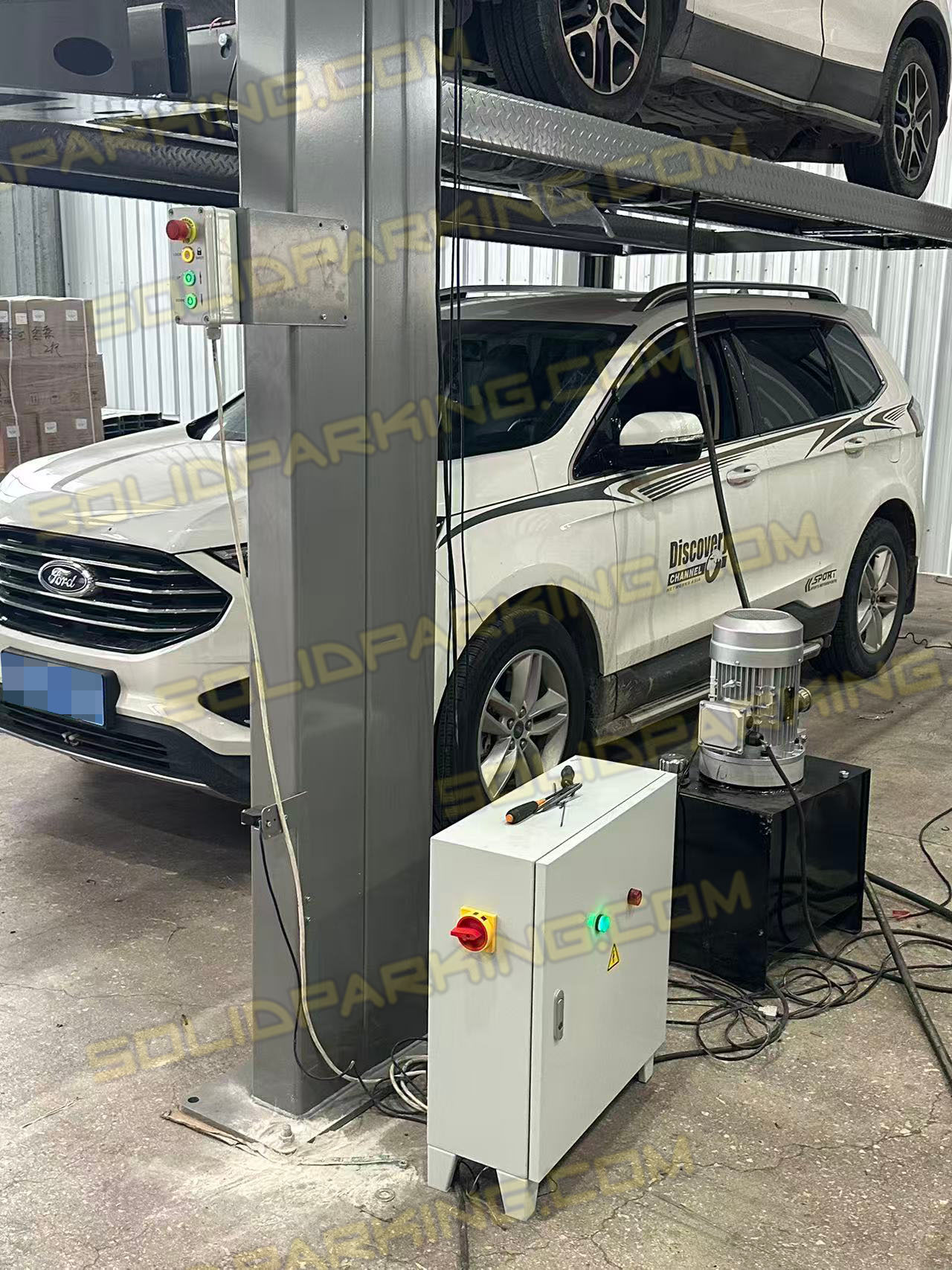
| Operation | Electric lock release + illuminated control buttons | Electric lock release + push-button control |
| Main positioning | High-density storage | Storage + maintenance + flexibility |
FP-630’s current published specifications list a 50-second lifting time, up to 2,300/2,000 mm parking width, up to 2,100/1,800 mm parking height, and up to 3,600/2,700 kg lifting capacity.
The 630X configuration supplied for this article has a larger overall structure and three levels, with four parking positions at 2,500 kg each. Its specified vehicle envelope is 5,000 mm long, 2,000/1,850 mm wide and 1,700 mm high.
One important point stands out immediately:
The 630X does not simply increase every FP-630 specification.
It increases the number of stored vehicles, while accepting a more controlled vehicle envelope and a lower per-position capacity than the highest-rated FP-630 section.
That distinction matters when selecting the right system.
Why the 630X Focuses on Storage Density
The strongest argument for the 630X is simple:
Four vehicles instead of three.
But for a commercial buyer, the more useful concept is not “one extra car.”
It is:
more vehicles stored within a limited footprint.
Imagine a dealership with a growing inventory of new vehicles.
The available warehouse footprint is fixed.
Adding more conventional ground-level parking means:
- more floor area,
- more circulation area,
- potentially more construction,
- or another storage location.
A 4 car parking lift changes the storage equation by using vertical space.
That makes the 630X configuration especially interesting for inventory-driven applications where vehicles may remain stored for relatively long periods.
This is different from a high-turnover parking garage where the main objective is extremely fast retrieval.
The 630X should therefore be positioned as a storage-first solution, not as a universal solution for every parking application.
630X as a Dealership Car Storage System
Among commercial applications, dealerships are one of the clearest potential fits for a dealership car storage system.
A dealership may need to store:
- new vehicles waiting for delivery,
- demonstration vehicles,
- incoming inventory,
- premium vehicles,
- seasonal vehicles,
- vehicles awaiting preparation,
- or overflow inventory.
The problem is that vehicle inventory takes up expensive horizontal space.
A vertical storage configuration gives dealerships another option.
Why a dealership may choose four-car storage
The logic is straightforward.
If a fixed area can accommodate four vehicles vertically rather than four vehicles spread across multiple conventional positions, the dealership can potentially improve land utilization.
The 630X supplied configuration is designed around this principle, with four 2,500 kg parking positions and three levels.
It is particularly interesting for dealerships where:
storage duration is relatively long + vehicle dimensions are predictable + space is expensive.
That last point is important.
A dealership carrying mainly standard passenger vehicles is a better candidate than one whose inventory consists primarily of large pickups and oversized SUVs.
The supplied 630X configuration specifies a maximum vehicle height of 1,700 mm and a vehicle width range of 1,850–2,000 mm, so vehicle dimensions should be checked before project approval.
630X as a Vertical Car Storage System
The second major application is the wider vertical car storage system market.
This includes:
Vehicle warehouses
Automotive warehouses can use vertical stacking to increase inventory capacity without immediately expanding the building.
Car collections
Private collectors may want to store multiple vehicles in a limited garage footprint.
Showrooms
Luxury and specialty vehicle businesses can use vertical storage to preserve valuable display or customer areas.
Vehicle preparation facilities
Vehicles waiting for detailing, inspection, delivery, or transport can occupy vertical storage positions rather than consuming the entire workshop floor.
Long-term storage
When vehicles are not being retrieved every few minutes, storage density becomes more important than extremely fast cycle time.
This is where the 630X makes the most commercial sense.
Where the 630X Is Different From FP-630
The FP-630 solves a somewhat different problem.
SolidParking describes the FP-630 as a triple-stack four-post car lift combining a large and small lift, each with its own control system. One lift can be used for storage while the other can be used for maintenance or repair.
That creates a significant advantage for workshops and mixed-use facilities.
For example:
One vehicle is stored above.
Another vehicle is being serviced.
The two lift sections can be operated independently.
This makes FP-630 particularly attractive when flexibility matters.
The 630X, on the other hand, is better understood as:
more storage capacity per system.
So a useful decision framework is:
Choose 630X when density is the priority.
Choose FP-630 when flexibility and mixed storage/service use are more important.
Is a 4 Car Parking Lift Right for Every Vehicle?
No.
This is one of the most important points in the buying decision.
A four-car configuration should not be selected simply because four vehicles sound better than three.
Vehicle weight and dimensions matter.
The 630X supplied configuration is rated at 2,500 kg per parking position and specifies a maximum vehicle height of 1,700 mm.
That can be suitable for many passenger vehicles, but a project with large SUVs, pickups, or heavier EVs requires a more detailed engineering review.
EV adoption makes this even more relevant.
The IEA reports that global electric car sales exceeded 20 million in 2025, with electric vehicles representing about one-quarter of new car sales worldwide. Its 2026 outlook expects continued growth.
That means parking equipment buyers increasingly need to consider vehicle weight rather than assuming that a conventional passenger-car specification will work for every future vehicle.
A proper project assessment should therefore consider:
vehicle gross weight + length + width + height + ground clearance + required parking frequency.
Safety and Installation Matter More as Storage Density Increases
A high-density vertical car storage system cannot be evaluated only by the number of vehicles it stores.
The supporting structure, safety locks, hydraulic system, controls, floor conditions and vehicle envelope all matter.
The supplied 630X configuration specifies:
- mechanical safety locks,
- a wire-rope anti-break lock,
- hydraulic protection,
- circuit-breaker protection,
- upper and lower-level limit controls,
- photocell detection,
- and a hydraulic cylinder combined with wire-rope balancing.
It also specifies an installation floor with a slope of less than 1%, concrete thickness above 200 mm, and concrete strength above 3,600 psi.
These figures should be treated as the project configuration requirements supplied for this unit, rather than universal requirements for every SolidParking lift.
That distinction is important because foundation requirements can vary by model and project.
SolidParking’s FAQ also notes that parking lift foundation and ceiling requirements vary depending on model and number of parking levels.
4 Post Storage Lift Explained: Why It Is a Preferred Solution for Long-Term Car Storage (2026)
Which Markets Are Most Suitable for the 630X?
The 630X is not equally relevant in every country.
Its strongest markets are those where:
vehicle storage is valuable + land is limited + inventory needs to be stored efficiently.
Australia
Australia is an especially interesting market because the term car stacker is already familiar in the local parking industry.
Residential development, automotive workshops and commercial vehicle storage all create potential demand for high-density vertical parking.
Australia is also paying increasing attention to the fire-safety implications of modern vehicles, EVs and car stackers. Australia’s ABCB has proposed changes specifically addressing carpark fire safety, including sprinkler protection for car stackers located within carparks.
For this market, content should emphasize:
4 car parking lift
car stacker
vehicle storage
space efficiency
project compliance
United States
The US is another strong market, especially for:
- dealerships,
- vehicle storage facilities,
- collector garages,
- luxury vehicle storage,
- workshops,
- and commercial vehicle inventory.
However, the US market has a high proportion of large SUVs and pickup trucks.
That means the 630X should not be marketed as:
“Fits every vehicle.”
Instead:
“High-density four-car storage for projects with controlled vehicle dimensions.”
For larger vehicles, FP-630 or another higher-capacity configuration may be more appropriate.
UAE and Saudi Arabia
The Gulf region is particularly interesting for premium vehicle storage, dealerships, luxury developments and space-efficient commercial facilities.
In these markets, the selling point can shift from:
“save parking space”
toward:
“maximize valuable indoor floor space.”
That makes the 630X relevant not only to conventional parking but also to premium automotive facilities.
Europe
The European market has good potential, especially for high-density urban projects, but technical and regulatory review is critical.
European customers are more likely to evaluate:
- vehicle dimensions,
- structural conditions,
- safety,
- CE requirements,
- fire protection,
- building integration,
- and long-term maintenance.
Therefore, European content should focus less on:
“Four cars!”
and more on:
“How do you design a four-car storage system correctly?”
Who Should Buy the 630X?
The best audience is not simply “people who need parking.”
A much more precise buyer profile is:
Automotive Dealerships
★★★★★
Especially businesses with predictable passenger-car inventory and expensive indoor floor space.
Vehicle Storage Operators
★★★★★
Especially long-term storage where maximum density is more important than rapid retrieval.
Car Collectors
★★★★☆
Particularly collectors who have multiple vehicles but limited garage footprint.
Automotive Warehouses
★★★★★
A strong fit when the main goal is inventory capacity.
Commercial Property Developers
★★★★☆
Potentially attractive where parking capacity must increase without expanding the building footprint.
Repair Shops
★★★☆☆
Possible, but FP-630 may be the better choice when independent maintenance operation is important.
Who Should Choose FP-630 Instead?
The FP-630 may be the better choice when the project prioritizes:
higher vehicle capacity
larger vehicle dimensions
independent lift operation
maintenance and repair
mixed storage and service use
The current FP-630 is explicitly designed with separate large and small lifts and independent control systems, allowing one section to be used for storage while the other supports maintenance or repair.
So the comparison is not:
630X = new / FP-630 = old
It is:
630X = density
versus
FP-630 = flexibility
That is a much more accurate product strategy.
630X vs. FP-630: Which One Should You Choose?
A simple way to make the decision is to start with the project objective.
Choose the 630X when:
You want to store four vehicles in a three-level configuration, your available footprint is limited, vehicle dimensions are controlled, and long-term storage is more important than rapid retrieval. The supplied 630X configuration provides four 2,500 kg parking positions.
Choose FP-630 when:
You need three-car vertical storage with more operational flexibility, especially when the site also needs maintenance or repair functions. FP-630 provides independent large and small lift sections and is rated up to 3,600/2,700 kg depending on the section.
Consider a different system when:
You require:
- fully automated vehicle retrieval,
- much higher parking capacity,
- very high daily throughput,
- oversized vehicles,
- or a project with specific fire and building-code constraints.
Mechanical four-post lifts are not automatically the best answer for every parking project.
The right solution depends on the combination of vehicle dimensions, capacity, retrieval frequency, site constraints and project goals.
Why a 4 Car Parking Lift Is Becoming More Relevant
The broader parking market is moving toward higher space efficiency.
At the same time, vehicle mix is changing.
EVs are increasing globally, while parking facilities are facing new requirements around vehicle size, safety, infrastructure and storage methods.
Australia’s building-code work, for example, specifically identifies increased vehicle size, new energy sources such as EV batteries, and newer vehicle parking/storage methods such as car stackers as reasons for updating carpark fire-safety provisions.
This means future parking equipment decisions cannot be based only on:
“How many cars can it park?”
The better question is:
“How many suitable vehicles can this system safely and efficiently store within the available building?”
That is where the 630X has a clear position.
Conclusion
The 630X configuration represents a different approach to four-post parking.
Its main advantage is not simply that it is another version of the FP-630.
Its purpose is more specific:
maximize vehicle storage density within a controlled footprint.
With three levels, four parking positions and 2,500 kg capacity per position, the supplied 630X configuration is particularly relevant to dealerships, vehicle warehouses, car collections and long-term storage applications.
The standard FP-630 remains a strong option when flexibility, larger vehicle capacity and independent storage/maintenance operation matter more.
So the right question is not:
“Is 630X better than FP-630?”
It is:
“Does this project need more parking density or more operational flexibility?”
For a dealership looking for a dealership car storage system, a warehouse needing a vertical car storage system, or a property owner trying to store more vehicles without expanding the footprint, the 630X deserves serious consideration.
Have a project layout? Send us the floor plan, vehicle dimensions and required parking capacity for a project-specific review.
FAQ
How many cars can a 630X 4 car parking lift store?
The supplied 630X configuration is designed to store four vehicles across three vertical levels, with a rated capacity of 2,500 kg per parking position.
Is the 630X the same as the FP-630?
No. The 630X configuration described here is a four-car, three-level configuration, while the current FP-630 is a three-car four-post combo with separate large and small lifts and independent controls.
What is the maximum vehicle size for the 630X?
The supplied configuration specifies vehicles up to 5,000 mm long, 2,000/1,850 mm wide and 1,700 mm high.
Is a 4 car parking lift suitable for dealerships?
Yes, particularly for dealerships that need high-density indoor inventory storage. The vehicle dimensions, weight, building conditions and retrieval requirements should be checked before selecting the final configuration.
Is the 630X suitable for EVs?
Potentially, but EV weight and dimensions must be checked against the rated capacity and parking envelope of the selected configuration. The rapid growth of EV sales makes vehicle-weight verification increasingly important for parking projects.
What is the advantage of a vertical car storage system?
The main advantage is using vertical space to increase the number of vehicles that can be stored without proportionally increasing the ground footprint.