
Residential 2 Post Car Lift: TP-320 vs TP-270 vs TP-270H vs TP-230H — The Ultimate Shared Post Parking Lift Buyer’s Guide for 2026
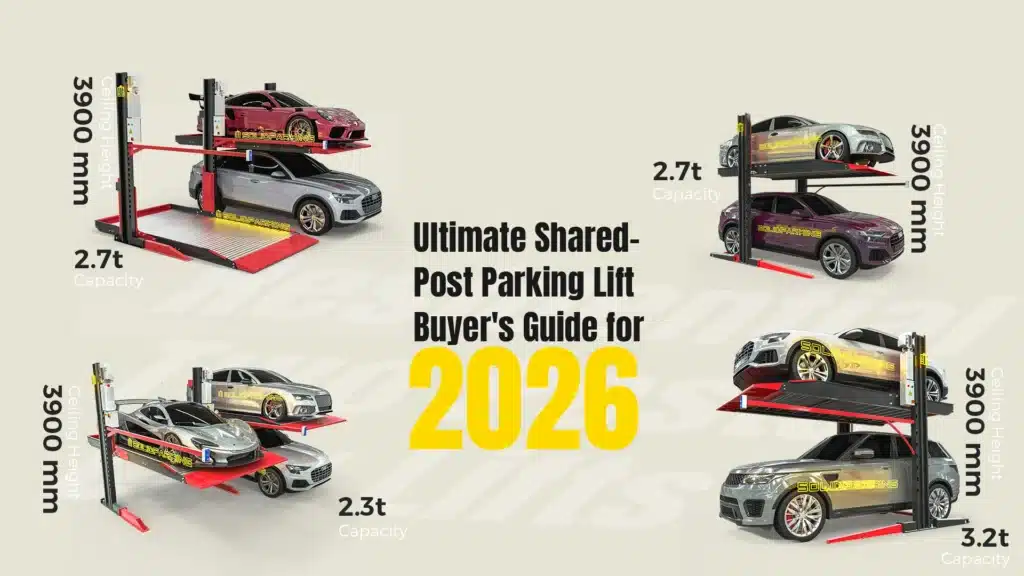
The Only Residential 2 Post Car Lift Guide You'll Need Before Buying
The demand for the Residential 2 Post Car Lift market has never been higher.
As garages become smaller, vehicles become larger, and real estate becomes more expensive, homeowners and developers are increasingly turning to Hydraulic Two Post Parking Lift systems to maximize parking capacity without expanding building footprints.
However, most buyers face the same problem.
They spend weeks researching:
- Which parking lift is best?
- Do I need a 2.3-ton, 2.7-ton, or 3.2-ton system?
- Which lift is best for SUVs and EVs?
- What is a Shared Post Parking Lift?
- Which model provides the best value?
- How do developers maximize parking density?
This guide answers all of those questions.
Whether you’re a homeowner, architect, developer, EV owner, luxury garage designer, or parking consultant, this comparison of SolidParking’s TP Series will help you choose the right solution without wasting time or money.
Why Residential 2 Post Car Lifts Are Growing Worldwide
Modern parking challenges are changing.
Vehicles are becoming:
- Larger
- Heavier
- Wider
- More expensive
At the same time, urban land costs continue to increase.
Building larger garages is rarely the most economical solution.
Instead, homeowners and developers are increasingly investing in a Residential 2 Post Car Lift to unlock unused vertical space.
Today’s Hydraulic Two Post Parking Lift systems allow property owners to:
- Double parking capacity
- Increase vehicle storage
- Improve property value
- Future-proof garages for larger SUVs and EVs
- Reduce land and construction costs
As electric vehicles continue to gain market share, parking infrastructure is becoming a long-term investment rather than a simple storage solution.
Residential 2 Post Car Lift vs Automotive Service Lift
One of the most common mistakes buyers make is confusing parking lifts with service lifts.
Although both are often called “2-post lifts,” they serve very different purposes.
| Residential 2 Post Car Lift | Automotive Service Lift |
|---|---|
| Designed for vehicle storage | Designed for vehicle repair |
| Maximizes parking capacity | Maximizes technician access |
| Long-term vehicle parking | Maintenance operations |
| Shared-post compatible | Independent structure |
| Real estate optimization | Workshop productivity |
If your goal is vehicle storage, parking efficiency, or garage expansion, you need a Shared Post Parking Lift, not a workshop lift.
What Is a Shared Post Parking Lift?
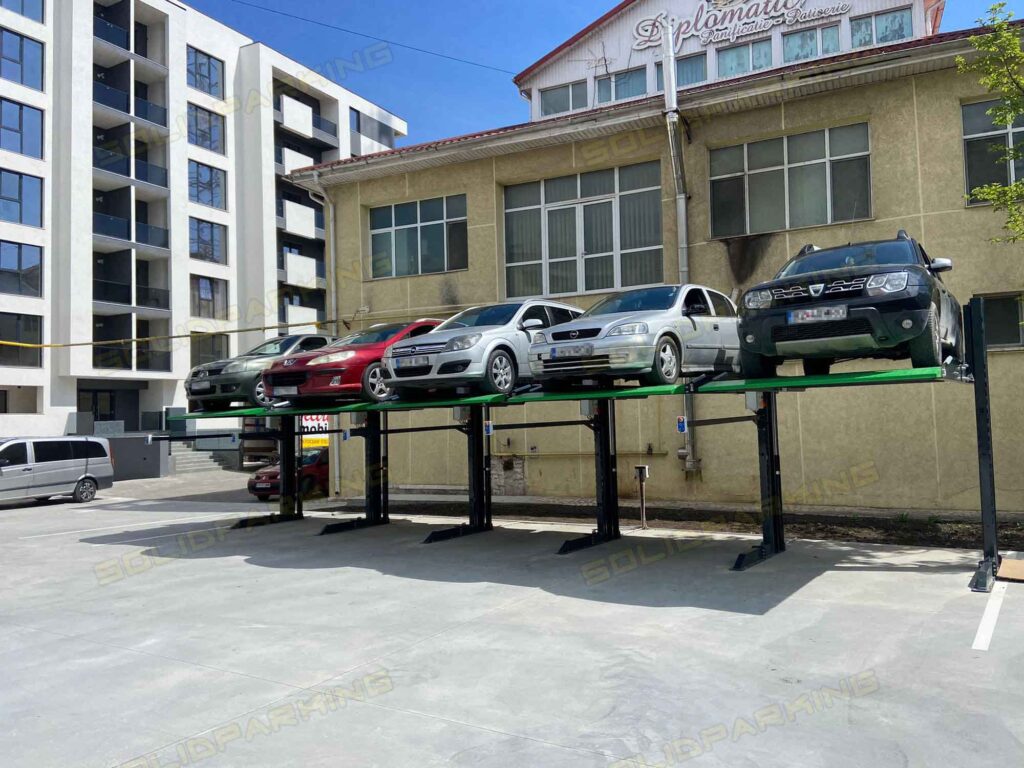
A Shared Post Parking Lift is a parking system where adjacent lifts share structural columns rather than requiring a dedicated set of columns for every parking space.
Traditional parking lift layouts look like this:
- Lift A = 2 columns
- Lift B = 2 columns
- Lift C = 2 columns
Total = 6 columns
Shared-post layouts allow multiple parking modules to share common structural supports.
The result is a more efficient parking grid that reduces structural redundancy while increasing parking density.
Every model in SolidParking’s TP Series supports Shared Post Parking Lift configuration.
This means buyers can choose the best lift for their vehicles without sacrificing layout efficiency.
Why Shared Post Parking Lift Systems Matter
Most buyers focus on lifting capacity.
Developers focus on parking yield.
Architects focus on layout efficiency.
The real value of a Shared Post Parking Lift is that it maximizes the value of every square foot of parking space.
Benefit #1: Higher Parking Density
Parking ratio directly affects project profitability.
A fixed garage width can only accommodate a limited number of conventional parking structures.
Shared-post engineering helps maximize the number of parking spaces within the same footprint.
Benefits include:
- Higher parking yield
- Better parking-to-unit ratios
- Increased development value
- Improved project feasibility
For developers, more parking often translates directly into higher property value.
Benefit #2: Fewer Columns Does NOT Mean Less Stability
One of the biggest misconceptions about a Shared Post Parking Lift is that fewer columns create a weaker structure.
This is incorrect.
Shared-post systems distribute loads through a connected structural framework.
Benefits include:
- Better load distribution
- Reduced structural redundancy
- Lower fatigue concentration
- Improved long-term stability
The objective is not to remove support.
The objective is to eliminate unnecessary support.
Benefit #3: Reduced Foundation Requirements
Every parking column requires:
- Anchoring
- Drilling
- Foundation preparation
- Installation labor
Fewer columns mean fewer foundation points.
Benefits include:
- Faster installation
- Lower labor costs
- Reduced concrete work
- Lower anchor requirements
For large projects, these savings become substantial.
Benefit #4: Lower Structural Steel Consumption
Traditional systems repeat the same structural components over and over.
Shared-post layouts eliminate much of this repetition.
Benefits include:
- Reduced steel usage
- Lower transportation costs
- Lower material costs
- More competitive project budgets
Benefit #5: Cleaner Architectural Design
Architects increasingly prefer Shared Post Parking Lift systems because fewer columns create cleaner spaces.
Benefits include:
- Better sightlines
- Improved lighting
- Easier circulation
- Premium showroom-like appearance
This is especially important for:
- Luxury condominiums
- Apartment developments
- Luxury garages
- Premium vehicle storage projects
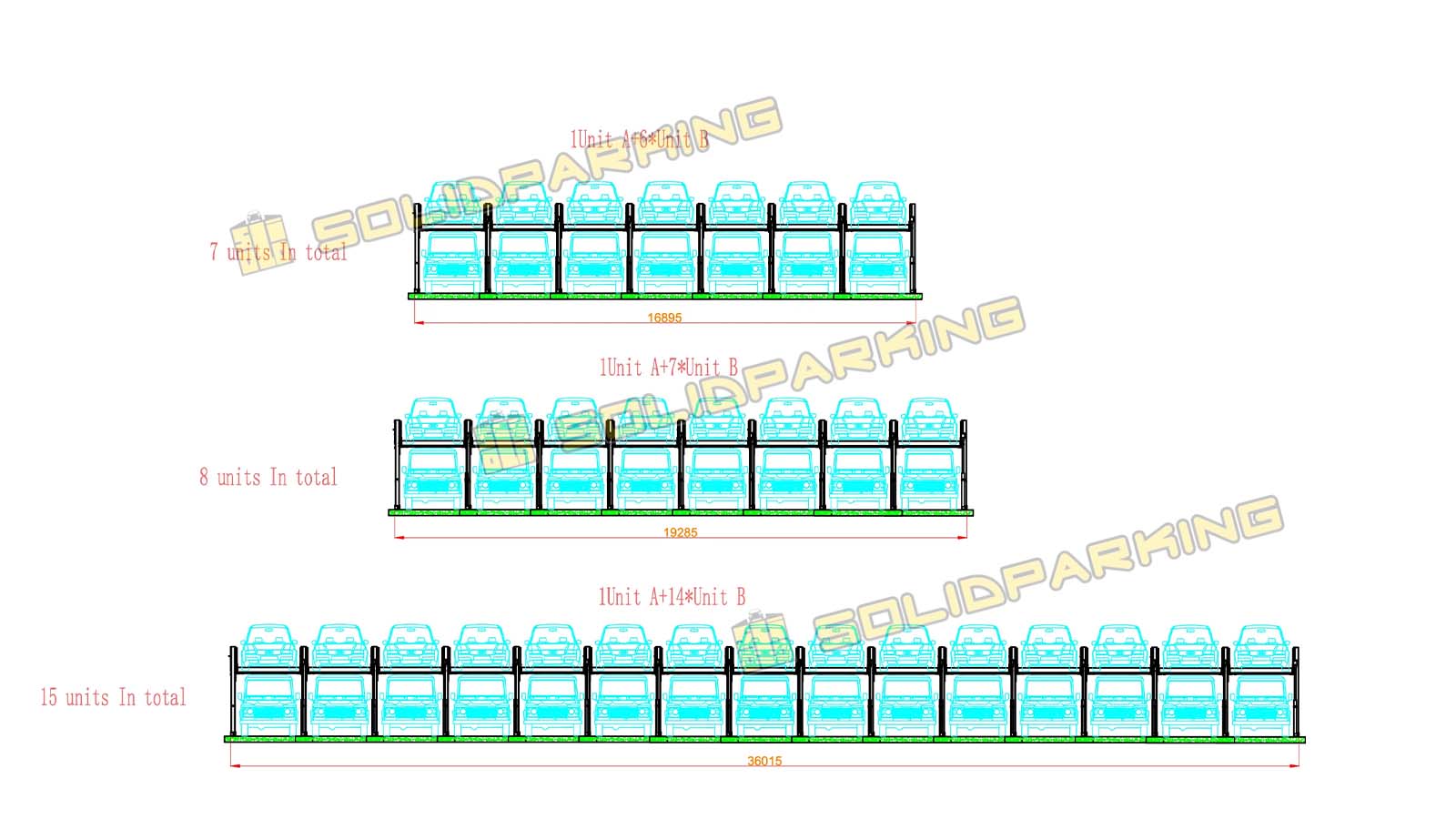
Real Shared-Post Layout Example
A real shared-post layout demonstrates how efficiently the system scales.
| Configuration | Parking Spaces | Overall Length |
| 1 Unit A + 6 Unit B | 7 Spaces | 16,895 mm |
| 1 Unit A + 7 Unit B | 8 Spaces | 19,285 mm |
| 1 Unit A + 14 Unit B | 15 Spaces | 36,015 mm |
Instead of treating every parking space as an independent structure, the system expands through a shared structural network.
As additional spaces are added, parking density increases without introducing unnecessary structural repetition.
This is one reason why developers increasingly specify Shared Post Parking Lift systems in apartment projects, mixed-use developments, and commercial parking facilities.
The Four Questions Every Buyer Should Answer
Before comparing specifications, answer these four questions.
What Is Your Heaviest Vehicle?
Vehicle weight immediately narrows your options.
Heavy SUVs and EVs often require larger lifting capacities.
What Vehicle Will You Own Five Years From Now?
Many buyers purchase a lift for today’s vehicle rather than tomorrow’s vehicle.
Future-proofing matters.
What Is Your Ceiling Height?
This is often the most important measurement.
A low-clearance garage can eliminate certain lift options immediately.
Do You Need Maximum Parking Density?
If parking yield is important, Shared Post Parking Lift systems provide significant long-term advantages.
TP-320 vs TP-270 vs TP-270H vs TP-230H
Technical Comparison Table
| Specification | TP-320 | TP-270 | TP-270H | TP-230H |
| Capacity | 3,200 kg | 2,700 kg | 2,700 kg | 2,300 kg |
| Drive System | Dual Cylinder Direct Drive | Dual Cylinder Direct Drive | Single Cylinder | Single Cylinder |
| Motor | 3.0 kW | 2.2 kW | 2.2 kW | 2.2 kW |
| Overall Height | 3,400 mm | 3,500 mm | 3,210 mm | 3,010 mm |
| Max Vehicle Width | 2,200 mm | 2,050 mm | 2,050 mm | 2,050 mm |
| Base Length | 3,151 mm | 3,151 mm | 2,036 mm | 1,726 mm |
| Shared Post Compatible | Yes | Yes | Yes | Yes |
TP-320: Best Hydraulic Two Post Parking Lift for Heavy SUVs and EVs
The TP-320 is the flagship model in the TP Series.
Best For
- Luxury SUVs
- Pickup trucks
- Premium EVs
- High-end residential garages
Key Advantages
- 3,200 kg lifting capacity
- Dual-cylinder direct drive
- Wider 2,200 mm vehicle platform
- Strongest future-proofing capability
If you expect larger EVs and SUVs in the future, the TP-320 is the safest long-term investment.
TP-270: Best All-Around Residential 2 Post Car Lift
The TP-270 is the most balanced model in the lineup.
Best For
- Villas
- Residential communities
- Mixed-use developments
- Standard SUVs
Key Advantages
- 2,700 kg capacity
- Dual-cylinder direct drive
- Excellent balance of performance and value
For many homeowners, this is the default professional choice.
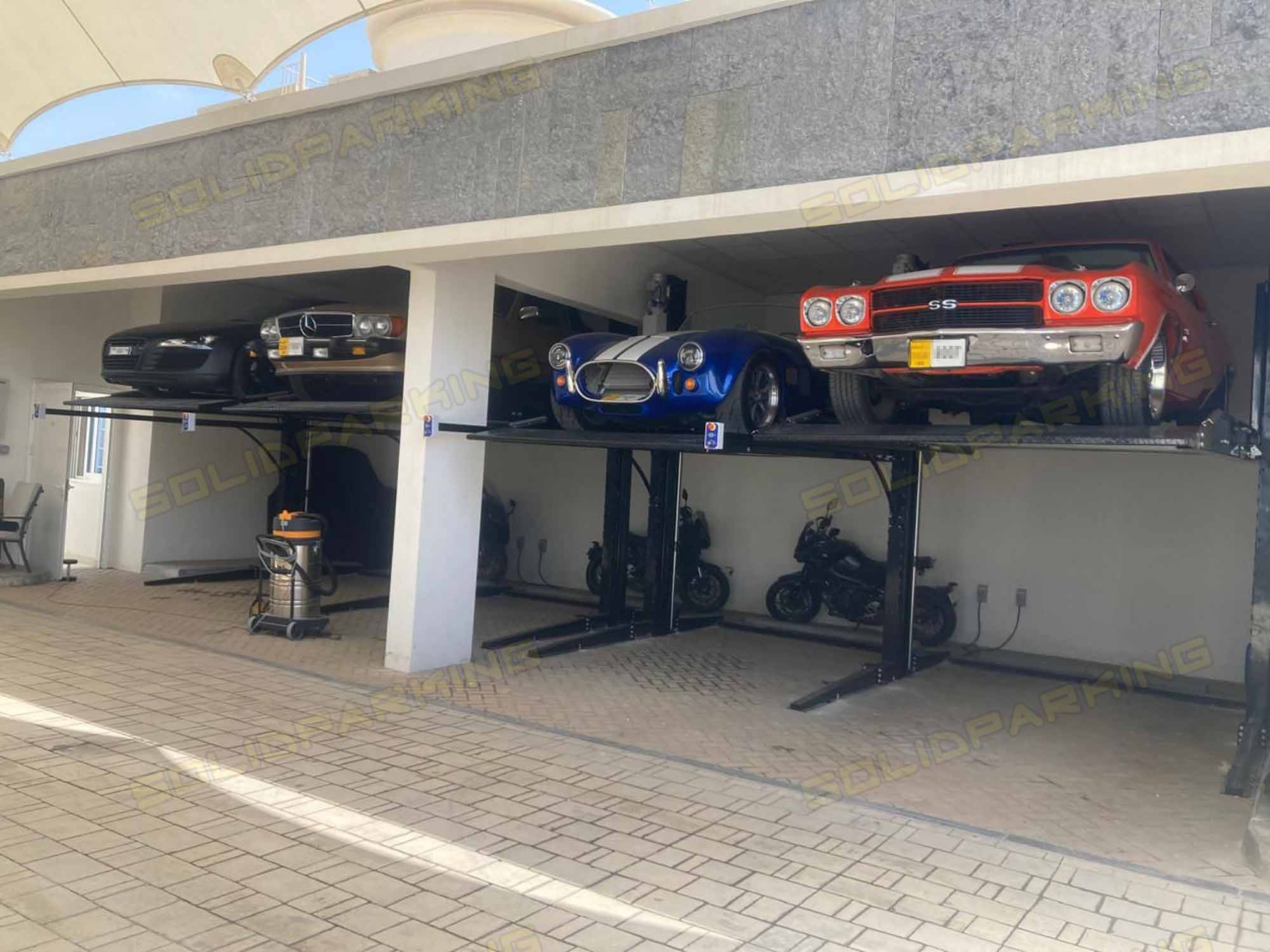
TP-270H: Best Shared Post Parking Lift for Tight Layouts
The TP-270H introduces a significantly shorter base footprint.
Best For
- Hotels
- Apartment projects
- Commercial parking
- Tight circulation layouts
Key Advantages
- 2,036 mm short-base design
- Easier vehicle maneuvering
- Better use of constrained parking areas
TP-230H: Best Residential 2 Post Car Lift for Low Ceilings
The TP-230H was designed specifically for restricted spaces.
Best For
- Basements
- Urban garages
- Low-clearance projects
Key Advantages
- 3,010 mm overall height
- Faster lifting speed
- Compact footprint
If ceiling height is your biggest challenge, this model is often the best solution.
Which Lift Fits Your Customer Profile?
| Customer Type | Recommended Models |
|---|---|
| DIY Garage Enthusiasts | TP-270, TP-230H |
| Multi-Car Families | TP-270, TP-320 |
| EV Owners | TP-320 |
| Luxury Homeowners | TP-320 |
| Apartment Developers | TP-270H, TP-270 |
| Commercial Projects | TP-270H, TP-320 |
Shared Post Parking Lift ROI Analysis
For developers and architects, the conversation changes.
The question becomes:
How much parking can we fit inside a fixed footprint?
Shared-post systems help improve:
- Parking ratios
- Construction efficiency
- Material efficiency
- Long-term project profitability
The result is often:
- More parking spaces
- Better land utilization
- Lower structural costs
- Higher property value
This is why Shared Post Parking Lift systems are increasingly specified in luxury condominiums, mixed-use developments, and urban residential projects.
Frequently Asked Questions
What is the best Residential 2 Post Car Lift for EVs?
The TP-320 is generally the preferred choice due to its 3,200 kg capacity and wider platform.
Are Shared Post Parking Lift systems safe?
Yes. Shared-post systems distribute loads across a connected structural framework while maintaining the same safety systems used in standalone lifts.
Which model is best for low ceilings?
The TP-230H, with its 3,010 mm overall height.
Which model is best for apartment developments?
The TP-270H is often selected because its short-base design improves parking circulation and layout efficiency.
Can Shared Post Parking Lift systems be expanded later?
Yes. One of the biggest advantages of shared-post engineering is modular scalability.
Do all TP Series models support shared-post layouts?
Yes. TP-320, TP-270, TP-270H, and TP-230H all support Shared Post Parking Lift configuration.
What is the difference between a Residential 2 Post Car Lift and a service lift?
A Residential 2 Post Car Lift is designed for parking and vehicle storage, while service lifts are designed for maintenance and repair work.
Final Recommendation
If you need maximum lifting capacity and future-proof EV compatibility, choose the TP-320.
If you want the best balance of performance and value, choose the TP-270.
If your project requires tighter circulation and higher parking efficiency, choose the TP-270H.
If ceiling height is limited, choose the TP-230H.
Most importantly, every model supports Shared Post Parking Lift configuration, allowing homeowners, architects, and developers to maximize parking density while minimizing structural waste.
The result is simple:
More parking spaces. Fewer columns. Better land utilization. Higher project value.
Free Layout Review
Still unsure which lift is right for your project?
Send us your garage dimensions, architectural drawings, or project requirements.
Our engineering team will provide a FREE layout review and recommend the most efficient Residential 2 Post Car Lift solution for your space.