Car Turn Table: 5 Key Ways a Car Rotating Platform Transforms Your Garage

2026-01-12
car turntable platform

Table of Contents

1. Introduction: Why a Car Turn Table Matters

If you’ve ever struggled to maneuver your car in a tight driveway or crowded garage, you know how frustrating it can be. As a technician who has installed dozens of car lifts and rotating platforms, I’ve seen firsthand how a car turn table—also called a car rotating platform—solves these problems with elegance.

In this article, I’ll walk you through 5 key ways a car turn table transforms your garage. From improving safety and saving space to enhancing vehicle presentation, these insights are drawn from years of professional experience with residential, commercial, and industrial installations.

More Reading: Design and Fabrication of “360 Degree Car Parking”

2. Technical Overview: How Car Rotating Platforms Work

A car rotating platform may look simple, but it is an engineering marvel designed for precision, safety, and durability.

2.1 Drive Mechanisms

  • Pin-tooth or gear drive: Heavy-duty models use a gear drive for precise rotation and high torque, capable of handling SUVs and small trucks.

  • Friction drive: Residential platforms often use a friction wheel pressed against the platform edge. Smooth, quiet, and easier to maintain.

  • Hydraulic rotation: Found in premium showrooms, these rotate large vehicles or collections with precise control.

2.2 Platform Design and Materials

FeatureTechnician Insight
Diameter3–10 meters
Load Capacity2,000–10,000 kg depending on model
Surface MaterialSteel, aluminum, tempered glass; anti-slip critical
Height/InstallationSurface-mounted (120–150mm) vs pit-mounted
Rotation Speed0.2–2 RPM; adjust for safety
ControlKey switch

From a technician’s point of view, the long-term performance of a car turn table often has less to do with the motor and more to do with what’s underneath the platform. Bearing load ratings and platform thickness are easy to overlook during specification, yet they determine how smoothly the system will perform after years of daily use. Cutting corners here may reduce upfront cost, but it almost always shortens the lifespan—especially in garages where the car rotating platform is used multiple times a day.

This structural reliability is also why turntables play such an important role in compact parking systems. Well-engineered rotation mechanisms don’t just make maneuvering easier; they help minimize vehicle retrieval times and reduce the overall space required for parking layouts. When bearings, rollers, and platform structure are properly designed, the rotation becomes predictable and precise, allowing tighter circulation paths and more efficient use of every square meter. In high-density residential or urban parking environments, that efficiency is often the difference between a workable garage design and a compromised one.

See Reference: Optimal parking systems analysis

3. Types of Car Turn Tables and Their Best Applications

From a technician’s perspective, car turn tables are generally categorized as:

  1. Residential Surface-Mount Turntables – Quick install, ultra-thin, ideal for sedans and small SUVs.

  2. Residential Pit-Mount Turntables – Flush with driveway for a clean look; requires excavation and drainage planning.

  3. Commercial Showroom Platforms – 360° rotation, stainless steel or premium finishes, sometimes integrated with LED lighting.

  4. Industrial/Heavy-Duty Turntables – Gear-driven, heavy-load capacity, used for trucks, heavy equipment, or warehouses.

Car Rotating Platform in Showroom

4. Residential, Commercial, and Industrial Use Cases

4.1 Residential Garages

  • Eliminates dangerous reversing on narrow streets

  • Optimizes tight driveways

  • Can be paired with lifts to maximize vertical space

4.2 Showrooms

  • Rotates vehicles for 360° views

  • Reduces staff effort moving cars

  • Enhances vehicle display aesthetics

4.3 Parking Garages

  • Improves traffic flow in compact structures

  • Rotates vehicles toward exits efficiently

4.4 Industrial Applications

  • Handles trucks or machinery

  • Saves space in loading docks or warehouses

  • Reduces physical labor and accident risk

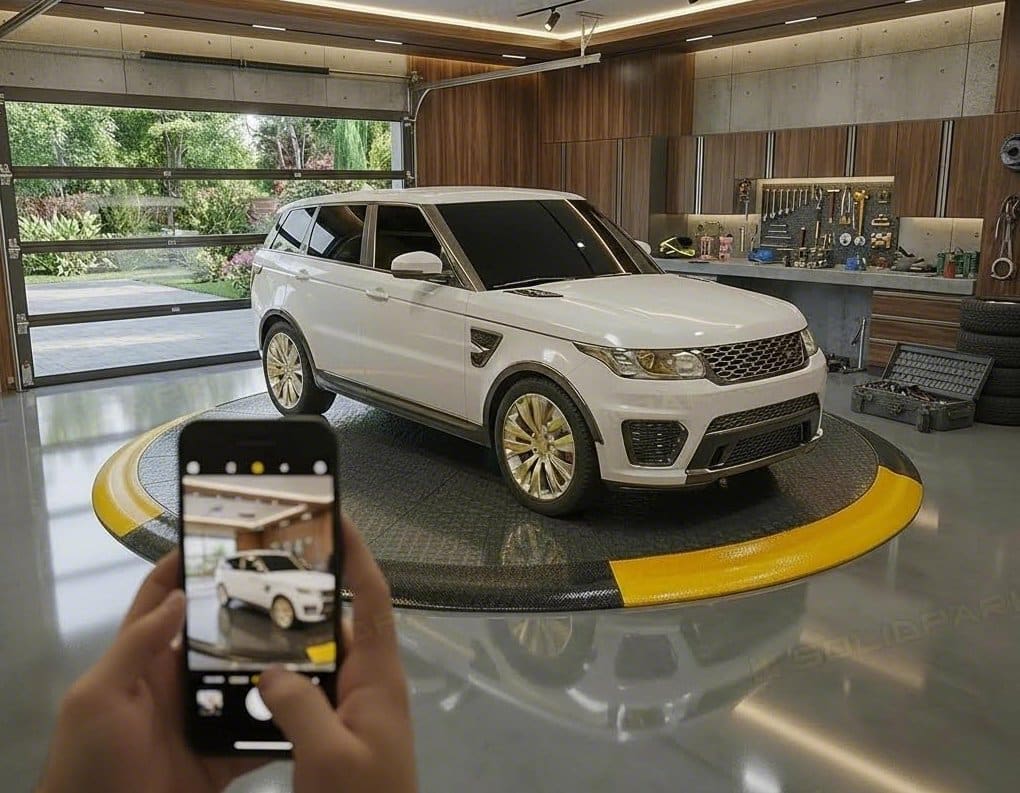
Car Turn Table installed in residential garage

5. Installation Insights From a Technician

Surface-mounted:

  • Low-cost, minimal civil work

  • Perfect for retrofits or shallow foundations

Pit-mounted:

  • Flush look, higher aesthetic appeal

  • Excavation and drainage required

  • Cost: Depending on site

Electrical and Safety Considerations:

  • Voltage: 220V/380V

  • Overload sensors, emergency stop, and safety edges essential

  • Routine maintenance: bearings, rollers, drive motors

  • Pro Tip: Opt for redundant motors to prevent single-point failures

6. Cost, Market Trends, and Smart Features

Pricing Overview

TierPriceLoad / Notes
Budget OEM$3,000–$5,000Residential 3–4 m diameter
Mid-range$5,000–$10,000CE certified, remote control
Premium$10,000 upShowroom or heavy-duty platforms 

Trends

  • Smart IoT-enabled controls

  • Ultra-thin platforms (<150mm) for surface mounting

  • Premium materials: stainless steel, tempered glass, LED integration

  • Custom diameters for showrooms or industrial use

7. Top Manufacturers and Product Comparison

Below is a side-by-side comparison of notable car turn table / car rotating platform providers — including SolidParking’s CTT solution — so you can see how different products stack up in terms of application, capacity, and design features:

Manufacturer Type Load / Focus Notes & Unique Selling Points
CarTurner (USA) Residential/Showroom Turntable ~3,600 kg Industrial-grade stainless steel, wireless remote, transparent pricing, no permit install required 🇺🇸 — premium quality build.
Rotoquip Spinsy Residential Surface Turntable ~4,000 kg Ultra-thin surface mount, quick installation, low profile for residential driveways.
Morallift / Hydropark CTT Residential/Commercial Turntable Varies (OEM) Custom diameters and load capacities; remote control; can be ground or pit installed.
Spacepark VT Series Residential/General Parking ~4,000 kg Galvanized structure with remote, tailored finishes, motorized forward/reverse control.
SolidParking CTT Residential/Commercial Turntable ~3,500–10,000 kg* Part of SolidParking’s Special Platform lineup — offers 360° rotation for tight garages and driveways with low-profile design and customizable specs. Designed for simplicity, safety, and space-saving without complex maneuvering.

*SolidParking’s CTT is listed as capable of customizable widths and capacities with up to ~3,500 kg lifting capacity and configurable vehicle widths, making it suitable for a variety of parking environments (residential, commercial, or mixed use). Custom specs can be tailored further to fit specific vehicle sizes and project needs.

More Solid Parking Special Platform Details

8. Pros, Cons, and Maintenance Considerations

Pros:

  • Safer maneuvering, avoids reversing accidents

  • Space-efficient and visually appealing

  • Enhances vehicle display in garages or showrooms

Cons:

  • Premium units are expensive

  • Pit-mounted installations require excavation

  • Motors and bearings need periodic maintenance

Technician Tips:

  • Check bearings every 6 months

  • Keep platform surface clean and anti-slip

  • Lubricate gears and check motor health annually

9. Final Thoughts: Choosing the Right Car Turn Table

A car turn table or car rotating platform is more than a luxury—it’s a space, safety, and presentation solution.

Key Considerations:

  • Choose based on vehicle size, use frequency, and installation type

  • Consider smart control options for home automation

  • Prioritize quality materials and load ratings for longevity

  • Surface-mounted units are perfect for retrofits; pit-mounted units offer seamless aesthetics

By understanding these 5 key ways a car turn table transforms your garage, you can make an informed investment that improves convenience, functionality, and value.

qrcode