
Parking System Breakthrough: 62% Capacity Gain Using Automated Parking System and Puzzle Parking System
Project Overview: Rethinking the Parking System
In modern urban development, the parking system is no longer a secondary design element. It directly affects land efficiency, project ROI, and long-term asset performance.
In this mixed-use development project, the original parking garage design layout was based on a conventional ramp-driven structure. While functional, it failed to meet rising demand without expanding land.
The challenge was clear:
- Increase parking capacity
- Avoid land expansion
- Reduce structural inefficiency
- Improve long-term ROI
This led to a redesign of the entire parking system architecture.
Why the Traditional Parking System Failed
Traditional ramp-based parking systems often waste: 30–40% of usable space through circulation lanes and inefficient vehicle movement.
The original parking system relied on a standard parking garage design layout with ramps and circulation lanes.
Key issues included:
- Up to 35% space lost to circulation and ramps
- Low vehicle density per floor
- High excavation and construction cost
- Limited flexibility for future expansion
In this configuration, the parking system became a cost center instead of a value generator.
Shift to Automated Parking System Thinking
The real turning point in this project came when the development team stopped treating parking as a simple layout issue and started approaching it as a broader space optimization challenge.
In many traditional projects, parking garage planning focuses primarily on circulation flow — how vehicles enter, turn, ramp upward, and exit the structure. While this approach has been standard for decades, it often creates significant inefficiencies in modern urban developments where land availability is increasingly limited and construction costs continue to rise.
Instead of relying on a conventional ramp-driven configuration, the project team explored a more intelligent spatial strategy centered around an advanced automated parking system.
This shift fundamentally changed the design philosophy.
Rather than prioritizing horizontal vehicle movement, the new approach focused on maximizing usable cubic volume within the structure itself. By reducing unnecessary circulation space and optimizing vertical organization, the development was able to significantly improve overall parking efficiency without expanding the building footprint.
Unlike traditional parking layouts, an automated parking system can:
- Eliminate large internal driving ramps
- Reduce wasted circulation and maneuvering space
- Improve parking density within constrained sites
- Enable more effective vertical stacking strategies
- Create a more organized vehicle storage environment
- Support modern high-density urban developments
This transition moved the project away from a conventional 2D parking layout mindset and toward a more advanced 3D spatial engineering model.
Instead of designing around vehicle movement alone, the parking structure was redesigned around spatial efficiency, structural integration, and long-term scalability.
Key Advantage of Automated Parking System
One of the most significant benefits of implementing an automated parking strategy is the ability to dramatically improve space utilization while maintaining operational efficiency.
For urban developments, where every square meter directly affects project economics, this becomes a major competitive advantage.
The redesigned system delivered several operational improvements:
- Higher parking density per square meter
- Reduced dependency on land expansion
- Better integration with mixed-use building structures
- Improved long-term flexibility for future growth
- Lower structural waste caused by oversized circulation zones
- Enhanced organization within the parking environment
Beyond increasing vehicle capacity, the new parking strategy also improved the overall functionality of the development itself.
Architects and developers were able to preserve more usable building area for revenue-generating functions instead of dedicating excessive space to ramps and circulation lanes.
This made the redesigned parking system not just an infrastructure improvement, but a strategic component of the project’s long-term asset optimization plan.
As urban projects continue moving toward higher density development models, automated parking solutions are increasingly becoming a foundational tool for improving parking efficiency, land utilization, and overall project performance.
Further Reading:
Puzzle Parking System (Solid Parking PPS Series)
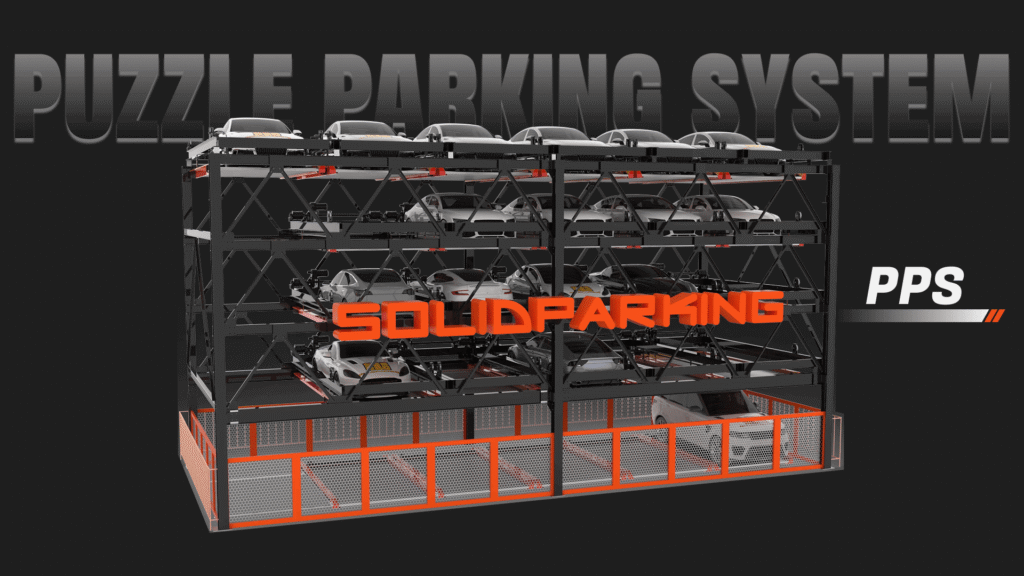
To further optimize capacity, the project integrated a puzzle parking system, specifically the Solid Parking PPS series.
This system combines mechanical lifting and horizontal shifting mechanisms to maximize space efficiency within a compact footprint.
How the Puzzle Parking System Works
The Solid Parking PPS series puzzle parking system operates through:
- Vertical vehicle stacking
- Horizontal sliding platforms
- Independent control modules
- Flexible structural configuration
This allows multiple vehicles to occupy the same ground footprint through mechanical repositioning.
Why Puzzle Parking System Matters
Compared to conventional parking system designs, the PPS series delivers:
- 2–3x increase in parking density
- Lower excavation requirements
- Modular scalability for future expansion
- Compatibility with automated parking system layouts
Impact on Parking Garage Design Layout
The integration of automated parking system + puzzle parking system completely reshaped the parking garage design layout.
Key improvements included:
- Reduced ramp dependency
- Increased vertical space utilization
- Improved structural efficiency
- Higher parking density per level
The parking system was no longer a fixed layout — it became a flexible spatial optimization engine.
Final Results: 62% Capacity Increase
After implementation, the redesigned parking system achieved measurable improvements:
| Metric | Before | After |
|---|---|---|
| Parking Spaces | 84 | 136 |
| Land Expansion | Required | Not Required |
| System Type | Traditional parking system | Automated + Puzzle parking system |
| Efficiency | Low | High |
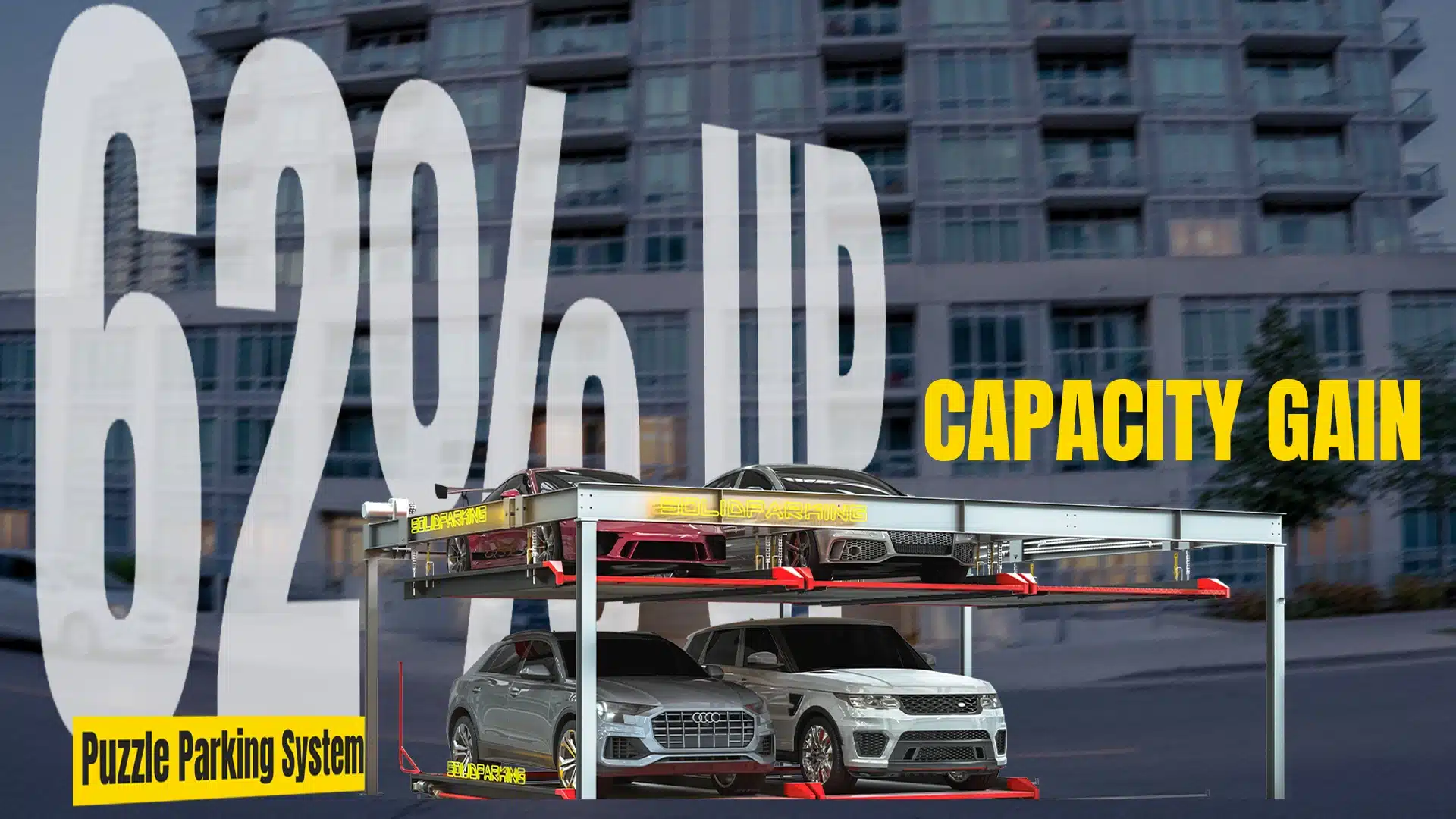
Total Result: 62% Increase in Parking Capacity without expanding the project footprint.
Key Takeaways for Developers & Architects
This project reflects a broader transformation in how modern urban developments approach parking design and infrastructure planning. Instead of treating parking as a secondary engineering requirement, it is increasingly being recognized as a core component of spatial and financial optimization within high-density projects.
1. Parking system = spatial optimization tool (not just infrastructure)
Traditionally, a parking system was viewed as a purely functional necessity — a space required to accommodate vehicles with minimal design consideration beyond compliance and capacity.
However, in modern urban development, this perspective is rapidly changing.
A well-designed parking system now plays a direct role in:
- How efficiently land is utilized
- How building volume is allocated
- How much usable space is preserved for revenue-generating functions
- How overall project ROI is structured
In this context, the parking system becomes less about storage and more about strategic spatial engineering. It directly influences how architects and developers design entire building footprints in dense urban environments.
2. Automated parking system = foundation of efficiency
The introduction of an automated parking system represents a fundamental shift from conventional ramp-based parking models.
Instead of relying on large internal circulation zones and driver-operated movement paths, automated systems restructure parking around mechanical efficiency and vertical organization.
This approach helps reduce:
- Redundant driving lanes
- Large ramp structures
- Inefficient horizontal circulation patterns
At the same time, it improves:
- Vertical space utilization
- Vehicle handling efficiency
- Overall structural compactness
More importantly, it allows developers to rethink parking not as a flat, area-consuming element, but as a vertically optimized system embedded within the building’s core design logic.
3. Puzzle parking system (Solid Parking PPS series) = density multiplier
Beyond automation, the puzzle parking system, particularly the Solid Parking PPS series, introduces another layer of spatial intensification.
Unlike conventional layouts, puzzle systems use mechanical stacking and horizontal shifting mechanisms to significantly increase parking capacity within the same footprint.
This approach is especially effective in constrained urban sites where expansion is not possible.
Key advantages include:
- Higher vehicle storage density without land expansion
- Modular and scalable installation structure
- Better adaptability for mixed-use developments
- Efficient use of both vertical and horizontal space
When combined with automated parking principles, the puzzle system acts as a “density multiplier,” enabling projects to achieve significantly higher parking capacity without increasing structural footprint.
Overall Insight
Together, these three layers represent a shift in thinking:
parking is no longer a static infrastructure requirement — it is an integrated spatial optimization strategy that directly impacts development efficiency, land value, and long-term project performance.
Request a Free Parking Layout Consultation
Discover how much parking capacity your project could gain with our automated parking system and puzzle parking system solutions.
Get:
✔ Free project evaluation
✔ Parking capacity analysis
✔ Parking garage design layout recommendation
✔ Customized PPS series solution proposal