
2 Post vs 4 Post Car Lift: EV-Compatible Car Lift Guide + Expert Car Lift Review (2026)
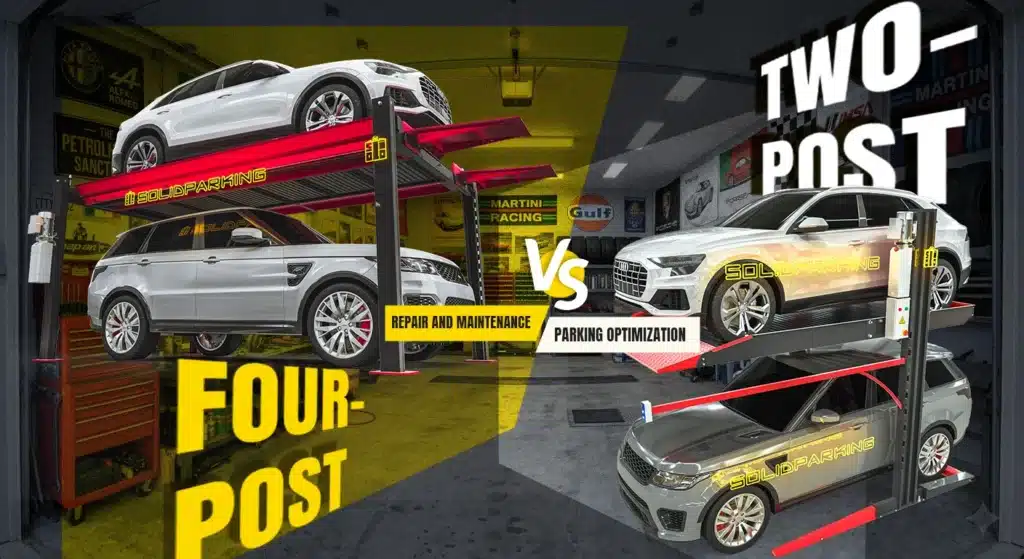
When evaluating a 2 post vs 4 post car lift, most buyers initially treat it as a simple technical comparison. However, in real-world planning—especially for architects, developers, and garage designers—it is a decision that directly impacts space efficiency, EV compatibility, and long-term usability.
In most modern applications:
- 2 post car lift = parking optimization system
- 4 post car lift = repair and maintenance system
This distinction is critical when designing residential garages, commercial parking layouts, or EV-ready facilities. Many early buyers only realize this difference after reading multiple car lift reviews, watching installation videos, or browsing forums like The Garage Journal.
Understanding this early prevents costly design mistakes and ensures the system matches the actual use case.
Before comparing lift configurations for EV use, it helps to understand how car stackers work and how two-post and four-post parking systems differ at a broader level.👉 car stacker and parking system guide
| Feature / Criteria | 2 Post Car Lift (Parking System) | 4 Post Car Lift (Repair System) |
|---|---|---|
| Primary Function | Parking-focused vertical stacking system | Repair and maintenance service platform |
| Core Use Case | Space optimization & multi-level parking | Vehicle servicing, inspection, maintenance |
| Operational Logic | Lift-based vehicle stacking | Drive-on platform support |
| Vehicle Positioning | Chassis-supported lifting | Wheel-supported parking |
| Space Efficiency | Very high (compact footprint, vertical density) | Moderate (larger footprint required) |
| Best Application | Residential parking, high-density developments, compact garages | Workshops, repair shops, maintenance bays |
| User Experience | Easy drive-on / drive-off operation | Requires controlled parking alignment |
| Structural Requirement | High vertical load concentration points | Distributed load across four columns |
| Ceiling Height Sensitivity | High (depends on stacking height design) | Medium (platform lift clearance required) |
| EV Compatibility | Suitable for EV parking density planning | Strong for EV maintenance and charging access |
| Installation Complexity | Higher (structural alignment critical) | Lower (more plug-and-play style setup) |
| Long-Term Use Case | Parking optimization infrastructure | Mechanical servicing infrastructure |
| Design Intent (Architectural) | Maximize parking capacity per m² | Enable maintenance accessibility |
| Typical Buyer | Developers, architects, parking planners | Auto shops, workshops, service centers |
2 Post- Car Lift Review
The 2 post car lift is primarily used for parking and space optimization, especially in high-density residential or commercial environments.
Key Characteristics:
- Minimal footprint design
- Vertical stacking capability
- High-density parking layout
- Suitable for compact garages
Advantages:
- Maximizes parking capacity per square meter
- Ideal for tight urban developments
- Supports modular and shared-post configurations
4 Post- Car Lift Review
The 4 post car lift is designed primarily for vehicle repair, inspection, and maintenance operations.
Key Characteristics:
- Drive-on platform structure
- Stable wheel-supported parking
- High safety for long-term stationary use during service
Advantages:
- Easy to operate (drive-on design)
- Ideal for workshops and maintenance bays
- Stable platform for mechanical access
EV-Compatible Car Lift Considerations
Modern planning increasingly requires an EV-compatible car lift due to heavier vehicle weight and charging integration.
Key EV Factors:
- Increased vehicle weight load
- Battery safety clearance
- Charging cable routing
- Ventilation requirements
Best Fit:
- 4 post systems → better for EV stability during charging
- 2 post systems → better for EV density stacking in parking structures
Space Efficiency Comparison
2 Post Car Lift:
- Higher vertical density
- Lower footprint usage
- Ideal for parking optimization projects
4 Post Car Lift:
- Higher stability
- Lower operational complexity
- Better for long-term storage or repair use
If the lift will be installed in a residential garage, garage ceiling height, floor condition, daily vehicle access, and available clearance become equally important. Our residential garage comparison covers these considerations in more detail.
Structural & Ceiling Requirements
Both systems require different engineering considerations:
2 Post Systems:
- Requires reinforced vertical load points
- Higher dependency on structural alignment
4 Post Systems:
- Requires consistent ceiling clearance
- Distributed load across four columns
Car Lift Review Insights
From aggregated car lift review patterns across forums and installer feedback, most buyers go through a similar journey:
- Start with space shortage
- Watch installation videos
- Compare technical specs
- Realize use case mismatch
- Re-evaluate based on actual lifestyle needs
Key Insight:
Most dissatisfaction comes not from product quality—but from choosing the wrong system type for their actual use case.
Integration with Modern Parking Systems
In large-scale developments, both systems are often integrated into hybrid layouts:
- 2 post systems → high-density parking zones
- 4 post systems → maintenance or EV service zones
- Automated systems → circulation and optimization layers
Where Buyers Start Thinking Differently About SolidParking (2 post vs 4 post car lift)
For Buyers Leaning Toward 2-Post Lifts
TP-270 — When Buyers Want Their First “Real” Garage Upgrade
This usually appeals to:
- first-time lift buyers
- moderate DIY enthusiasts
- sports car owners
- homeowners testing workshop functionality
The attraction is less about extreme specs…
And more about:
“This feels manageable without feeling temporary.”
TP-320 — Where Many EV and SUV Buyers Eventually Land
This is where buyer psychology changes noticeably.
Instead of optimizing for:
today’s vehicle
buyers begin optimizing for:
future vehicles.
That’s why many enthusiasts skip smaller lifts entirely once they start thinking about:
- EV weight growth
- larger SUVs
- long-term ownership
- avoiding future upgrades
TP-320 fits that mindset because it removes one of the biggest buyer anxieties:
“Will I outgrow this lift later?”
For Buyers Leaning Toward 4-Post Storage Lifts
FP-360 — When Buyers Realize the Problem Is Space
Most homeowners do not initially search for storage systems.
They search because the garage stopped functioning smoothly.
FP-360 starts making sense when buyers realize:
expanding upward is cheaper than expanding outward.
And for many households, that realization changes the entire buying direction.
FP-360X — When Modern SUVs Start Feeling Huge
This is usually where buyers:
- own wider vehicles
- want easier parking comfort
- dislike tight platform clearance
- expect larger future vehicles
The appeal is less about technical capability…
And more about reducing daily friction.
What Buyers Most Commonly Regret Later
After reading enough car lift reviews and enthusiast discussions, the same patterns appear repeatedly.
Regret #1
Buying based only on the current vehicle.
Regret #2
Underestimating SUV size growth.
Regret #3
Buying a workshop lift when the real issue was storage.
Regret #4
Choosing the cheapest option without considering long-term use.
Interestingly, very few buyers regret:
- extra capacity
- extra width
- easier usability
But many regret buying too small too early.
Final Buying Shortcut
If the comparison between systems still feels unclear, this framework usually simplifies the decision immediately by focusing on real-world use case, not specifications.
| If Your Main Goal Is… | Usually Better Choice |
|---|---|
| Space-efficient vehicle parking | 2-post parking system |
| Maximum garage space utilization | 2-post parking system |
| Repair, inspection, or maintenance work | 4-post repair lift |
| Easy daily vehicle access | 4-post repair lift |
| EV storage with stable platform support | 4-post repair lift |
| High-density parking layout planning | 2-post parking system |
| Long-term vehicle storage or workshop use | 4-post repair lift |
| Flexible garage usage (home + service) | Depends on layout design strategy |
🧠 Final Insight for Buyers
By the end of the decision process, most buyers realize something important:
The real question was never:
“Which lift is better?”
It was:
“Am I designing a parking space optimization system, or a vehicle service environment?”
Once that distinction is clear, the decision between a 2-post parking system and a 4-post repair lift becomes significantly easier—and far more aligned with how the space will actually be used every day.
FAQs (Decision Help Section)
1. Are EV-compatible car lifts strictly necessary?
Yes, especially for modern EVs and heavier SUVs. EVs place significantly higher loads due to battery weight, so higher-capacity lifts are essential for safety and stability. Wider vehicles also benefit from broader runways and optimized column spacing to reduce risks such as door impact and tire sidewall contact during loading.
2. Do I need special concrete for a car lift?
For most 2-post lifts, yes. A reinforced concrete slab (typically at least 4 inches thick, and often 6 inches for heavier-duty models, rated around 3000 PSI or higher) is required because the posts concentrate load into small points. 4-post lifts distribute weight across a wider footprint, so they are often more forgiving and can typically be installed on standard residential garage slabs, depending on condition and specifications.
3. What is the safest option for beginners?
A 4-post lift is usually preferred for beginners. Its drive-on design feels more intuitive, requires no arm positioning, and provides a more stable visual and physical setup. This reduces user error and makes it more suitable for households where multiple drivers may use the system.