Introduction – Why Choosing the Right Garage Car Lift Matters
Selecting a garage car lift for a home garage is more than picking a piece of equipment—it’s a combination of safety, space management, and long-term investment. For North American homeowners, the choice involves balancing garage dimensions, vehicle weight, local regulations, and lift type. Choosing incorrectly can lead to installation issues, unsafe operation, or reduced equipment lifespan.
Many homeowners underestimate:
Ceiling height and floor strength requirements
Load capacity differences across lift types
Safety systems critical for residential use
Proper lift spacing for multiple vehicles or storage
This guide provides a detailed, technical breakdown to help you select a home garage car lift that is safe, functional, and future-proof.
Step 1: Accurately Measure Your Garage
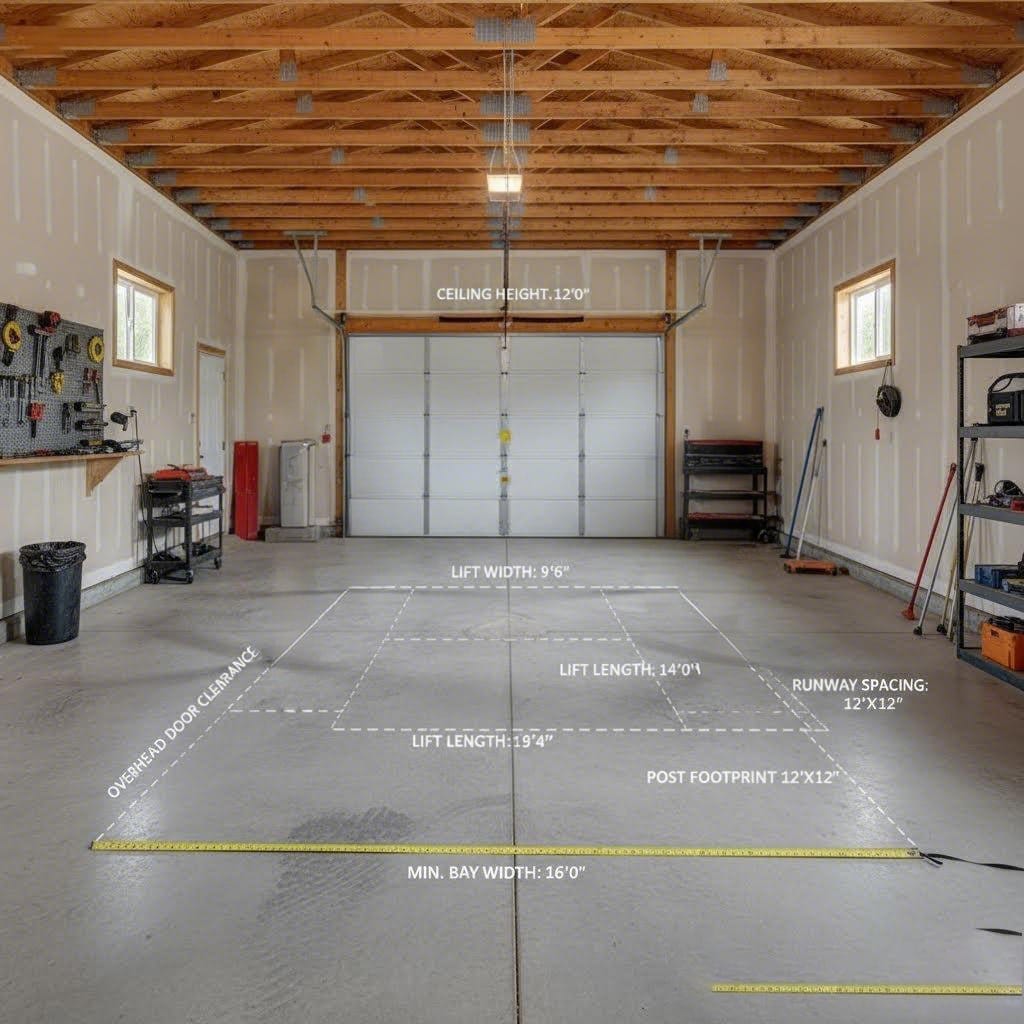
Ceiling Height Considerations
Minimum recommended height for 2-post lifts: 8–9 feet
For 4-post lifts or lifts with storage functionality: 9–10 feet
Note: Ceiling-mounted lighting, HVAC ducts, and garage door openers reduce available space.
Floor Strength & Load-Bearing
Residential concrete floors must typically be at least 1 inches thick for 2-post lifts and 1.5 inches for 4-post lifts.
Floor reinforcement may be necessary for heavy lifts (>10,000 lbs) or multiple stacked vehicles.
For North American homes, concrete quality (psi rating) varies; check local standards.
Garage Width & Depth
Ensure clearance for opening vehicle doors, moving tools, and walking around the lift.
Example: Standard 2-post lift footprint: 8–9 ft width × 17–19 ft depth
Pro Tip: Always leave at least 24–36 inches around lift posts for safe operation.
Assess the levelness of the ground.
Step 2: Determine Vehicle Load Capacity
Calculating Required Lift Capacity
Single-car lifts should exceed vehicle weight by at least 20–25% for safety margin.
Typical residential vehicles:
Sedan: 3,000–4,500 lbs
SUV: 4,000–6,000 lbs
Pickup/Truck: 5,000–8,000 lbs
Long-tail keywords: how to choose car lift for home garage, safe home car lift guide
Multiple Vehicle Scenarios
If lifting two vehicles sequentially or simultaneously (stacked lifts), ensure combined weight does not exceed lift rating.
Example: TP-320 dual lift from SolidParking supports up to 7050 lbs – sufficient for most home garages with two vehicles.
Step 3: Compare Lift Types & Safety Features
2-Post Lifts
Compact footprint, fits tight garages.
Recommended for single-vehicle storage or maintenance.
Choosing the right garage car lift for your home in North America requires balancing garage dimensions, vehicle weight, lift type, safety features, and budget. By following this technical guide:
Measure your garage accurately
Calculate required load capacity
Compare lift types and safety features
Set a realistic budget and select a trusted brand
Ensure proper installation
You can make an informed, safe, and long-term investment in your home garage.
❓ Frequently Asked Questions (FAQ)
Q: Can I install a car lift on a standard 3-inch garage floor?
A: Generally, no. Most 2-post and 4-post lifts require a minimum of 4 to 6 inches of reinforced concrete with a rating of at least 3,000 PSI. Installing a lift on a thin or cracked slab is a major safety risk. Always measure your slab thickness by drilling a small pilot hole before purchasing.
Q: Do I need a professional electrician to install a home car lift?
A: Yes. In North America, most residential lifts run on 220V/240V single-phase power. To meet local building codes and ensure your warranty remains valid, a licensed electrician should install a dedicated circuit and a proper disconnect switch.
Q: Are home car lifts safe for long-term "stacked" storage?
A:4-post lifts are the gold standard for long-term storage. Unlike 2-post lifts, which put constant stress on the vehicle’s frame and the lift’s hydraulic seals, a 4-post lift allows the vehicle to sit on its tires. Ensure the lift features automatic mechanical safety locks that engage once the desired height is reached.
Q: How much extra height does an Electric Vehicle (EV) require?
A: While the height of the vehicle remains the same, the weight is the primary factor. EVs can weigh 25–50% more than internal combustion engine (ICE) vehicles of the same size. If you plan to lift an EV, we recommend a lift with a minimum capacity of 7,000–9,000 lbs to ensure a safe overhead margin.
Q: What is the ALI Gold Label, and why does it matter?
A: The Automotive Lift Institute (ALI) is the independent safety watchdog for North America. A “Gold Label” means the lift has been independently tested and certified to meet the ANSI/ALI ALCTV safety standards. Choosing a certified lift ensures the highest level of operator safety.