Car Storage Lift Systems are not just equipment selections. For architects and developers, they are design tools used to resolve a core constraint: increasing parking capacity within limited building volume while maintaining usability and compliance.
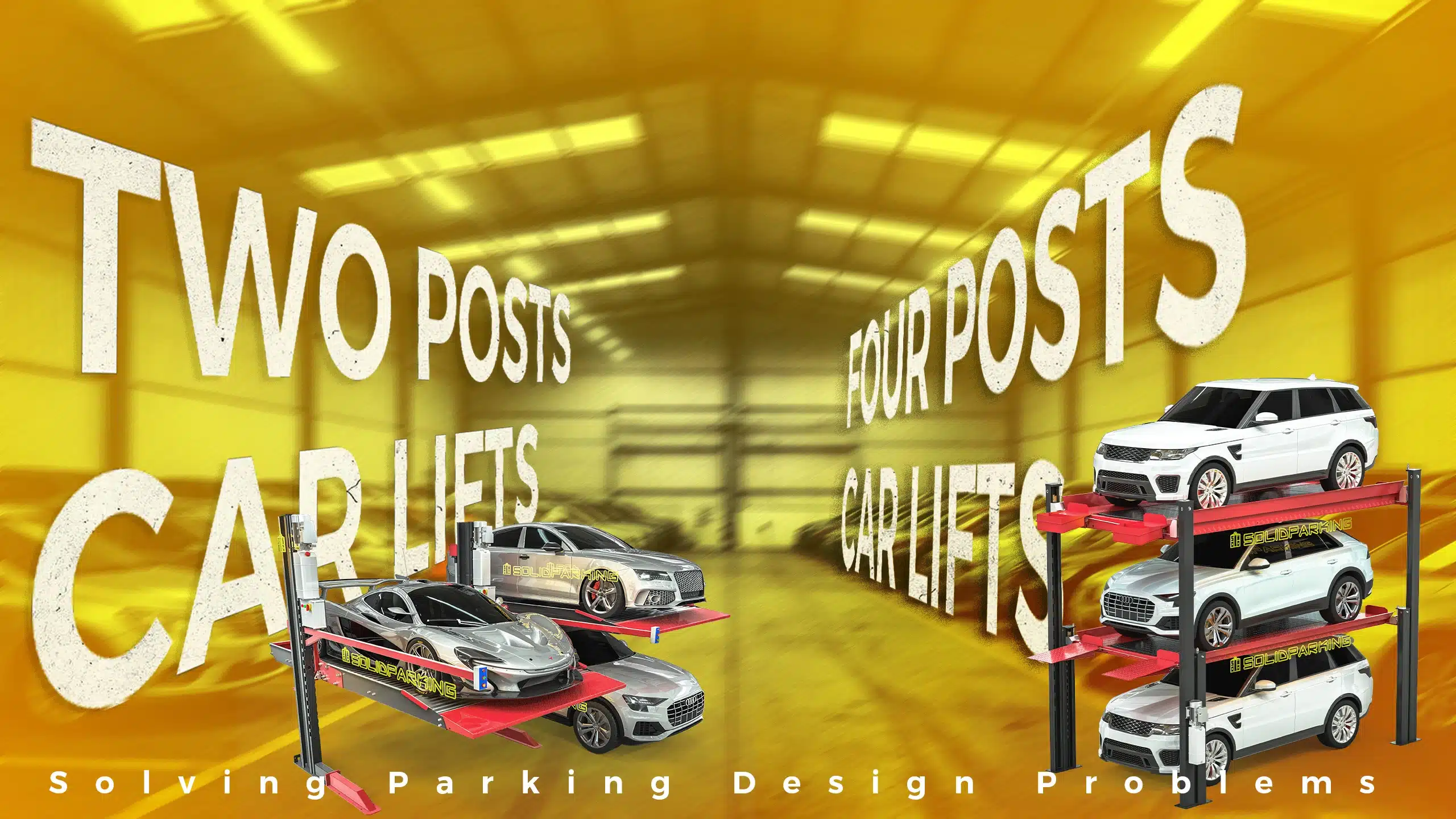
SolidParking’s TP Series (2-post lifts) and FP Series (4-post lifts) are engineered for different design priorities. Understanding how each system performs in real projects is critical for correct specification.
According to Urban Land Institute, efficient parking design is directly tied to project viability and land value optimization.
The Parking Constraint in Architectural Design
Architects typically encounter four constraints when designing parking:
Limited basement footprint
Floor-to-floor height restrictions
Local parking regulations
User operability and safety expectations
Car Storage Lift Systems address these by shifting parking from horizontal expansion to vertical stacking. The challenge is selecting the correct system based on project priorities.
Parking inefficiency is not just a design issue but an economic one. Research by Donald Shoup’s book-The High Cost of Free Parking highlights how excessive land allocation for parking reduces development value and urban density. This reinforces the role of Car Storage Lift Systems as a strategic tool rather than a mechanical add-on.
Overview of Car Storage Lift Systems
Car Storage Lift Systems increase parking capacity by vertically stacking vehicles using mechanical lifting platforms.
They are commonly categorized into:
2-post systems (independent or shared column design)
4-post systems (platform-based systems)
These correspond directly to SolidParking’s:
TP Series (2-post)
FP Series (4-post)
SolidParking TP Series (2-Post Systems)
The TP Series is designed for high-density parking and efficient use of structural grid space.
Relevant Models
TP-200
TP-230H
TP-270 / TP-270H
TP-320
Core Design Characteristics
Two-column structure with lifting platform or arms
Post-sharing capability for modular layouts
Optional tilting platform (H models) to reduce height requirements and improve drainage
Independent operation per unit
Design Advantages
High parking density per square meter
Flexible layout for irregular basement grids
Suitable for retrofit and constrained sites
Lower cost per parking space compared to platform systems
Design Limitations
Requires precise vehicle positioning
Less intuitive for end users compared to drive-on systems
May require operational guidance in residential settings
Typical Applications
High-density residential basements
Affordable housing projects
Urban developments with strict footprint constraints