Automatic Car Lifts: How Rotary Parking Systems Redefine Urban Parking

2026-01-30
automatic car lifts-rotary parking system

1. Automatic Car Lifts: The Real Problem They Are Solving

Automatic car lifts are often discussed as space-saving devices. That description is incomplete.

From an engineering perspective, automatic car lifts exist to solve a systems problem:

How do you store vehicles with maximum density while minimizing motion complexity, structural burden, and operational risk?

Traditional parking structures solve circulation with geometry — ramps, aisles, turning radii. Automatic car lifts replace geometry with mechanics.

The success or failure of an automated parking solution is not determined by how advanced it looks, but by:

  • How many motion paths exist

  • How predictable those motions are

  • How failure is contained when something goes wrong

This is where different categories of automatic car lifts diverge sharply.

2. Where the Rotary Parking System Fits in Automated Parking

A rotary parking system (RPS) is not an alternative to automatic car lifts.
It is a specific subtype of fully automated parking lifts.

Simplified Classification

Automatic Car Lifts

  • Semi-automatic parking lifts

  • Fully automated parking lifts

Fully Automated Parking Lifts

  • Rotary parking system (RPS)

  • Puzzle parking systems

  • Shuttle-based APS

  • Robotic APS

The rotary parking system occupies a unique position in this taxonomy. It is the most mechanically conservative form of full automation.

Instead of adding flexibility through additional motion axes, an RPS achieves efficiency by removing them.

That distinction is not philosophical — it is mechanical.

3. Mechanical Architecture of a Rotary Parking System

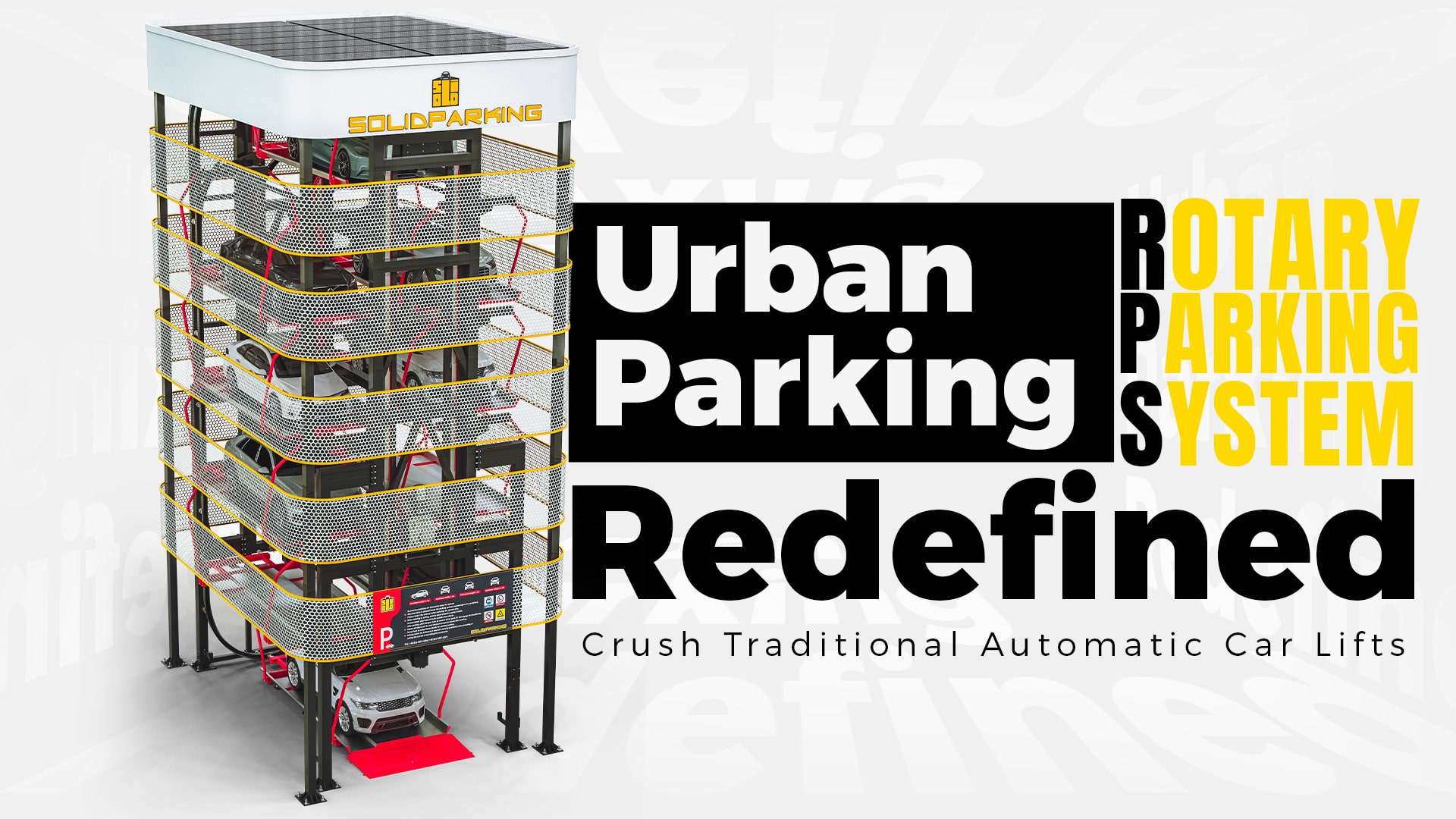
At its core, a rotary parking system is built around a closed-loop vertical circulation of pallets.

Primary Components

  • Structural frame (tower or shaft configuration)

  • Vehicle pallets connected in a continuous chain

  • Drive system (motor, gearbox, sprockets or traction system)

  • PLC-based control logic

  • Position sensors and mechanical interlocks

[ Pallet ] → ↑
|
[ Pallet ] ← ↓

There is:

  • No lateral shuttle

  • No horizontal transfer

  • No vehicle steering inside the system

The vehicle enters and exits at a fixed transfer point. Everything else is vertical rotation.

This simplicity is deliberate.

Related Reading:

The Future of Urban Parking Solutions: Rotary Parking Lifts

4. Motion Logic: Why Fewer Axes Matter

Engineers evaluate automated systems by asking one question:

How many independent movements must succeed for one operation to complete?

In a rotary parking system:

  • One motion loop

  • One direction of travel

  • One primary drive

Compare this to other automatic car lifts:

  • Puzzle systems introduce lateral + vertical alignment

  • Shuttle systems introduce transfer timing dependencies

  • Robotic APS introduce multi-axis coordination

Each additional axis increases:

  • Control complexity

  • Sensor dependency

  • Failure probability

  • Maintenance burden

The rotary parking system avoids this entirely by using deterministic motion. The system either rotates or it doesn’t. There is no ambiguity.

5. Density Is Not a Feature — It’s a Consequence of Design

Marketing materials often describe rotary parking systems as “high density.”
That is true — but misleading.

High density is not a feature.
It is the result of eliminating non-storage space.

What RPS Eliminates

  • Internal drive aisles

  • Turning clearances

  • Ramps

  • Redundant structural depth

By compressing parking into a vertical loop, a rotary parking system achieves density not by stacking harder, but by wasting less.

This is why, among fully automated parking lifts, RPS consistently delivers:

  • Higher vehicle count per square meter

  • More predictable structural loading

  • Simpler architectural integration

Further Study: New Passport Study Shows Cities Shifting Toward Compliance-First Parking Strategies

6. Reliability, Maintenance, and Failure Modes

Automatic car lifts do not fail because they are automated.
They fail because their failure modes are poorly bounded.

Rotary parking systems are engineered around containment.

Typical Design Principles

  • Mechanical locks independent of software state

  • Redundant position sensing

  • Gravity-safe pallet retention

  • Manual recovery paths

If power is lost, the system stops — safely.
If a sensor fails, motion is inhibited — predictably.

Maintenance is equally straightforward:

  • Repeating components

  • Uniform wear distribution

  • Modular replacement

This is why RPS installations often demonstrate stable performance over long service periods without escalating maintenance complexity.

7. Comparing Fully Automated Parking Lifts (Fact-Based)

System TypeMotion AxesControl DependencyMaintenance ComplexityPredictability
Rotary Parking SystemSingle vertical loopLowLowHigh
Puzzle Parking SystemVertical + lateralMediumMediumMedium
Shuttle APSMulti-axisHighHighMedium
Robotic APSMulti-axis roboticVery HighVery HighVariable

This comparison is not about innovation.
It is about operational discipline.

8. Lifecycle Thinking: Why Engineers Prefer Rotary Systems

When evaluated over a full lifecycle, rotary parking systems tend to align better with how engineers think about infrastructure:

  • Predictable performance

  • Gradual wear, not sudden failure

  • Low dependency on proprietary software

  • Clear maintenance logic

Automatic car lifts that rely heavily on software orchestration may offer flexibility, but they also introduce long-term uncertainty.

The rotary parking system trades flexibility for certainty — and in infrastructure, certainty wins.

9. Final Perspective: Quiet Engineering Beats Clever Automation

The rotary parking system is not impressive at first glance.
It does not advertise intelligence.
It does not promise infinite configuration.

Instead, it does something more valuable.

It works.

Among automatic car lifts, the rotary parking system represents a philosophy that engineers respect:

  • Reduce motion

  • Bound failure

  • Let mechanics do the heavy lifting

In a world increasingly obsessed with complexity, the rotary parking system remains a reminder that good engineering is often boring — and that’s exactly why it lasts.

qrcode