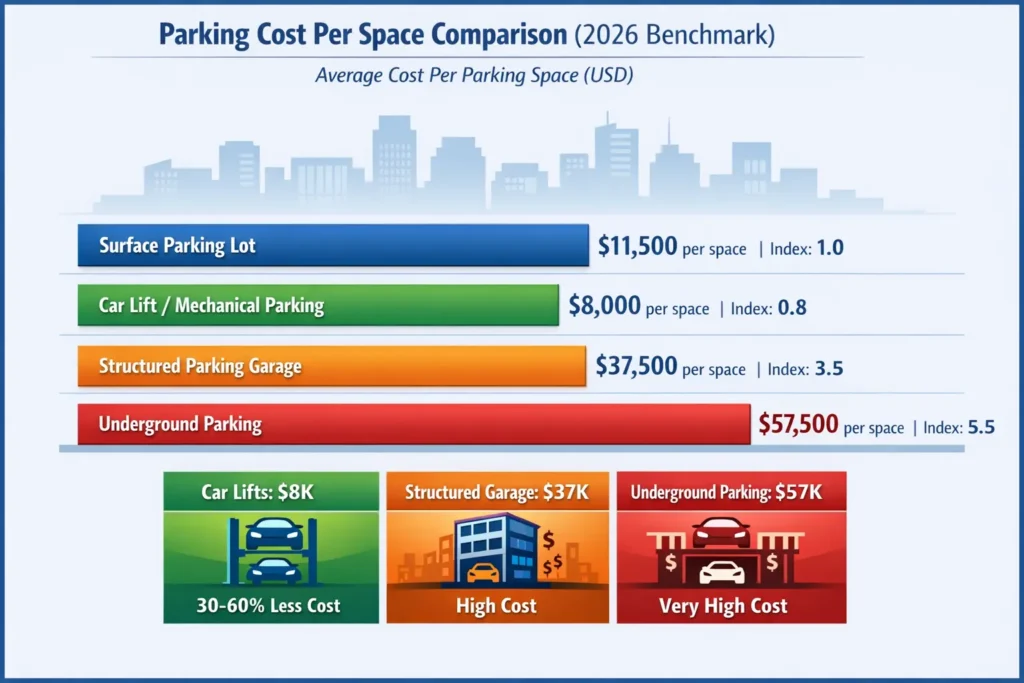
Key Insight (Visual Breakdown): Why Car Lift Price Wins
Instead of thinking about car lift price as a cost, it should be evaluated as a cost-per-capacity solution.
🏗️ Cost per Parking Space Comparison
Solution Type
Cost per Space
What You’re Actually Paying For
Surface Parking
Low upfront, high land cost
Land acquisition + space inefficiency
Structured Parking
$25,000 – $35,000+
Concrete construction + excavation + long build time
Car Lift Systems
$8,000 – $15,000
Mechanical vertical space utilization
🧠 What This Really Means (Simple Interpretation)
❌ Traditional Thinking
“Car lift price is an equipment cost.”
✅ Correct Engineering + ROI View
“Car lift price is the cost of creating a new parking space inside existing land.”
📉 Side-by-Side Capacity Logic
🅿️ Traditional Parking (Horizontal Expansion)
1 space = 1 land unit
Expansion requires:
More land
More construction
More permits
Scaling is expensive and slow
🚗 Car Lift Systems (Vertical Expansion)
1 footprint = 2–3 vehicles
Uses:
Vertical height (10–15 ft typical)
Existing structure
Scaling is:
Faster
Cheaper
Modular
📈 Simple ROI Visualization (Snippet-Friendly)
If we simplify the logic:
Traditional Parking: High land cost → low scalability → slow ROI
Car Lift Systems: Fixed footprint → multiple spaces → faster ROI
🎯 Key Insight
The real value of car lift price is not the equipment itself—it is the cost of generating additional parking capacity within an existing footprint. Compared to structured parking, mechanical systems significantly reduce the cost per parking space while increasing scalability and revenue potential.
🔥 One-Line Summary
👉 Car lift systems reduce the cost per parking space by using vertical space instead of expensive land expansion.
Dependent vs Independent Systems (ROI Core)
Comparison Table
Feature
Dependent Systems
Independent Systems
Car Lift Price
Lower
Higher
Operation
Requires moving vehicles
Independent access
Throughput
Lower
Higher
Best Use Case
Residential
Commercial / high turnover
ROI Potential
Moderate
High
What This Means
Lower car lift price doesn’t always mean better ROI
Independent systems often generate more revenue in high-traffic environments
How to Calculate ROI (Simple Model)
Basic Formula
ROI = (Annual Revenue – Car Lift Price) / Car Lift Price
Example
System cost: $100,000
Added spaces: 10
Revenue per space: $200/month
👉 Annual revenue = $24,000
👉 Payback period ≈ 4–5 years
Why This Matters
The real value of a car lift price is how quickly it turns into revenue.
Real-World Use Cases
Residential Projects
Lower turnover
Dependent systems often sufficient
Commercial Parking
High turnover
Independent systems maximize revenue
Hospitality / Valet
Hybrid approach
Balance between cost and speed
Hidden Costs to Consider
Even when evaluating car lift price, don’t overlook:
Maintenance costs
Operational downtime
User behavior inefficiencies
Space layout limitations
👉 These factors directly impact ROI.
Frequently Asked Questions
How much does a car lift price typically cost?
A car lift price typically ranges from $1,000 to $3,000 per parking space depending on system type and configuration.
Are car lifts worth the investment?
Yes. In most cases, the increased parking capacity generates revenue that offsets the initial cost within a few years.
What affects car lift price the most?
System type (dependent vs independent), capacity, and site conditions are the main factors influencing price.
Which system has better ROI?
Independent systems generally provide higher ROI in high-turnover environments, while dependent systems work well for lower-demand scenarios.
Conclusion
At the end of the day, car lift price is not just a cost—it’s an investment decision.
When evaluated correctly, it becomes clear that:
It’s cheaper than building new parking
It unlocks unused space
It generates long-term revenue
And most importantly:
It turns parking from a limitation into a profit center.