Choosing between car stackers, two post lifts, or four post lifts isn’t about buying the heaviest system or the one with the fastest cycle time. Those numbers look impressive on a spec sheet, but they rarely determine whether a parking system will actually work—safely, efficiently, and without daily compromises.
The real decision starts with geometry, not tonnage.
Every parking lift is ultimately a steel structure interacting with a vehicle’s chassis, suspension travel, wheelbase, approach angle, and departure angle. If those relationships aren’t understood from the beginning, even the most “overbuilt” system can become unusable the moment a lower car enters the picture.
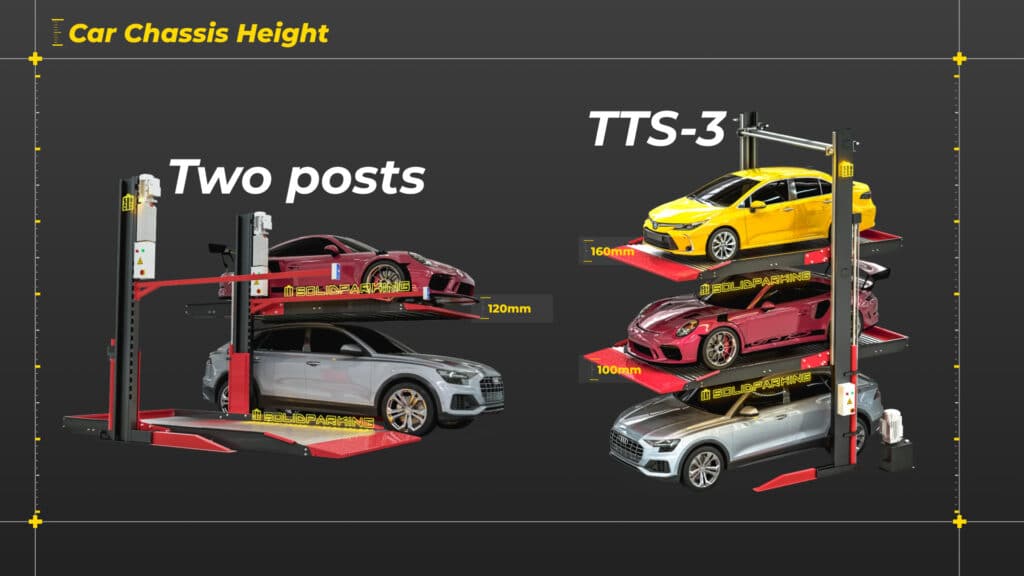
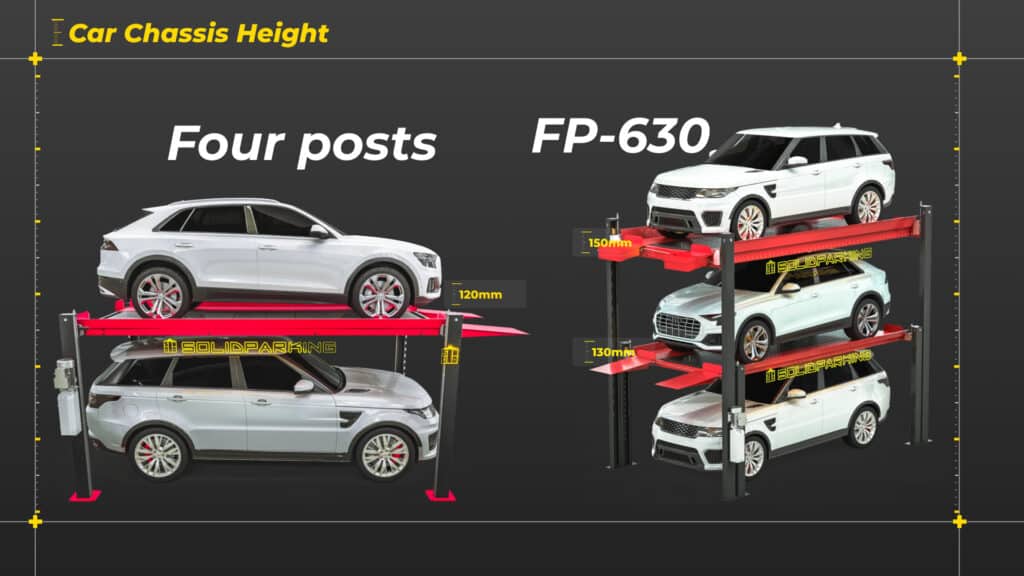
The most critical parameter is chassis height—specifically the lowest static and dynamic ground clearance among all vehicles that will use the system. This includes not only today’s vehicles, but the ones you’re likely to own next. Sports cars, EVs with battery trays, performance sedans, and even newer SUVs often sit far lower than people expect once suspension compression and ramp transitions are factored in.
Start by identifying the lowest chassis height in your fleet. Then decide which vehicle belongs on which level—upper or lower—based on approach geometry, ramp angle, and platform thickness. From there, evaluate how the lift’s steel members, cross-beams, locking points, and pallets interact with that lowest point under real-world conditions, not ideal ones. Remember: a car doesn’t enter a lift in a perfectly static state. It pitches, rolls slightly, and compresses as it moves across ramps and platforms.
Future-proofing is just as important. A system that works perfectly for your current vehicle lineup may fail the moment you switch to a lower EV, a performance model, or a car with a longer wheelbase and tighter approach angle. Designing only for “what you have today” is one of the most common and expensive mistakes in parking lift selection.
Once these fundamentals are correct—chassis height, approach angles, platform geometry, and vehicle allocation—everything else naturally falls into place. Load capacity becomes a confirmation rather than a guess. Automation speed becomes a convenience rather than a risk. Even maintenance costs tend to drop, because the system isn’t being forced to operate at the edge of its tolerances.
Follow these five proven principles, and you’re not just buying a parking system—you’re investing in a piece of infrastructure that integrates cleanly with your vehicles, your building, and your future needs.
And if your vehicle’s chassis height is lower than standard, that’s exactly where SolidParking differentiates itself.
SolidParking doesn’t rely on one-size-fits-all platforms. Through recessed decks, ultra-low pallets, extended entry ramps, optimized beam profiles, and vehicle-specific configurations, SolidParking engineers parking systems around real vehicle geometry—not assumptions. The result is a lift that accommodates low-chassis vehicles without sacrificing structural safety, lock integrity, or long-term reliability.
👉 Talk to SolidParking before you commit. A short, technical chassis-height and vehicle-geometry review today can prevent costly redesigns, vehicle damage, and operational limitations tomorrow—ensuring your parking system works not just now, but for the next generation of vehicles as well.