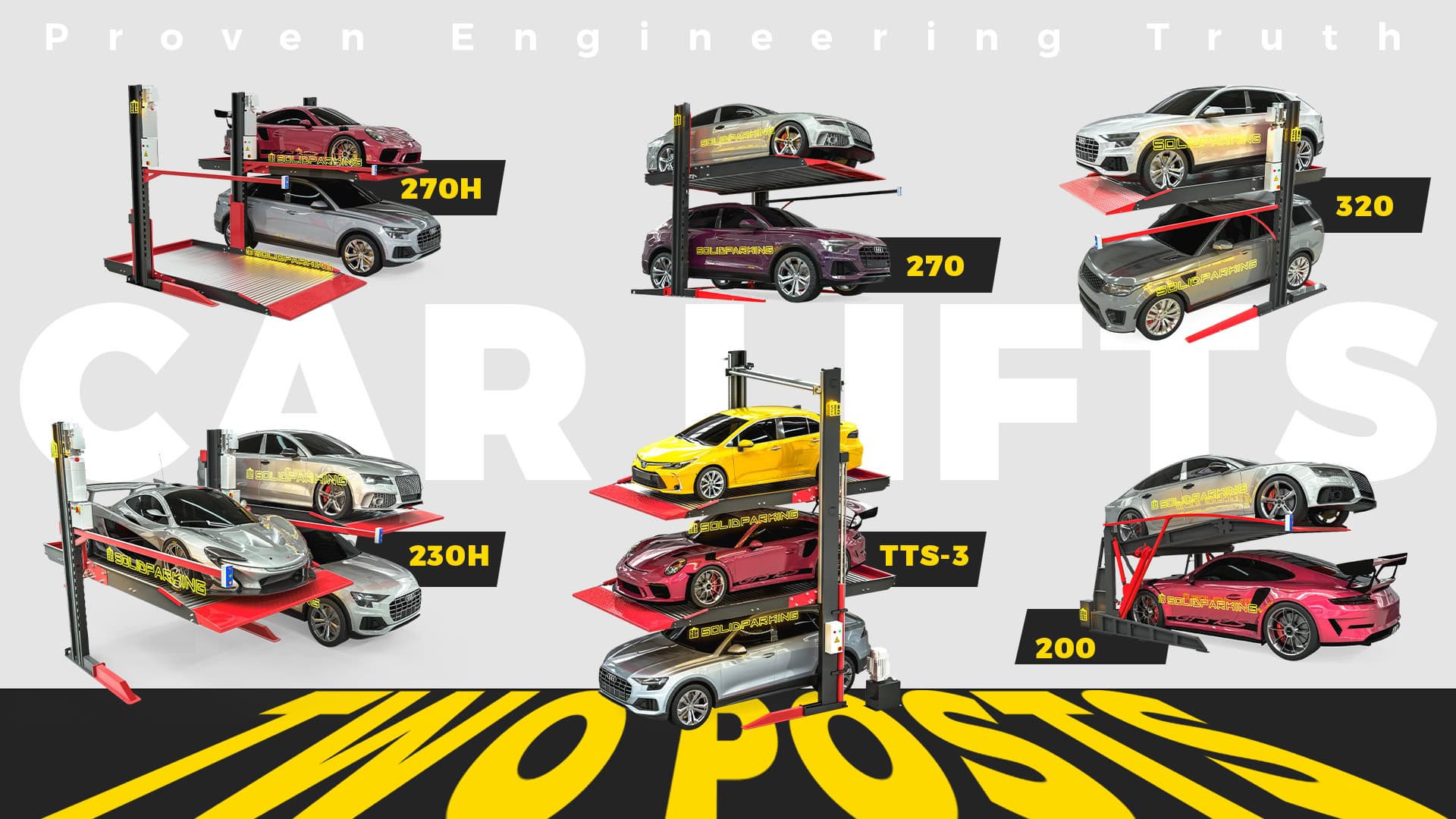
1.Why Two Posts Car Lifts Still Matter in Modern Parking
Two posts car lifts remain one of the most widely used vertical parking solutions in the world, even as automated parking systems and robotic garages gain attention. The reason is simple: they solve a very real problem — lack of space — without requiring complex infrastructure, software, or heavy civil work.
For homeowners, developers, architects, and property managers encountering parking lifts for the first time, two post lifts often feel almost too simple. Two columns, one platform, a hydraulic system — how complicated can it be?
The reality is that two posts car lifts sit at the intersection of structural engineering, mechanical safety, and human behavior. Over the last several decades, researchers have studied why lifts succeed, why they fail, and what design principles consistently reduce risk.
This article brings together academic research, industry safety studies, and real-world engineering practice, then maps those findings onto modern two post parking products — especially SolidParking’s two posts lifts — in a way that is understandable even if you’ve never worked with parking systems before.
2.How Academic Research Looks at Two Posts Car Lifts
Before products and brands existed, engineers studied vehicle lifts as load-bearing mechanical systems. Universities and safety institutes approached lifts with three main questions:
Where does the vehicle weight actually go?
What happens when the load is not perfectly centered?
What causes failures over time?
Load Distribution Is Never Perfect
Multiple peer-reviewed studies show that vehicle weight on two post car lifts is rarely distributed evenly. Factors such as engine position, fuel load, trunk cargo, and even vehicle geometry change how forces travel through the structure.
This is important because uneven loads increase:
Bending stress in the posts
Torsional forces in the platform
Fatigue over long-term use
Static Parking vs Dynamic Use
Academic research also makes a clear distinction between parking lifts and service lifts. Parking lifts experience mostly static loads — the vehicle is raised, locked, and left alone. Service lifts experience dynamic loads, including movement, people, tools, and impacts.
Studies consistently show that static loading is far less demanding on materials if mechanical locking systems are used correctly. This is why two posts car lifts designed specifically for parking look very different from workshop lifts.
3. Load, Balance, and Stability
Let’s strip this down to basics.
Where the Weight Travels
When a vehicle is lifted on a two post lift, the weight follows this path:
Car → Platform → Posts → Anchors → Concrete Slab
Good engineering focuses on keeping this path:
Short
Straight
Balanced
The longer or more twisted the path becomes, the more stress builds up in the structure.
Why Two Posts Car Lifts Are Enough (When Designed Correctly)
People often ask why two post car lifts don’t tip over. The answer lies in:
Column stiffness
Anchor design
Locking systems
When these elements are engineered together, the system behaves as a single rigid frame. Academic modeling using finite element analysis confirms that well-designed two post structures can safely handle parking loads for extended periods.
4. Safety: What Really Prevents Failures in Two Posts Lifts
Research into lift accidents reveals an important truth: most failures are not sudden or mysterious. They are usually the result of predictable issues.
Mechanical Locks Matter More Than Hydraulics
Hydraulics are excellent for lifting, but poor for holding loads long-term. Safety research strongly supports the use of mechanical anti-fall locks that physically support the platform once it reaches height.
Modern two posts car lifts designed for parking include:
Multiple lock positions along each column
Gravity-activated locking teeth
Manual or controlled lock release
These systems allow vehicles to remain parked without relying on hydraulic pressure.
Human Factors
Another major finding from safety research is that human behavior matters. Clear controls, visible lock engagement, and simple operation reduce misuse. This is why modern lifts emphasize straightforward operation rather than complex automation.
5. From Research to Reality: Engineering Decisions Behind Modern Designs
Academic research does not design products — engineers do. The role of engineering teams is to translate theory into practical decisions.
Dual-cylinder systems distribute lifting force more evenly across both posts. Single-cylinder systems simplify hydraulics but require higher structural stiffness to compensate. Both approaches can be safe when engineered correctly.
Column Geometry and Material
Stronger steel profiles and precise fabrication reduce deflection and fatigue. This improves long-term stability, especially for parking applications where vehicles may remain elevated for long periods.
More locking positions reduce the distance a platform could move in the unlikely event of failure. Research shows that shorter fall distances dramatically reduce risk.
Older buildings → prioritize tolerance and simplicity
Tight ceilings → prioritize compact designs
High density → accept stricter operating discipline
8. Final Thoughts from Industry Engineers
After decades of academic study and field experience, engineers broadly agree on one conclusion:
Two posts car lifts are not outdated — they are refined.
When designed specifically for parking, equipped with proper mechanical locks, and matched to the right environment, two post lifts offer one of the most efficient ways to double or triple parking capacity.
SolidParking’s two post car lifts reflect this evolution — not by chasing complexity, but by applying proven engineering principles in practical, user-friendly designs.